




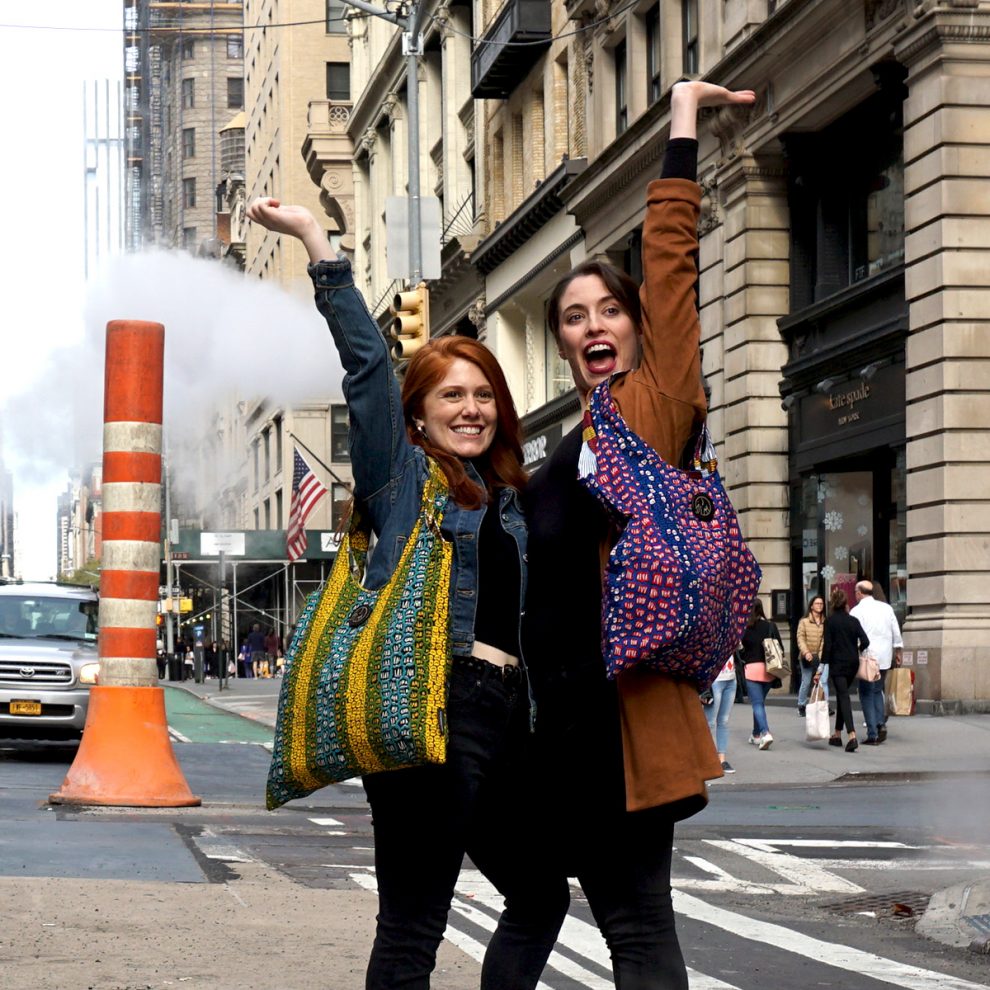
Tembo NYC aims to make the right decisions
After 20 years in advertising, Deb Chusid decided it was time to do something for the force of good.
“There’s something Jane Goodall said about making decisions, making the right decisions, and really that’s what we’re all about: good decision-making,” Chusid said.
Goodall’s real quote was: “What you do makes a difference, and you have to decide what kind of difference you want to make.” Chusid must have had it in mind when she founded Tembo NYC, a reusable bag company that aims to support environmentalism and women’s empowerment.
“For 10 years, I’ve been volunteering in Africa and in Thailand with animals and seeing the damage on the environment, whether it be drought, lack of water or change migration,” Chusid said. “I said, ‘Wow, this is a problem I have to fix.’”
“Tembo” is the Swahili word for elephant — one of the animals Chusid has worked hard to protect. Like many start-ups, Tembo originated as a solution to a simple problem: the abundance of disposable plastic bags.
“It really started with the whole sustainability notion, because we can’t keep throwing away things,” Chusid said. “Our whole ocean — there’s going to be more plastic in the ocean than fish, I think, by the year 2050. That’s flat-out disgusting.”
Chusid argued that we tend to have a “throw-away mentality,” where we seek the convenience of disposable products even though they are bad for the environment. Instead, she insisted, we should all be making the small, easy changes that can lead to bigger ones.
Tembo’s reusable bags couldn’t come at a better time, as the New York State ban on single-use plastic carryout bags begins in March. In New York City, there will also be a five-cent fee on paper carryout bags beginning at the same time, according to the NYC Department of Sanitation.
 “40% of people forget their bag,” Chusid said in reference to a survey of her audience. People also tend to give excuses, she said, like, “I can’t remember,” or, “It’s this dirty, smelly thing just sitting in the car.”
But despite their convenience, plastic bags are a huge problem for cities. The NYC Department of Sanitation lists the cost of disposing of them at $12 million annually. Plastic bags are not recyclable in the city curbside program, and most of them end up in landfills.
That’s why Chusid has tried to make her bags just as convenient as plastic ones, while also adding an element of style.
“I think my differentiator is the fashion that I put with it,” she said. “I know there are reusable bags out there that are cheap that you can use, or that women have leather totes. The differentiator is really because I’m coming at it from a fashion perspective.”
Tembo bags use a specific textile known as African wax fabric. All of the bags display vivid colors and bold patterns, and they often have a contrasting fabric as a liner.
“It is made in the Netherlands, but it is designed [by] and designed for the women of Africa,” Chusid explained. “The colors of different fabrics actually reflect the region and the women who like them.”
Each fabric has its own story, Chusid continued. For example, the orange fabrics are more popular in Nigeria, and in the Congo, people tend to prefer blues.
“I’ve narrowed it down to fabrics that have historical meaning, and as I grow, I’ll add another one. This one is worn by Nigerian women, and they would wear it to their annual meetings, so it means unity,” she said. “These are their traditional fabrics … the colors will change, but the meanings are always there.”
Chusid was especially excited to talk about the “Six Bougies” print, which was designed in the Congo just after the Second World War.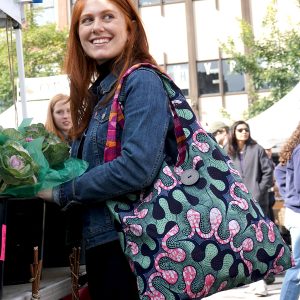
“There was this woman who had like, six Mercedes,” Chusid said. “And so the vendors and the women created this fabric to honor her. Later, the meaning became that this woman was strong enough to take on six men, represented by the spark plugs, and they say if you’re wearing it, that’s what you’re saying to the world. ‘I’m strong enough to take on six men.’”
The theme of empowering women goes beyond just the fabric design; Chusid also spoke proudly of her partnership with the Artisan Sewing Co-op. The Co-op, founded in 2017 by three Bangladeshi immigrants, currently hand-makes the bags in Queens.
The Co-op is part manufacturing, part educational; the women who make the bags can work from home, which helps eliminate the need for childcare. The experienced sewers also help train others on weekends, Chusid explained.
“They can be part of household-making decisions,” said Chusid, emphasizing the power of income. “And they can contribute to their child’s education, which women and mothers are more likely to do. Giving a woman a job is the best way you can empower [her].”
Eventually, Chusid plans to donate a portion of profits to Bhejane Trust, a Zimbabwe-based non-profit that helps maintain national parks and fight poaching.
“This organization — that I love so much — they install water points throughout the park,” Chusid said. “This year, they are in a brutal drought, and those water points are so important for the animals. And that goes back to climate change and to the bags and everything. It’s a strange thing that we’re all connected.”


