The signing of an agreement between New York City’s construction unions and the Real Estate Board of New York was lauded by a group of high-profile developers speaking at a panel at the NYU School of Professional Studies Schack Institute of Real Estate’s 52nd Annual Conference on Capital Markets in Real Estate last week.
“New York is now an open shop for the first time, and the impact will be felt for years to come,” said Stephen Ross, chairman and founder of Related Companies.
But, the group noted, challenges remain. Affordable housing is difficult to build with market-rate apartments subsidizing it, observed MaryAnne Gilmartin, co-founder and CEO of L&L MAG. The minimum monthly rent of $2,700 for deregulation is high for most quarters of the city.
“It will limit our ability to grow,” she said.
State regulations and relations also are a concern, noted Scott Rechler, chief executive officer and chairman of RXR Realty.
“A faction in Albany is being driven by ideological zeal, not practicality,” he said. “If everything has to be 100% union labor, you can’t built affordable housing. I don’t think any of us have operated in such an anti-business and anti-real estate situation before.”
On the office space side, the panel seemed comparatively unconcerned about the problems at WeWork.
“It’s about 1% of the Manhattan marketplace,” noted William Rudin, chief executive officer and co-chairman of Rudin Management Company. “Will it give back space? Yes, but the model has been validated. Flex space is here to stay.”
In fact, noted Marty Burger, chief executive officer of Silverstein Properties, permanent tenants often ask during negotiations if co-working spaces are available to allow them to expand temporarily.
“We never saw that three years ago,” Burger added.
Nor is the vast amount of new office space coming on line a concern, as New York must compete with new development in other global capitals. But affordable housing and infrastructure must catch up, Rechler added.
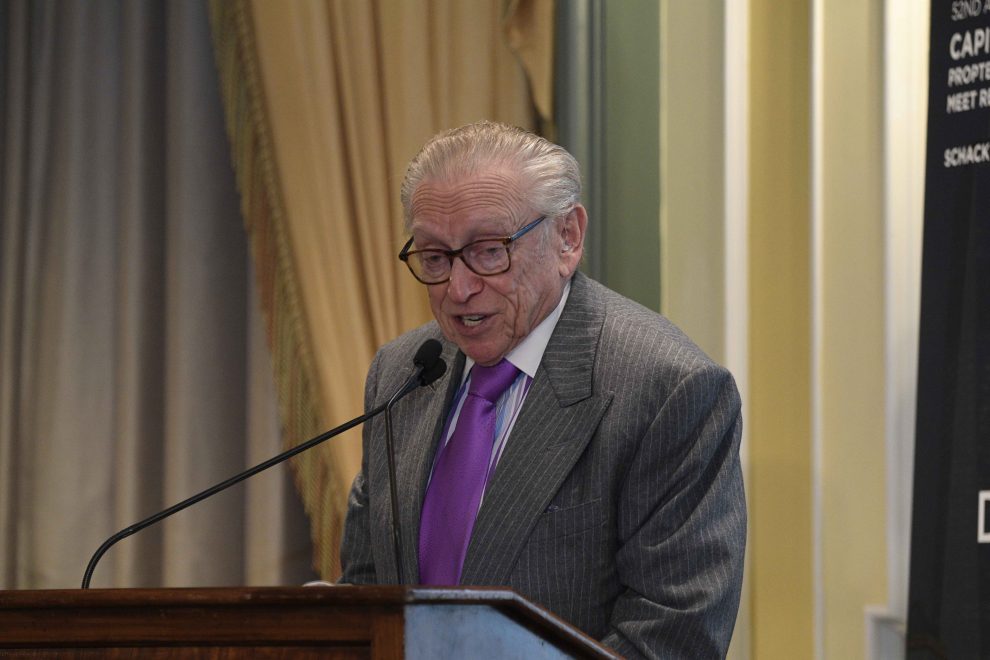
“We have plenty of problems,” said Larry Silverstein, chairman, Silverstein Properties, and founder and chairman emeritus of the Schack Institute advisory board, in an address just before the panel. “Can you tell me any major city that doesn’t? New York has a resilience that is absolutely unprecedented.”