
Proptech is transforming the commercial real estate industry with innovative digital solutions that span the front, middle and back office. However, as the industry advances in many areas, institutional investor reporting has only become more burdensome and inefficient. According to the Global Private Equity Outlook 2020 report, 70% of managers agreed that investor reporting has become one of the biggest pain points facing private equity CFOs. And despite the burden, institutional investor needs are still not being adequately met.
These problems represent a structural challenge for the industry, as reporting requirements balloon with each new fund. Something similar happened a few decades ago with college applications in the U.S. As students started applying to more schools, they wasted countless hours on applications that were mostly asking for the same details — such as test scores, grades and extracurriculars — just in slightly different forms for each school. The Common Application streamlined the admissions process by enabling students to submit one set of common information, one time, while automatically customizing it for multiple school applications. In many ways, the commercial real estate reporting problem is the same — mostly common data needs to be customized for individual limited partners (LPs), just like the common data in the college application is customized for schools. When Juniper Square surveyed institutional LPs, only one in seven said they receive “good data in a timely manner.” One in seven!
Institutional Reporting Today
At the basic level, the challenge is that every institutional LP and general partner (GP) has set up their own investment databases independently. Some of these are home-grown and some are built using third-party software systems. But none of them speak to each other, and data is typically shared through inefficient, error-prone Excel spreadsheets and PDFs.
For years, quarterly reports have been transmitted using PDFs. This is easy enough for GPs who can publish one report to serve all LPs. But PDFs don’t work for LPs who invest with many different GPs, all of whom have developed their own unique PDF formats and data definitions. Limited partners are then forced to burn team time (or hire a third party) to parse through these PDFs and pull relevant data points. However, because different GPs report on different data points, it doesn’t matter how efficiently or accurately the information is extracted from each PDF report — analysts are never left with a consistent, apples-to-apples dataset with which to work.
As a result, an ever-increasing number of LPs and consultants turn to Excel templates to facilitate data collection. Theoretically, this approach solves for data consistency — a given LP or consultant can expect to receive the same file from all GPs — but this has created a mountain of new problems. Previously, a GP produced a single PDF report for all LPs. Now, GPs are asked to complete tens or often hundreds of reporting templates each quarter, most of which were developed independently of one another with unique formats and data definitions. It’s starting to make sense that less than 15% of LPs receive good data in a timely manner.
A Shared Data Solution
Prior to the advent of TurboTax, the average American taxpayer faced a predicament similar to that of an institutional GP. Let’s say a taxpayer lived in three different states over the course of a year. These various governing bodies require roughly the same information, but each have unique forms with slightly different data definitions. The process of completing the different tax returns was time-consuming and error-prone for the taxpayer.
Can you imagine if TurboTax’s approach to the problem was to convince all 50 states to adopt the same standard tax form? It might eventually work, but it would take years. Not only would these governments need to agree on a standard data taxonomy but, importantly, they’d also need to overhaul all of the internal systems that they had built around their legacy data collection forms.
So, instead, TurboTax leveraged modern software to craft a frictionless solution. The taxpayer inputs data one time, in one format, and the software creates a layer of abstraction to ensure that each government receives the data it needs, in the format it requires, without any need to make updates to other internal systems.
The same pattern exists in real estate today. Every institutional LP has implemented systems built on the assumption that data will arrive in a particular format. It’s a tall enough order to align the real estate industry around a common set of data standards; it’s not feasible to ask every LP organization (not to mention every consultant, custodian bank and benchmarking provider) to overhaul their broader systems so that they can accept data in a new format.
Industry groups, like the Institutional Limited Partners Association, National Council of Real Estate Investment Fiduciaries, Pension Real Estate Association European Investors in Non-Listed Real Estate (INREV) and Asian Association for Investors in Non-Listed Real Estate (ANREV) are building coalitions to solve the first problem, and Juniper Square is building software to solve the second.
Looking Ahead
Juniper Square is tackling this problem head on in partnership with industry-leading LPs, GPs, consultants and industry bodies. We’ve had an incredible group of early partners and have been listening, learning and iterating quickly.
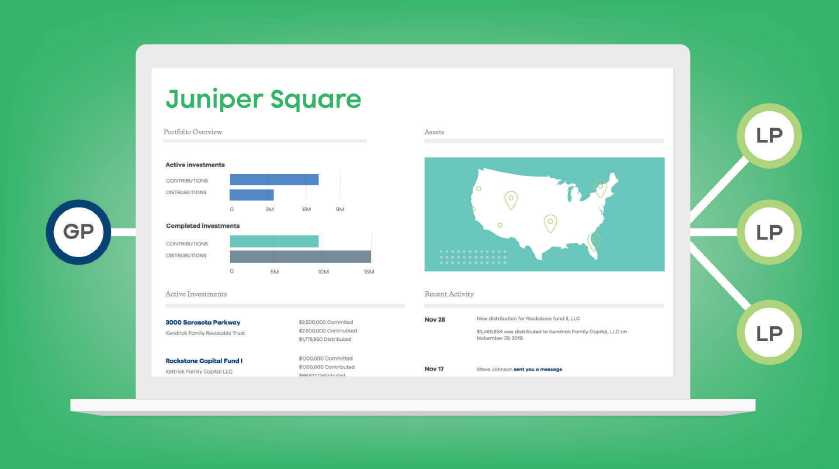
The concept is simple: give every institutional LP and GP in the industry a streamlined and secure way to connect around a shared view of their partnership and its underlying assets. But how that comes to life is anything but trivial. The LP needs to be able to easily access, manipulate and export their view of the information. At the same time, the GP needs to remain in control of what data is shared, with whom and at what resolution. With direct access to asset and performance data from all their GPs in one place, LPs have more accurate, timely and standardized information across portfolios, making it easier for them to evaluate performance and make important investment decisions. GPs not only save hundreds of hours spent filling out bespoke templates, but also are able to maintain oversight into how their data is shared.
Today, hundreds of GPs, including Beacon Capital Partners, Rockpoint Group, Water-ton and 59 of the private equity real estate (PERE) top 100 already use Juniper Square technology to create a shared view of partnership data with a network of participating LPs. And many of the world’s largest LPs, including Bouwinvest, Ivanhoe Cambridge, Oregon State Treasury and UPS Pension Investments, are using this technology to access information on their real estate holdings unavailable elsewhere.
Now here’s something to be excited about: making the burden of institutional reporting a thing of the past; or, at a minimum, making it no more daunting than applying to 20 colleges with the click of a button. And, while change doesn’t happen overnight, with guidance from Juniper Square’s institutional partners, this is within reach for the commercial real estate industry.
Kevin de Regt is the product manager for institutional reporting at Juniper Square, an investment management solutions provider designed specifically for real estate. Juniper Square launched Institutional Reporting in July 2021, a solution that streamlines limited partner reporting with a centralized record of performance and asset data, managed and controlled by general partners. Founded in 2014, Juniper Square offers the private funds industry easy-to-use software that streamlines fundraising, investment operations and investor reporting. Learn more at junipersquare.com.
Features