
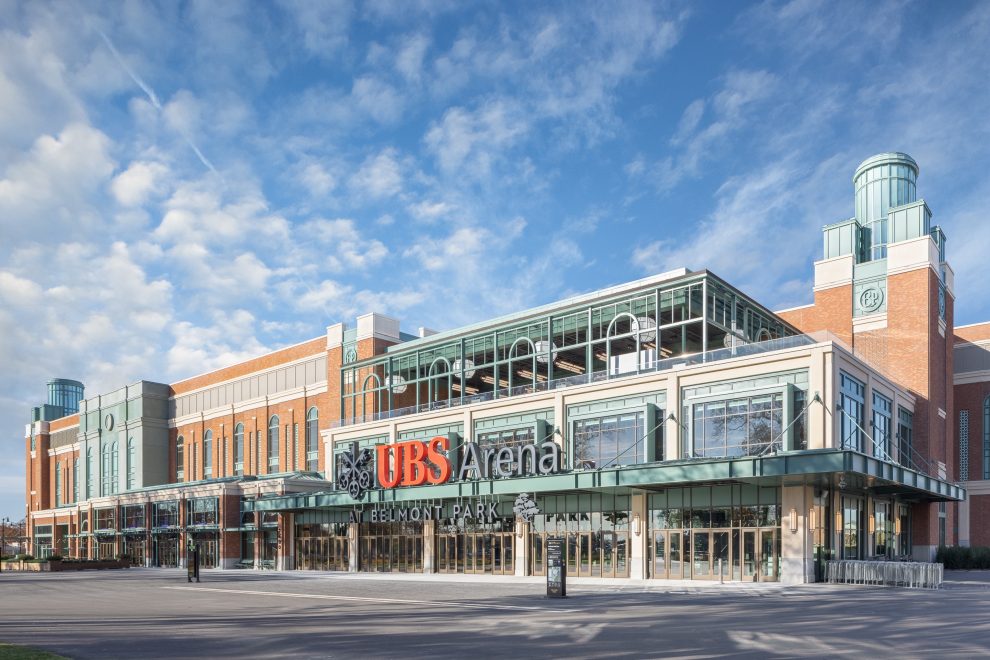
Built for hockey and made for music, the UBS Arena, a 745,000-square-foot, 17,250-seat hockey and entertainment arena in Elmont, New York and the new home of the NHL’s New York Islanders, opened on November 20. But the real story is that the arena is set to be one of the most operationally efficient venues in the world.
Global design firm Populous served as architect of record and worked with New York Arena Partners (the ownership group made up of Oak View Group (OVG), Sterling Project Development and the New York Islanders) to establish the arena’s design vision. It developed the arena’s overall layout, seating bowl, location of the suites and clubs, event level spaces, as well as documenting and overseeing design of all interior spaces, some in collaboration with Jump Studios (a Populous company) and Good,Rich. The building’s exterior was designed by JRDV Urban Architecture.
Thornton Tomasetti provided structural design and construction engineering services. The architect is Populous, and the general contractor is Aecom Hunt, in association with Barton Malow. The arena’s long-span roof is constructed of 2,300 tons of steel and features four trusses that are 350 feet long and 35 feet deep. The heaviest roof truss weighs 180 tons. The roof has a rigging capacity of 400,000 pounds and was designed to support a 100,000-pound scoreboard that can be located above the ice for hockey games or fully retract into the roof structure for concerts and other events. At the time of construction, the high-resolution LED scoreboard was the largest center-hung scoreboard in New York state and features one of the longest traveling hoists available in arenas. The rigging grid contains a grillage of beams, which provides coverage for the entire event floor.
A section of the arena’s upper level protrudes 20 feet into the seating bowl to provide members of the press, operations, and coaching staff with optimal views of the event floor. This was achieved structurally by hanging this portion of the arena from the long-span roof trusses.
UBS Arena features the only seating bowl in the metro New York area with sightlines specifically designed for hockey games, the developers said. Several large sections of the upper deck and the suite level cantilevers 16 feet into the seating bowl to put fans up close to action. These sections were carefully engineered to minimize crowd-induced vibrations. Portions of the lower seating bowl are retractable to clear the event floor for show load-in/load-out and to increase seating capacity for concerts and other events.
UBS Arena was also designed with concerts and other shows in mind. The spacious loading dock area, which at 50,000 square feet is the largest in the New York state, allows for seamless load-in/load-out between events, creating significant cost savings for artists. The loading dock is a relatively column-free space with long-span trusses that were designed as shop welded sections with minimal bolted field splices. The trusses are 10 feet deep and support an exterior green roof. In total, the loading dock lid is structured with 1,200 tons of steel.
The exterior design of UBS Arena was inspired by several New York landmarks past and present: Central Park, Ebbets Field, Grand Central Terminal, Park Avenue Armory and the Boathouse in Prospect Park. Five unique materials, each with its own structural system, were utilized for the exterior façade. They are architectural precast panels with thin brick, glazed curtain wall, insulated metal panels, louvers and glass fiber reinforced concrete (GFRC) panels. Coordination between the design and construction team was required to ensure load paths, engineering and architectural design intent was maintained. The interior architecture of the arena speaks to the historic nature of Belmont Park with bespoke clubs, premium areas and concourses. The main entry lobby is reminiscent of train terminals of the late 19th century and features a 155-foot-by-55-foot column-free space. Above it is an exterior terrace. Eight bars are strategically located around the concourses to have optimal sightlines of the ice. At several locations, these sightlines were achieved by transferring primary building columns and roof trusses above the bar areas to ensure spectators never miss a moment of the action.