
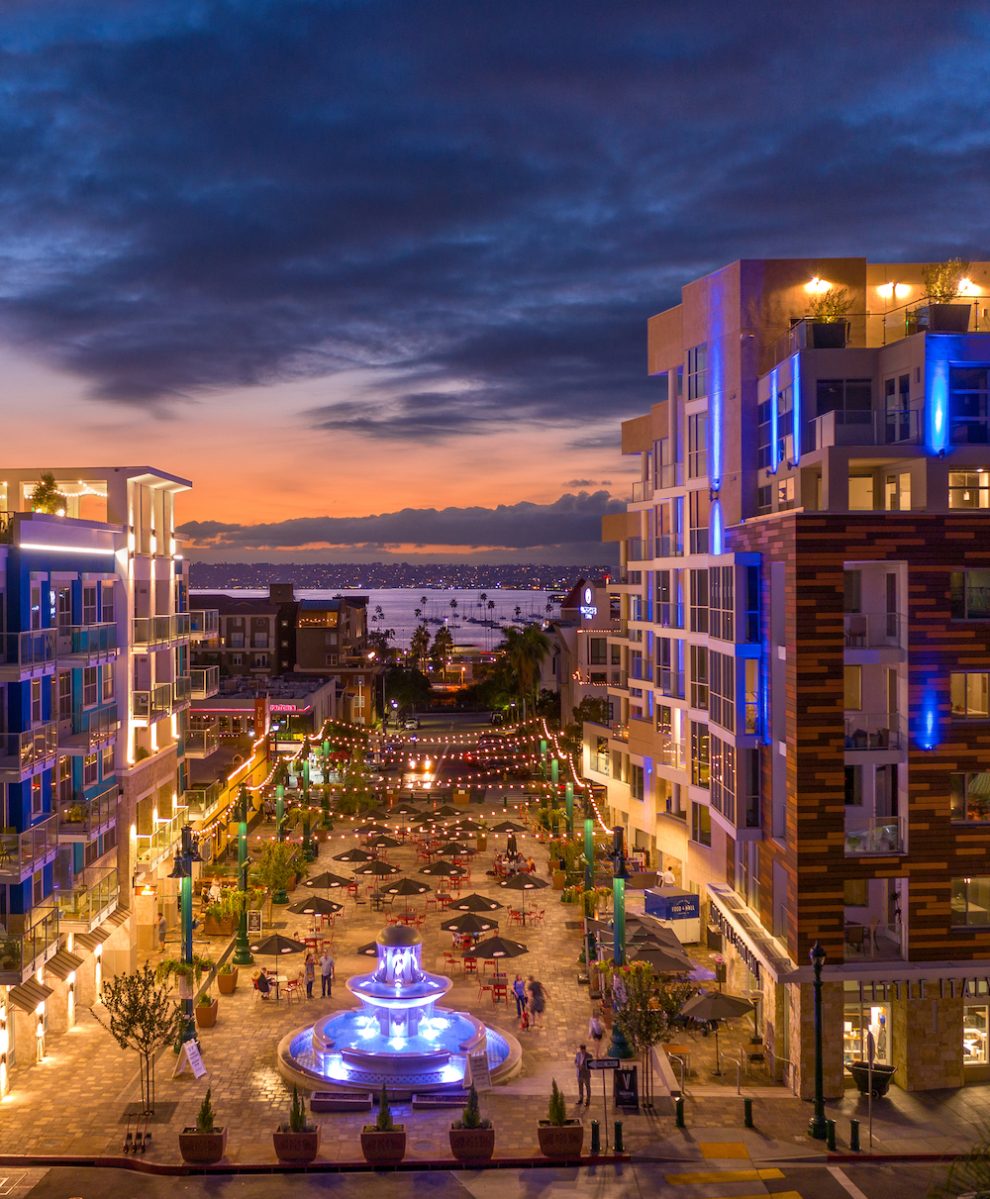
California’s housing crisis has affected every city and community across the state. Quantifying the need for housing within each region, The Regional Housing Needs Assessment (RHNA) mandated increases of housing stock specific to each city. The new requirements have added pressure on jurisdictions to create more permanent housing, spawning a multitude of mid-rise apartment projects in almost every community, including suburban locations. As municipalities explore new development strategies to grow housing stock, they often seek to leverage existing infrastructure to reimagine 21st century communities.
One such strategy adopted in several regions has been the expansion of light rail and public transit systems which have paved the way for larger, denser multifamily and mixed-use developments around each transit node. These transit-oriented developments have evolved from individual apartment projects alongside public transit to what we are seeing today — the master planning and design of distinct districts, comprising multiple, high-density residential and mixed-use buildings. The creation of such mini towns raises several new challenges for architects and planners, who are tasked with designing more intense, instant urban villages that still deliver an authentic sense of place and vibrant community life. As buildings become larger and neighborhoods denser, the importance of the public realm — the space between buildings — cannot be overstated.
Urban Design Hurdles
The dynamic design of the urban experience within the public realm is often viewed by cities and communities as one of the most important elements of a successful urban village. Unfortunately, too often the public realm and urban streetscape become the casualty of conflicting design objectives within these large, complex developments. With multiple development teams involved, each with its own agendas to maximize density for its individual projects, instant urban villages are often left with thin strips of landscape setback area along sidewalks in which to create an active streetscape. These minimal spaces neglect the importance of the public realm, minimizing activity to the detriment of the urban experience. To help remedy this, the city may establish a specific plan for a defined area that mandates guidelines beyond the base code for public accessible open space and streetscape guidelines. The Specific Plan may also be a form-based code with further guidelines defining architectural massing, style and other design parameters. All of these can assist in creating a more elevated design that delivers a cohesive, consistent urban character for the overall district.
Other conflicting development ideologies make it difficult for architects to deliver upon the promise of a true urban community experience. Often, well-meaning city planners ask for a specific amount of commercial space to be included in mixed-use, zoned areas which aim to create an urban live/work solution that theoretically reduces the resident commute and activates street frontages, contributing to the desired vibrant community experience. Unfortunately, the market for retail and commercial space has been declining in recent years with the emergence of e-commerce, a trend that has been further exacerbated by the pandemic and the work-from-home model.
Furthermore, the inherent design of the modern apartment community tends to discourage the idea of street-level public interaction. The most efficient apartment building typology generally comprises roughly 200 to 400 apartment units along with a bevy of upscale amenities (resort-style pools, pocket parks, fitness centers, game rooms, theaters, lounges, pet spas, etc.) designed to attract and retain residents and cater to their social desires. These large buildings include a central, multistory parking garage wrapped with apartment units, allowing residents to park their cars and walk directly to their units without stepping foot in an elevator.
Though the efficiency and convenience of these self-contained communities can’t be denied, each building internalizes its community and essentially functions as a stacked suburbia, leaving residents without any real need to venture into the public realm or contribute to the vibrant urban streetscape. With shifts in both market and social trends combined with few residents venturing outside of their secure apartment buildings, the majority of ground-floor retail within urban villages fails to attract businesses or realize the potential of the public urban space.
These are just a few of the hurdles that can impede the development of meaningful public spaces within an instant urban village. Fortunately, designers and planners are equipped with several strategies that, when thoughtfully employed, can elevate the public realm to realize the desired qualities of a true urban place.
Placemaking
Utilizing and reinterpreting some of the key principles of placemaking, architects and designers have developed design strategies to achieve an active urban realm specific to instant urban villages, creating special places where people want to live, work, play and recharge. Capitalizing on factors like a unique, desirable location, a critical juncture or destination, proximity to transportation, a historical site or beautiful view create value and identity. While working within each city’s guidelines and specific plan, designers are tasked to create environments that connect the new and the old, establish vibrant street frontages and provide a quality, active lifestyle within a dense urban village. The following strategies are integral to fostering human connection, uniqueness and engagement — key elements in crafting the urban experience.
- Pedestrian scale: It is important that a design has reference to the pedestrian scale in order to establish a connection and relationship between the user and the environment. This requires attention to architectural details and defining features at eye-level. Because the buildings tend to be very large, it is easy to overlook this key objective. The overall design must be visually pleasing, but designing specifically for the human experience at street level must be equally considered.
- Urban blocking: One key strategy in creating an appropriately scaled streetscape is to employ urban blocking, where the exterior massing of a project is segmented into differentiated sections along the street frontage, incorporating clever design and diversity. Historically, urban cities were developed in smaller chunks within the same general era which generated different architecture, giving the urban environment a natural sense of variety and visual interest. Today’s massive, super-block developments make it challenging for designers to establish a vocabulary that achieves an organic character and distinguishes one part of a community from another.
- Urban connectivity: Multifamily communities are traditionally designed to be self-contained, and as a result, do not beckon residents to contribute to the activity and vibrancy of the overall neighborhood and public. To promote community interaction, instant urban villages should emphasize connection points like fronting sidewalks with direct access stoops which animate the streetscape. Highlighting urban connectivity, design teams are beginning to incorporate features into apartment projects such as permeable courtyards and plazas that welcome the public and promote pedestrian activity throughout the neighborhood.
- Uniqueness: As a key component of placemaking, projects that achieve a high quality of uniqueness establish themselves as true landmarks. The danger of designing so many instant urban villages is that they tend to start looking similar. Designers should strive to create communities that are unique to the locale and lifestyle expectations of the future tenants, creating a place where people want to live because it is an expression of their identities. Historically, apartment projects were often tucked away on secondary streets in suburban areas and designed to blend in with the surrounding architecture and color pallets. Modern, instant urban villages are often located on major boulevard intersections, directly adjacent to mass transit stations or other notable public places. Community officials have become more aware of the importance of unique design for establishing an identity in their communities. Urban villages can act as the gateway to the city or community, which translates into higher expectations for unique design statements in city planning.
- Diversity: If the goal is to create a distinct sense of place, design diversity and architectural variation is key. Providing a diversity of living options that appeal to different lifestyles and economic groups contributes to the vibrant community fabric, while thoughtful integration of texture, enhanced materials and scale-defining elements create a quality of richness. This variation can be achieved with different streetscape criteria which provide pedestrian experiences unique to the area. Also, architectural expression can be allowed to vary from site to site and even within one project itself. Imagine strolling along a sidewalk, and the building frontage changes every 50 feet or so with different material, canopies and window treatments. There could also be a variety of landscape sections and paving material defining a sequence of sidewalk spaces. Instant urban villages benefit from diversity at all levels as a critical component to an authentic urban experience.
The rise of the instant urban village will continue as cities and development teams strive to combat the housing shortage. Elevating the public realm and honoring the space between buildings in these large developments can be achieved through responsible design and creative employment of placemaking. Ask any architect or urban designer, and they will agree that the opportunities afforded by dynamic public spaces can make or break a development, acting as the glue and secret sauce that unites a community and transforms a project into a place.