
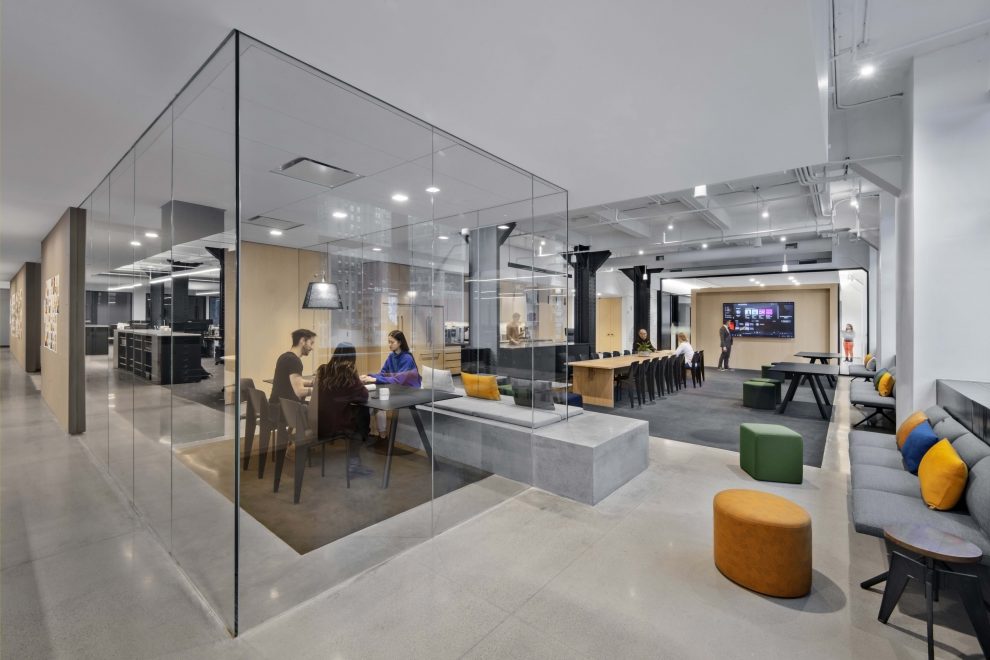
Since the founding of the U.S. Green Building Council in 1993, green building certifications have continued to rise in popularity as developers pursue a goal of creating a sustainable, wellness-focused built environment. Now more than ever, the industry is increasingly turning to Well, Fitwel and LEED certifications, which recognize commitment to crucial issues, but shouldn’t be the sole focus of developers and architects.
Though green building certifications are certainly a step in the right direction toward addressing the environmental impact of such practices, they don’t holistically reduce the central problem at hand in architecture and design practices: carbon. Designers and architects must think about sustainability and wellness critically, utilizing certifications as a baseline tool to enhance strategic, forward- thinking approaches to each project.
The Bigger Picture
In order to create longstanding, impactful building practices, designers must take on a well-rounded approach from the beginning of a project. Carbon emissions play a massive role in the immense impact the real estate industry has on the environment, providing opportunities for designers and architects to identify areas of impact throughout the lifespan of a project that can contribute to the overall sustainability of the structure. HLW’s internal sustainability consultancy division, Beyond, enhances environmental consciousness and sustainable methods across HLW project services, including architecture, interior design and lighting.
At Beyond, our team sees these certifications as a baseline for sustainable design. We optimize strategies and solutions to craft a well-rounded approach to each project, utilizing our expertise in embodied carbon analysis, daylight modeling, biophilic design and water use optimization, among a host of other services. This overarching view of sustainability considers the intricacies of design, all of which will help developers adhere to increasingly more rigorous sustainability and health regulations.
Marrying Impact and Efficiency
In order to create truly sustainable projects for the long term, there needs to be a particular focus on decarbonization, which our team applied to one of our latest projects, Schrödinger’s new Times Square office. The project design focuses on reducing embodied carbon emissions, the carbon dioxide associated with materials and construction processes, as much as possible. Office spaces are notorious for their short life cycles, becoming increasingly resource intensive as new residents completely redesign spaces due to constant turnover. These renovations, which typically occur every seven to eight years, accumulate into a massive, embodied carbon usage and subsequent impact on the environment. In many instances, companies attempt to address this issue through programs offsetting these emissions; however, in order to have the most effective impact, environmental practices must be woven into the very fabric of the structure.
Schrödinger’s new office provides a great example of enacting well-rounded sustainability practices that can implement long-term solutions toward reducing environmental impact. The new workplace prioritizes health, well-being and the environment equally; by focusing on these core concepts, design can be driven to balance use and impact, ultimately leading to a more sustainable, human-centric result. For the project, our multidisciplinary team set ambitious goals for both creativity and performance, pursuing three different rating systems: LEED v4 ID+C Gold, Fitwel 2 Stars and Well Health-Safety.
This process not only focuses on environmental impact, but it also crosses over to enhance company culture and values. The new office solidified Schrödinger’s commitment to promoting an inspirational and ecologically-conscious workplace culture in their own staff by demonstrating its commitment as an organization. Though our team utilized certifications to meet certain goals, they don’t define or capture the entire sustainability of the project; instead, they provided opportunities to apply sustainable ways of thinking to business practices as a whole.
By taking a holistic approach to sustainability from the onset, the strategy and design for Schrödinger’s new office emits 55% less carbon than the construction industry average, which is responsible for 40% of all global carbon emissions. This reduction in footprint also surpasses the benchmarks set by the American Institute of Architects’ 2030 Challenge — which seeks to bring the built environment to net zero emissions in the next eight years. To achieve this cutting-edge sustainable performance, we carefully examined every partition, ceiling system, carpeting and all other materials entering the building, measuring their carbon footprints to ensure the most sustainable option was utilized throughout the course of the project.
Further, our team worked to incorporate as many materials as possible that had a “Healthy Product Declaration,” which acts as a nutrition label for an item, such as carpeting or ceiling tiles. The declaration lists everything that went into making the item, down to the chemistry, to ensure it was sustainably sourced.
A Commitment to Long-Term Solutions
With buildings contributing 40% of global carbon emissions, according to Architector 2030, there’s no question that sustainability in the real estate industry is a key component to addressing the issue of climate change. As architecture, design and construction practices continue to evolve over time, the industry and its professionals must view each project as an opportunity to make a genuine, long-term commitment toward a healthy environment and occupant wellness.
By leveraging green certifications as a challenge to think holistically about structure lifespan rather than an all-in-one solution, the real estate industry can pursue projects that positively impact both the user experience and the ecosystem as a whole.