
Not long ago, someone asked me if sustainability was still a “thing,” that maybe environmentally friendly business practices in real estate have become so standard that it’s not as newsworthy as it once was.
It’s a fair question; years ago, I was told that any office building would have to be sustainable to be considered Class A. And the pandemic has only broadened the definition of sustainability to include wellness, too.
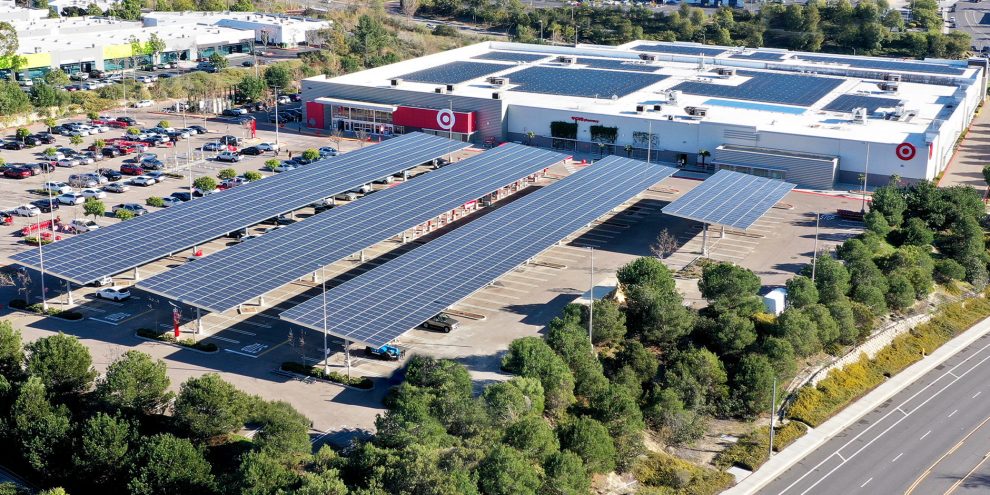
But what retailers are doing to maximize their efficiency and minimize the impact on the planet continues to expand, too. A case in point is Target, which announced its most sustainable store to date, one that will produce more energy than it needs to operate. The retrofitted store in Vista, California, will serve as a test ground for its investments in new units and other remodels to help achieve ambitious sustainability goals.
The store will generate renewable energy through 3,420 solar panels across its roof and newly installed carport canopies. The site is expected to produce up to a 10% energy surplus each year that it can transmit back to the local power grid, and Target has applied for net zero energy certification from the International Living Future Institute. The building also features elements to further reduce emissions, such as powering its HVAC heating through rooftop solar panels, instead of natural gas. Target also conserves 10% of its stores’ total energy use by using LED lighting instead of conventional lighting. Additionally, the store switched to carbon dioxide refrigeration, a natural refrigerant, that Target will scale chain-wide by 2040 to reduce its direct operations’ emissions by 20%.
The company has already made great progress. Since 2017 Target has already reduced its direct operations’ emissions by nearly 27%. One of the ways it intends to reach its net zero goal is through sourcing 100% of its electricity from renewable sources (including wind energy as well as solar) for its operations by 2030. New partnerships should bring the retailer to purchasing nearly half of its electricity from renewables later this year. The Vista store is one of 542 Targets with solar installations. (Full disclosure: I’m biased here, as my home is solar, too.)
The recycling, donations and composting operations at the Vista store, alongside Target’s other facilities, support the retailer’s goal to divert 90% of its U.S. operations’ waste away from landfills by 2030 as it aims for Zero Waste certification. Target is already diverting 80% of its operational waste. Additionally, the Vista site offers electric vehicle charging spaces, as the retailer provides more than 1,350 spaces at over 150 locations across more than 20 states.
On the luxury side of the spectrum, Neiman Marcus in its first-ever environmental, social and governance (ESG) report, detailing its efforts to target climate change, increase sustainable and ethical products and implement. circular services. The plan calls for reducing Scope 1 and Scope 2 emissions (direct emissions from company-owned and -controlled resources, such as manufacturing and transportation, and indirect emissions from the generation of purchased energy from a utility provider, respectively) 50% from a 2019 baseline by 2025. It also plans to perform a Scope 3 (covering indirect emissions not covered by Scope 2, including business travel, employee commuting and purchased goods and services) assessment in 2022 to understand the company’s position and chart a path toward a Net Zero goal. The company also plans to procure 100% renewable energy by 2030 across the business and join RE100, the global global initiative bringing together the major businesses committed to 100% renewable electricity.
Re-commerce is also part of the plan, as Neiman announced the intent to extend the useful life of over 1 million luxury items through circular services such as mending and alterations, restoration, resale and donation by 2025, up from the 350,000 products addressed in 2021 and committing to creating a FashionPhile Selling Studio that authenticates and intakes luxury product from customers inside every Neiman Marcus store.
Other retailers also are looking to save textiles — Five Below has eliminated print circulars, sells reusable bags and offers responsible products. A member of RE100, Starbucks plans to reduce its carbon, water and waste footprint by half by 2030 over a 2018 baseline. Its 2020 report saw an 11% year-over-year reduction in emissions.
And with their great outdoors focus, Patagonia and REI have long been committed to recycling products, etc.
So, yes, sustainability is still a “thing.” And we have so much more to look forward to.
Debra Hazel
Debra Hazel Communications
North Las Vegas, NV
(201)618-5247