
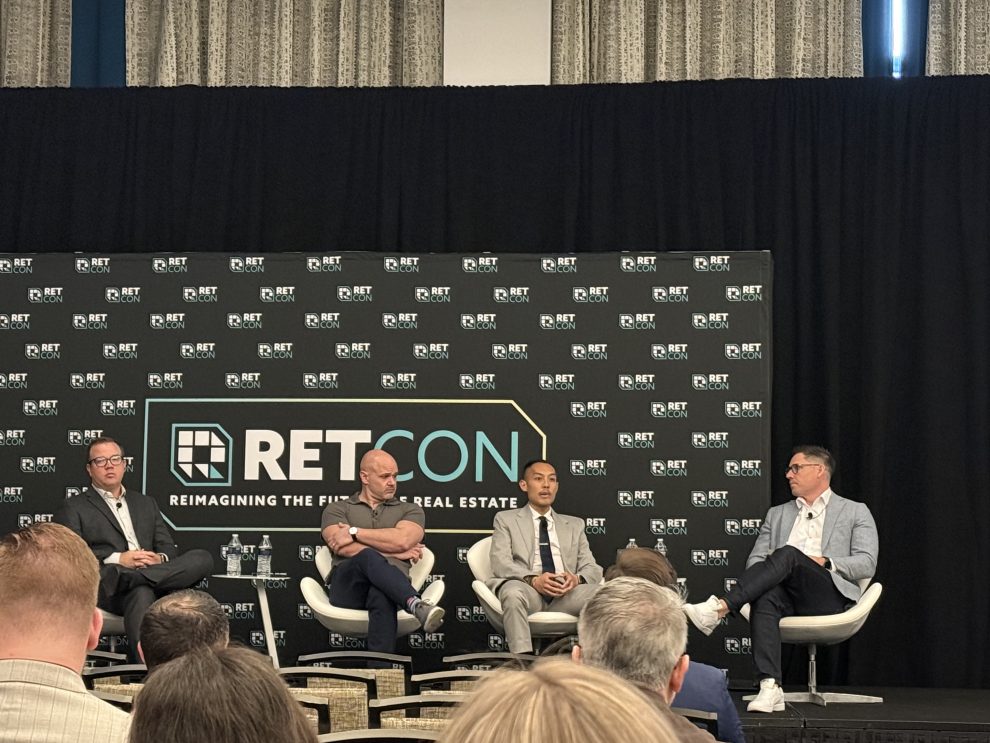
The shopper journey has changed in retail, and landlords through the strategic use of technology are playing an ever-growing role in their path, said speakers at the “Retail Reimagined: Crafting Spaces that Captivate and Connect” panel at RETCon, the proptech conference held in Las Vegas in March.
Ironically, at a time when technology such as e-commerce could have posed unsurmountable challenges to the sector, retail remains one of the strongest in commercial real estate, with national occupancy rates hovering 96%.
“The death of retail has been widely reported, but it’s one of the most resilient asset classes,” said panel moderator Lee Jackson, co- founder of Bridgeline Partners, a real estate and retail tech advisory group. “There’s been a lot of innovation.”
Tenant mixes have evolved to include services, food and beverage and fitness. Meanwhile, retail landlords, he observed, have multiple components, and two customers — the shopper and the tenant, Technology can help each with their journey, especially in what might appear to be the most mundane of places — the parking lot.
“Some conversions of retail space into new use types have driven some of the tech adoption,” Jackson added. “The customer journey starts before the visit because of technology.”
The journey starts with the on-site property team, with operations, marketing and leasing in constant communication to better understand the shopper and what they are looking for, said Tim Murphy, senior director, marketing technology at Newmark Merrill, which operates open-air, largely grocery-anchored centers in the western U.S.
“Our marketing is a hands-on approach, utilizing a lot of data from Placer.ai,” a provider of location data and analytics, Murphy said. “We were one of the first customers to use it in 2017.”
When the shopper arrives, they must have an experience, said Jay Richard-Yu, vice president of tech and innovation at Jamestown, with projects including One Times Square, Industry City in Brooklyn, and Ghirardelli Square in San Francisco. That requires tech, but also a real understanding of the human touch, even as they’re driving in and leaving.
“When you arrive at a shopping center, parking is your first and last impression. It’s our job to make parking a seamless experience,” he said. Similarly, “the last thing you want when you exit after dinner or an event, is to sit in traffic.”
Even visuals can help. Changing the paint color to a brighter, more welcoming shade in a garage can make a huge difference, he added.
“For us it’s really about identifying the right partners,” Richard-Yu added, especially in luxury properties. “When you valet your vehicle, they’ll put in a note and a branded water bottle to thank you for spending time in our centers.”
“When your property is clean and well-lit, it goes a long way,” Murphy said.
Tech is also helping with sustainability, Richard-Yu observed. Jamestown achieved zero net operational carbon at its Levi’s Plaza in San Francisco and is committed to achieving that goal company-wide by 2050.
“We’ve seen tremendous savings in this program and are excited to take this on the road for East Coast properties,” he said.
The best sources of information about any property are the shoppers and the tenants, suggested Ryan Byler, senior vice president of property management at Stoltz Management, an owner/operator in multiple real estate sectors.
“If you haven’t started using Google guide, that’s a good place to start,” said Byler.
Locals will let management know if a center has sufficient parking, sufficient ADA parking and if the lot or garage are bright enough at night. Other tenants are quick to report, as well.
“We are at the properties so much we can miss something, but Publix will tell you when your parking is not up to snuff,” Byler added.
Strong tenant relationships are absolutely critical.
“We rely on our tenant partners and listen to them,” Byler said. “We really do value them. If they’re a pain to you it’s because something is painful for them.”
Parking lots can also be the source of additional income, including EV chargers and even parking and charging drones. And it may become even more high-tech and exclusive, based on ideas from other sectors. Mercedes-Benz installed the first high-performance charging up at its headquarters in Sandy Springs, where Jamestown has several properties, Richard-Yu said.
“It’s about meeting what the visitor needs and taking them away from their screen,” Richard-Yu said.
That’s not all.
“Premium parking is growing for luxury shopping centers. There are people willing to pay a premium for parking,” Jackson said. “I do see a future where if you want to park at a premium center, you may have to register your vehicle, which you can then sync with purchase data.”
Newmark Merrill uses cameras and license plate recognition to count cars and see if guests who have attended events return atother times. But those cars could also be there for business.
“We have to set up parking to be a fulfillment center,” Byler observed. “It’s interesting to see how many people are repeating visits, including DoorDash picking up from restaurants. It does inform decisions about leasing.”
Cameras can serve other purposes, as well, especially if they are bolstered with AI, which can help keep properties safer.
“After mortgage and insurance, security is our next biggest line item,” Murphy said.
Installing cameras and connecting them to a AI-based system that can notify police, the on-site team and property management of problems, and compiling data into reports to track patterns could be extremely helpful.
“This is where AI can really help you,” Byler said. “For example, you have a slip/fall on your property and get sued months later. Now, there are AI cameras trained to record slip and fall. When I’m sued, I have the video. We all got slammed with insurance premiums going through the roof last year. This can help negotiate your premiums.”