
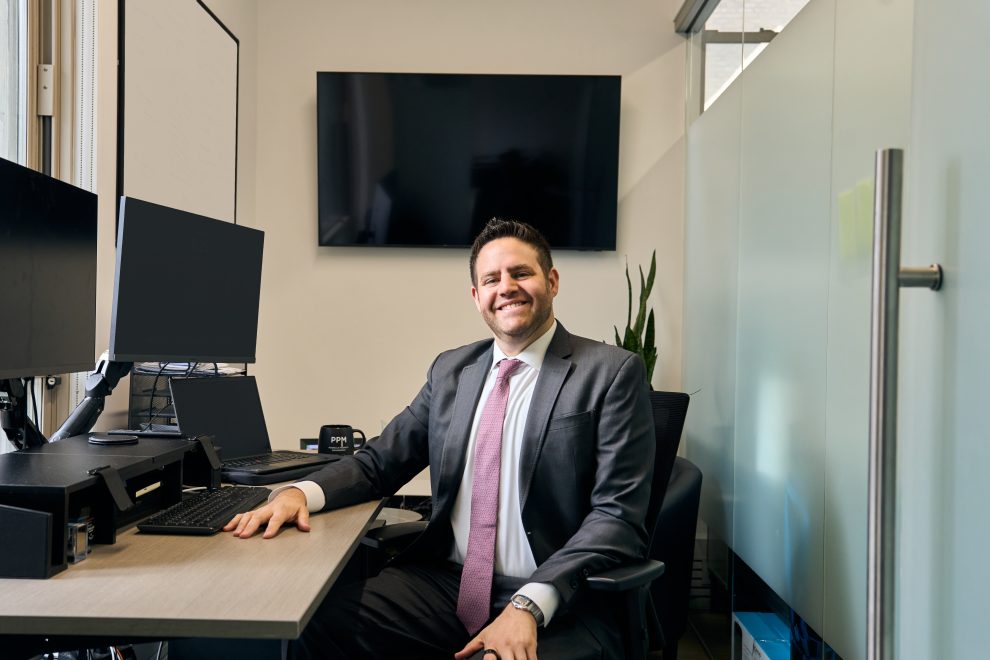
It’s hardly news that artificial intelligence (AI) has companies using it for everything from customer relations to staff management. And while Peninsula Property Management (PPM) is not shying away from advancements in technology, its founders, Joel Davis and Ernest Rrika, are committed to preserving their luxury property management company’s inimitable human touch.
While other firms have adopted standardized models in the name of efficiency, Davis and Rrika built PPM to offer the opposite: high-end management grounded in real field experience and guided by a deeply engaged leadership team.
“We’re redefining the industry because other companies are replacing people with AI, whereas our company is using it as a tool to save time for our employees so that they can engage more with the community and the staff,” said Davis, president of PPM.
Today, surveying PPM’s spacious and modern glass office, complete with a staff of 17, it’s hard to believe that the company was founded just under a year ago, in April 2025. Davis and Rrika were the company’s sole employees, working from a cramped office in Midtown. The circumstances were far from the luxury they aspired to engage with: the space, which they rented from a bead and button merchant, was tiny. Moreover, it was improbably and entirely pink, down to the lighting fixtures, the radiator and the ceiling tiles. Needless to say, it made a less than ideal venue for visits with clients. Davis and Rrika, scrappy and ambitious, made it work anyway, and soon were able to find more suitable headquarters.
“We truly feel like we’ve made it in the last year given where we came from,” said Davis.
In that first year, Davis and Rrika’s goal was to acquire between 15 and 20 buildings. Ever the over-achievers, they more than doubled their vision. Today, PPM manages a 43-property portfolio in the greater New York City area, complete with a staff of 17. The properties include condominiums, co-ops, commercial properties, new developments and hotels. Among the services it offers are property management, capital project oversight, development advisory, commercial asset management and energy strategy to help ownership groups operate efficiently, maintain compliance and enhance long-term property value.
This fast ascent, Davis and Rrika say, can be attributed to the PPM leadership’s collective 25 years of experience, as well as their dual commitments to personalized hospitality and cutting-edge technology. Davis’s expertise is in the former, Rrika’s the latter category.
Davis began his career in the hotel industry, training with Starwood Hotels & Resorts after graduating from George Washington University with a degree in business administration. He then managed the front office of the W Union Square Hotel. He brought his knack for hospitality over to real estate, managing various residential and commercial properties around New York City.
Rrika, a Pace University graduate with a degree in finance, serves as the director of operations at PPM. He has co-founded The Carbon Shield, and has years of experience at property management firms before teaming up with Davis.
Rrika’s strong background in technology — he created an app focused on Local Law 97 compliance — allows him to oversee the technical aspects of PPM. PPM’s fully cloud-based platform delivers real-time tracking of action lists, work orders, compliance items and capital projects. This has uniquely enabled the boutique firm to perform at the level of much larger companies.
“A lot of small companies don’t have the infrastructure to support a lot of buildings,” Rrika said. “From day one, we built a system that can handle multiple properties.”
This technology has proved especially helpful in managing the commercial properties, most of them office buildings, which comprise 50% of PPM’s portfolio.
Though technology can be useful in standardizing procedures and reporting, PPM uses it to permit more customization after a thorough and personalized onboarding process. That allows for consistent communication with residents, boards and staff — and emphasizes that PPM is only a phone call away. And that begins with the first day of onboarding a new building.
“We have a complete item list including finance, leasing, operations and compliance,” Rrika said. “We examine best practices and make sure they are being updated, that a lot of information isn’t being lost in the shuffle or prone to human error. There is a single source of information that everyone uploads.”
The timing and opportunity to launch a new company were right, Davis explained. Within four weeks, the two had signed two buildings, and business took off from there.
“Our name was out in the industry, and we were known for providing excellent service,” Davis said. “We did have to start from scratch, but attorneys, engineers and architects all knew us.”
PPM’s portfolio ranges from buildings erected in the 1910s to those just a few years old, requiring very different procedures and plans, especially since energy strategy has become a critical component of building management in New York City.
PPM provides data-driven energy strategy and sustainability advisory services that help buildings reduce costs, navigate compliance requirements and implement long-term efficiency initiatives that strengthen operational performance and asset value.
More immediately, Davis is using his hospitality training to improve the lived experience of both tenants and employees. With every new building, Davis personally trains the on-site team, visiting multiple times a week in the first two weeks, while Rrika examines all the building systems.
The existing staff is given 60 days to adopt the new system, with assessments after that period. The two remain on call for assistance.
“It’s not micromanaged,” Davis said. “It’s managed properly. We’re there to support them.”
For some clients, even the basics of hospitality can feel novel. PPM’s training has involved training doormen to greet tenants at the door by standing up and encouraging them to remain attentive and focused.
“It’s about empowering employees to want to feel connected to their tenants,” Davis said.
Similarly, though PPM maintains a relaxed and friendly office culture, accessibility to clients is, in Davis’s eyes, nonnegotiable. He maintains a strict policy whereby his employees must respond to customers on the same day, or, if an email comes in after 3 p.m., by 10 a.m. the next day. This ensures that clients feel heard and that the property management experience remains personal and deeply human.
It is this same desire to ensure quality experience to tenants and employees alike that has occasionally curbed PPM from expanding its portfolio too rapidly.
“As we grow, we want to do it with purpose and do it meaningfully,” Davis said. “We’re not saying no to business, but if we have too many projects in one month, we’ll scale back. We want to give our work a personal touch and to make sure the clients and the community are happy. It’s never easy changing managements, and we want to make it as easy as possible.”
Like any modern business, PPM is considering how to implement AI as it expands, and given Rrika’s background, new technologies are a natural fit for the company. Still, at the end of the day, PPM’s emphasis is on taking care of people.
“We have a passion for real estate and a passion for excellence,” Davis said. “We’re trying to make a difference as we build really long-term relationships.”