
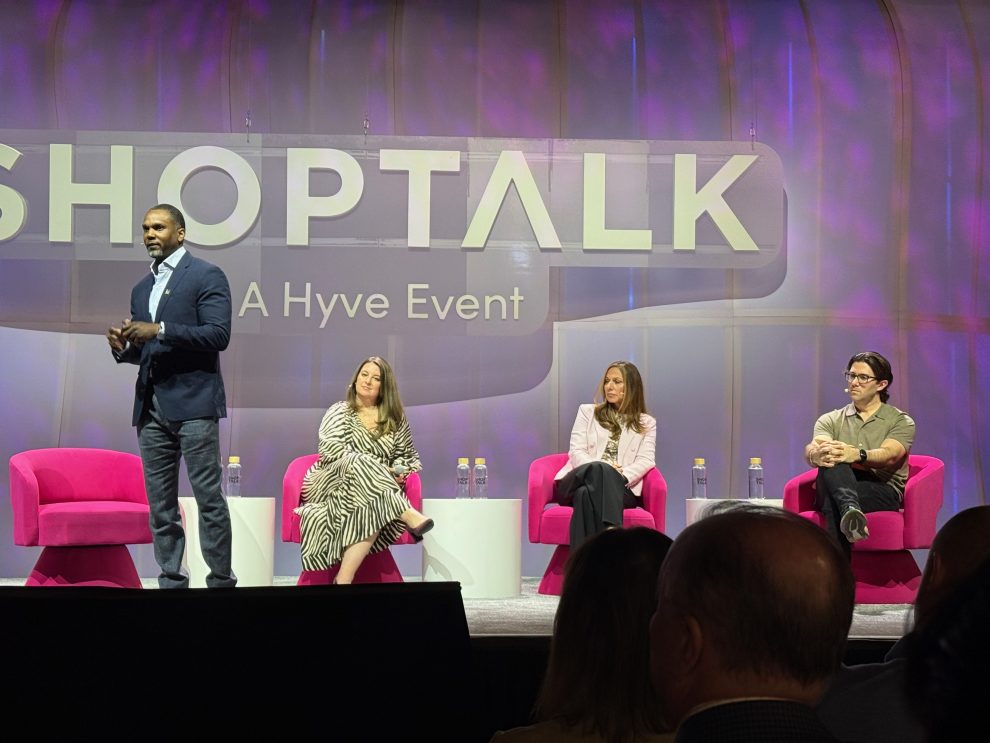
Physical stores are more than just locations for transactions – they can and should be places where culture and commerce meet community. Ensuring that remains true was the topic of one panel at Shoptalk 2026, held in Las Vegas in March.
“Malls have always been the third place,” said Lee Sterling, chief marketing officer at Simon Property Group. “Since 1960 and into the ’80s, ’90s, 2000s, this wasn’t about people going for a transaction but for going to places and making memories.”
Today’s shopping centers still aim to provide something for everyone — Sterling noted that the company works with more than 300 brands “from Apple to Zara and everyone in between,” and that Gen Z shoppers “love the mall pretty much as much as their parents did.”
That doesn’t mean that the experience hasn’t changed. Young consumers are seeking connection, and retailers can provide that, said Emily Lewis, general manager of retail for Glossier. The cosmetics company has tested multiple retail formats, from apps to physical stores.
Each of its three international flagships reflects its location, from London’s Covent Garden, which resembles a stately home; Los Angeles’ Melrose Avenue, with references to movie studio lots, and New York City’s Soho, which feels like an apartment, with a living room, dining room — and even offers a nod to subway stations.
“Two strangers meet in our flagship around a testing table, and that leads to conversation and laughing,” she said. “Eventually they exchange Instagram handles and come to all our Glossier events together as friends.”
Acknowledging that the three physical stores are geared as much to tourists as everyday shoppers, Lewis noted that each of the flagships incorporate design elements for selfies, as well as local merchandise that become souvenirs.
“It’s retail as a destination,” she said. “As a retail team we talk all the time about traffic and conversion, but the retailers that will win will be the ones the customers choose to be in because they belong.”
That same philosophy of belonging is “at the heart of Target,” said Cephas Williams Jr., its senior vice president of stores.
“[They’re] not just a place to shop. It’s where the connection hub of commerce and culture come together,” he said, adding that in April, all 350,000-plus associates were scheduled to undergo a massive training on community building.
Target started referring to shoppers as guests in 1991, he said. The challenge is to take that sense of community and scale it over a 2,000-store portfolio. Some event, such as a Taylor Swift album launch party, can be nationwide. But each store in April was charged with hosting an event every Saturday. The goal — for shoppers to consider an individual store “their” Target.
“We want our guests to feel delighted,” he said. “Our team members are our biggest brand ambassadors.”
Similarly, Simon’s centers also host community events and have local leasing teams as well as national professionals to create personalized tenant mixes, Sterling noted.
That said, retail remains challenging. Glossier was in the process of downsizing a portfolio of 12 stores to the three flagships, Lewis acknowledged.
Yet organized retail remains key to a company’s expansion.Sterling noted that Simon’s centers at King of Prussia, Pa. hosted the first Netflix House in the country, and a second has since been opened.
Immediacy is one advantage of the physical store — a shopper doesn’t have to wait for delivery, Lewis observed.
And rewarding loyalty is important. Glossier’s Lewis noted that the company has explored loyalty programs over the past year, while Target’s Williams observed that “Loyalty starts with the guests and listening to the guests.”
In November 2025, Simon introduced Simon+, a new loyalty program that rewards members with cash back, points and perks for shopping nationwide at Simon malls and Premium Outlets physical locations and online at ShopSimon.com or the ShopSimon app.
“Simon+ is the future of shopping rewards – and there’s truly nothing else like it,” said Sterling in the announcement. “As we continue to merge the best of in-store and online experiences and make shopping more convenient, Simon+ engages customers where they are and creates more reasons to shop, stay and return.”
“Our new loyalty program is our third pillar – value,” Sterling said at Shoptalk. “Everybody likes a good deal. Our new program is meant to connect.”
But it all starts with the physical store.
“The store is where you become immersed in a brand and where the brand story comes to life,” Simon’s Sterling said. “You can’t do that online in the same way. There’s a place for online and always will be. But people want that connection — they want to see it come to life in a physical space.”