
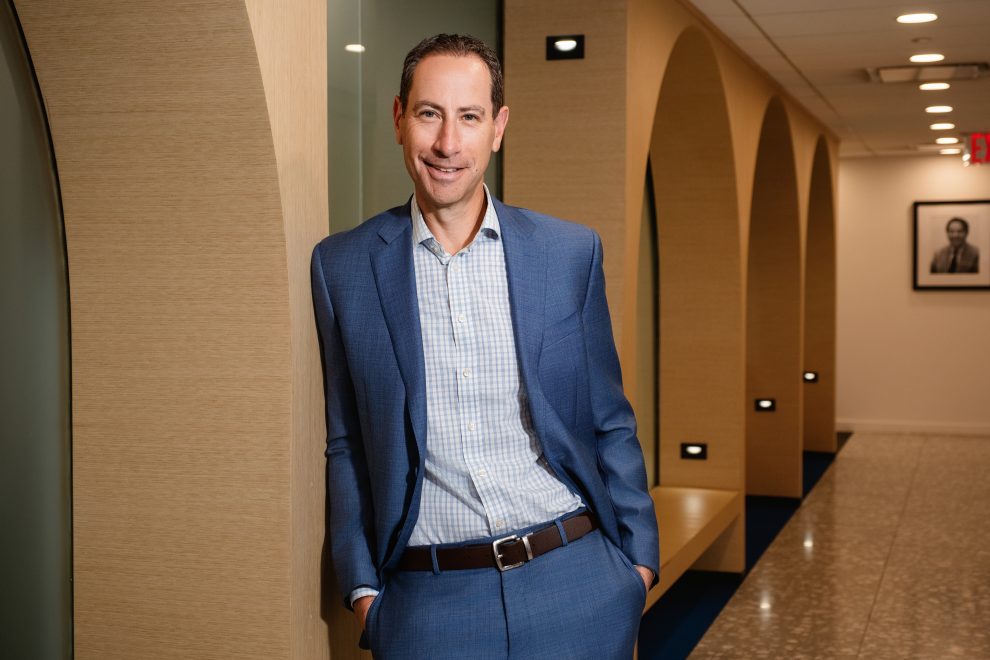
It’s no secret that developing in and around New York expanded its focus on development with the launch of GFP Development. The new, affiliated company formalizes the firm’s development and construction platform as GFP continues to pursue large-scale development, repositioning and conversion opportunities throughout the New York City region.
The new entity will be led by Brian Steinwurtzel, who will transition from his role as co-chief executive officer of GFP Real Estate to serve as chief executive officer of GFP Development.
“There’s a lot of opportunity when the market is uncertain. In fact, there’s more opportunity in an uncertain market than there is in a certain one,” Steinwurtzel said.
The launch of GFP Development formalizes a platform that has already overseen some of New York City’s most significant office-to-residential conversion projects, including 25 Water Street — now known as SoMA and one of the largest conversions in the country — and 222 Broadway, which reopened as the luxury rental property WREY. The company is also advancing major redevelopment initiatives including the recently announced repositioning of 100 Gold Street in partnership with New York City, alongside additional conversion projects such as 40 Exchange Place, as GFP continues expanding its development pipeline across the region.

The formal launch comes at a time when distress in the office sector, evolving zoning policies and growing demand for adaptive reuse opportunities are reshaping New York City’s development landscape. Patriarch Aaron Gural acquired Newmark & Co., a management and brokerage holding firm, in 1952 and began assembling what would become one of New York City’s largest privately held real estate portfolios. In the decades that followed, Jeffrey Gural helped expand the company’s ownership platform through acquisitions and repositionings across Manhattan, while longtime business partner Barry Gosin helped build and grow the brokerage business that would eventually become publicly traded Newmark Group.
By the 1990s and 2000s, additional members of the Gural family, including Jeffrey’s son Eric Gural and his sister, Jane Gural Senders, joined the business as the company continued expanding and modernizing its portfolio. When Brian, Jeffrey Gural’s nephew, joined the firm after business school, the company increasingly focused on large-scale acquisitions, adaptive reuse and development opportunities, including conversions of outdated office and manufacturing buildings into residential, student housing, life science and mixed-use projects. Eric Gural and Brian Steinwurtzel worked closely together on acquisitions, redevelopment and development initiatives through the end of 2021, helping to shape many of the projects and investment strategies that laid the foundation for GFP Development today.
In 2011, the company — then known as Newmark Knight Frank after other acquisitions — was sold to Cantor Fitzgerald spin-off BGC Partners. The Gurals retained Newmark Holdings’ portfolio, ultimately changing the company name to GFP Real Estate in 2017 to avoid confusion with Newmark Group. GFP Real Estate continues to operate that stable office portfolio.
“The legacy portfolio is one of the largest in New York City,” Steinwurtzel said. “It is the largest landlord of small- and medium- sized tenants in New York City, with a very successful portfolio of office buildings, and the team that runs that does a phenomenal job running them.”
Growing up with people who would visit buildings and look up listings when they were on vacation would seem a direct path to entering the family business. However, Steinwurtzel wasn’t originally planning on a real estate career, especially with a childhood in the late 1980s, a difficult time in the industry. Instead, he spent his teens and early adulthood working in technology.
His first job out of college was in the technology consulting department at PricewaterhouseCoopers, where he analyzed the operations of large businesses including Caterpillar to determine if they could integrate technology into their company. He then joined a startup that was funded by Goldman Sachs that created a corporate analysis tool for investment banks that aggregated publicly available information.
“Then at business school, I studied in the real estate program at Columbia,” he said. “It brought me back, and I was fortunate enough that my uncle and the people at Newmark were willing to give me an opportunity to work with them. The rest is history.”
During business school, Steinwurtzel had worked for Newmark as an asset manager for a Times Square-area building. On graduation day, Jeff Gural put him straight to work building a bowling alley in Harlem.
“It was a fascinating experience to have to construct this facility, which was a multi-story bowling alley, and then to deal with an operating business,” he said.
After that, he took on various projects that others were too busy to handle.
“I was in my uncle’s office almost every day, and I would just ask him for more,” he said. “I felt very fortunate that he felt confident enough in me to put me in a position to do many of these things.”
One of those projects was the Film Center building at 630 Ninth Avenue, a personal favorite of Aaron Gural. Built for the movie industry, it offered storage for highly flammable nitrate film. For safety, each of the building’s 14 floors had a built-in film vault, with separate sprinklers and exhausts to the roof. The problem was that each higher level had its own exhaust as well as all of the others from the floors below. As a result, a significant portion of the 14th floor consisted of exhaust shafts.
By 2016, nitrate film was obsolete. Only two vaults were being rented.
“It was not an efficient way to use the building,” Steinwurtzel said.
He persuaded the New York City Department of Buildings that then- 1540 Broadway’s landscaped terrace adjoining the executive lounge. Newmark could remove the vaults to create extra office space. It also moved the bathrooms and the hallways and consolidated them to make the building more efficient.
“The back of that building has tremendous views of Midtown. So, we removed most of the brick from the façade of that building and put in these brand new, gorgeous windows,” he said. “We recaptured a significant amount of space that we leased and opened up one whole side of the building to these gorgeous, expansive views. That project combined all sorts of elements — structural work, planning, very sophisticated rezoning and hiring and working with a great team of designers to reimagine the building.”
In many ways, The Film Center project set a tone for Steinwurtzel’s later work with GFP Real Estate. As the projects became more complex and sophisticated, Steinwurtzel rose through the ranks. Jeffrey Gural had encouraged his team to pursue development projects over the years, and COVID-19 accelerated opportunities around distressed office assets and adaptive reuse. Projects including SoMA at 25 Water Street and WREY at 222 Broadway became defining examples of GFP’s growing development platform and helped lay the groundwork for GFP Development today. Now, that will continue with GFP Development.
“This is an exciting evolution for our organization and a natural next step in GFP’s continued growth,” said Jeffrey Gural, chairman and CEO of GFP Real Estate, in the announcement. “Watching the business evolve across generations of our family while expanding into new areas of the industry has been incredibly rewarding. Brian has done an exceptional job building our development platform, and with him leading GFP Development, I am confident the company is poised to accomplish even greater things in the years ahead.”

A number of developments are in the pipeline but cannot yet be announced. Though one early undertaking is a development of land GFP Real Estate has owned for decades in Jersey City, N.J., most GFP Development projects will be newly acquired, financed by large private equity funds, their own equity and more.
“We’ve built a team that includes Tom Ortinau, head of acquisitions, and Scott Beadle, head of development and construction. This team is acquiring mostly large-scale projects,” Steinwurtzel said. “A significant number of people work on these projects, and very senior people invest their own money into the deals as well. We are all deeply committed to these projects, and there’s no way that I could do any of this without them.”
In the 1980s, Jeffrey Gural had acquired 150 Bay Street in Jersey City, a 1908 landmarked warehouse that had been converted to residential, artist lofts, retail and a small office component. A small parking lot was also part of the parcel, and GFP acquired another. GFP Development aims to rezone the site into more residential.
“One of the most interesting things about the project is that if we are successful in that rezoning, a significant amount of resources will go to the local artists community. That entire area was zoned for artists years ago,” he said. “If we’re successful with it, it will ensure that the artist community will stay for years to come.”
GFP Development will focus on the New York City area, one the team knows well and boasts a multitude of opportunities, despite the challenges.
“We feel very good about the opportunities that are presenting themselves today,” Steinwurtzel said. “We are a family business that’s been investing for decades in New York City, and we are confident that the city will continue to be successful in a place that people want to live and work. We’re looking at opportunities no matter the market conditions.”
GFP Development will pursue projects across multiple sectors, including life science, student housing, office repositionings, adaptive reuse and ground-up residential development.
“These projects are really difficult. They’re very complicated,” Steinwurtzel said. “It’s fun and rewarding to find projects like 150 Bay Street where we can partner with local arts groups to create win/wins for not only us but for the local community and even include elements of affordable housing within these projects.”
Meanwhile, members of the four-generation Gural family continue to play an active role across GFP Real Estate. Jeffrey Gural will assume the title of chairman and chief executive officer of GFP Real Estate, continuing to oversee the company’s day-to-day operations and legacy portfolio. Jane Gural Senders and Eric Gural will continue to serve as principals alongside other family leaders including AnnyRose Pahl, principal and general counsel, as well as David Kaye, Neith Stone and Kephra Stone, who oversee various aspects of asset management and leasing across the portfolio.
“Culturally, it makes sense to have different firms,” Steinwurtzel said. “At the same time, our core family values that we bring to both companies are the same. We will work together and help each other, just like we have in the past.”
In some ways, being in development was inevitable, as Steinwurtzel learned when he attended a large Gural family reunion in his 20s. He’d never met some of the attendees, a number of whom were from his great-grandparents’ generation and lived in other parts of the country. Chatting with one new acquaintance, he asked her to tell him about herself.
“She said, ‘I’m like everyone else here. I went into the family business,’” Steinwurtzel recalled. “Was there another family business I should be aware of? She wasn’t involved with Newmark. I asked her, ‘What do you mean?’ And she replied, ‘The real estate business. Every one of us is in the real estate business. It’s just in our blood.’”