




Founding Partners L. Stephen Hill and David West of Hill West Architects Discuss New York City’s Architecture Scene
In light of our theme of architecture for this month, we sat down with L. Stephen Hill and David West, founding partners of Hill West Architects. Originally founded as Goldstein Hill & West in 2008, the company recently rebranded upon Alan Goldstein’s retirement in 2016, and thus Hill West Architects was born.
With a team of over 120 talented professionals, Hill West has been making its mark on the New York City skyline with its creative and fresh, yet timeless designs. Here’s what the firm’s founding partners had to say about the state of architecture today.
What differentiates Hill West Architects from other firms?
Hill: Along with my partner, David West, we have built Hill West Architects with the most talented designers in New York from all ends of the Earth. This collaboration gives us a unique viewpoint when studying new projects and designs. Building designs are reactive to the context in which they sit, creating a wide variety of stylistic cues in our portfolio.
What sets the New York City architecture scene apart?
West: Architects view New York City as the center of the universe; it serves as a goal and the standard in terms of what architecture can be.
What are some of your biggest projects to date?
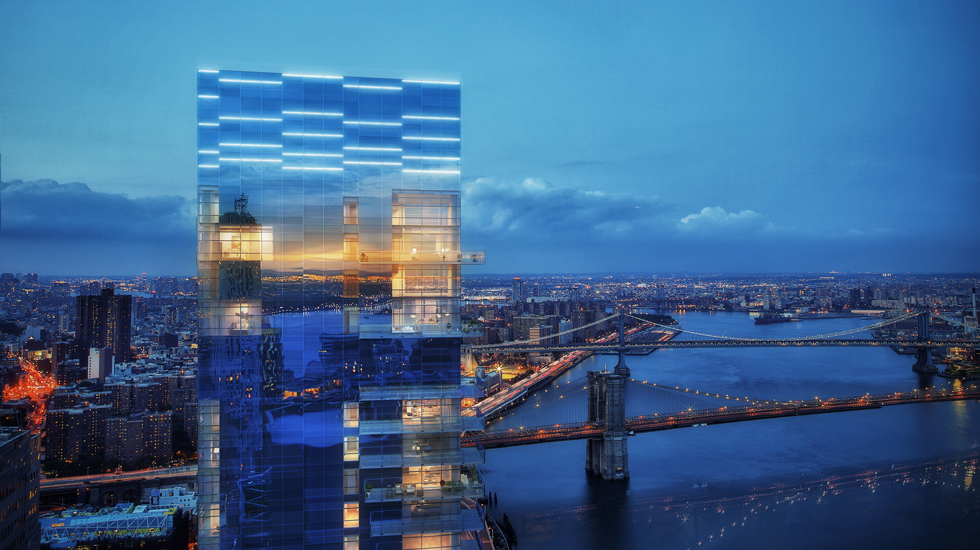
Hill: Unfortunately, we are not able to speak about our newest projects on the design boards right now. The confidentiality of our clients is extremely important to our practice. However, we are excited for the future of our projects. Of our current projects in the public eye, we are particularly proud of 1 Seaport, 365 Bond Street, 363 Bond Street, Tower 28, and Court Square City View Tower, which are some of our newest designs completed or in the process of being constructed.
West: Hill West has played a major role in shaping the New York skyline. Some of our biggest developments include Waterline Square, where we served as executive architect on all three buildings; Jackson Park in Long Island City; and SKY at 605 West 42nd Street, the 60-story luxury tower boasting an extraordinary amenity package, Yayoi Kusama artwork, and spectacular river and city views.
What are some new trends that you’re seeing in architecture?
West: Wellness is becoming increasingly important to all aspects of our lives, including architecture and design. Wellness reaches commercial real estate through creating healthy workplaces and designing sustainable and resilient buildings.
What are some of the biggest architectural developments in the city right now?
Hill: GID’s Waterline Square, which is a part of the Riverside South Master Plan for which David and I have been working on for the past 23 years. GID gave us the opportunity to contribute to the design of all three towers with KPF, Richard Meier, and Rafael Viñoly. I love the collaborative process of working with other architectural firms and derive great satisfaction in seeing thoughts and drawings constructed into concrete and glass.
Where do you see Hill West in the next five years? How are you planning for the future?
Hill: I have no idea. We started Hill West with 18 people in 2009 and have grown to 140. This is something I never would have predicted at the time. The hard work and dedication of our staff always has a way of exceeding my expectations. I do know that I love what we do and can’t imagine a life without it.
West: We do plan on expanding geographically and branching out to new project typologies. We’re excited to take on projects beyond greater New York City.
How has technology impacted architecture in recent years?
Hill: Too numerous to list. It is amazing to have the ability to print 3D models in-house and be able to virtually walk through our projects while they are still in the process of being designed.
West: Technology has greatly impacted architecture, from updating old mechanical systems to the use of Building Information Modeling and Revit in both the design process and construction.
What are your biggest considerations when approaching a new project?
Hill: Our first consideration is the client’s desire. Secondly, we look at the context of the building, the history and constraints of the site, and what our thoughts are for the future of that neighborhood.




Add Comment