
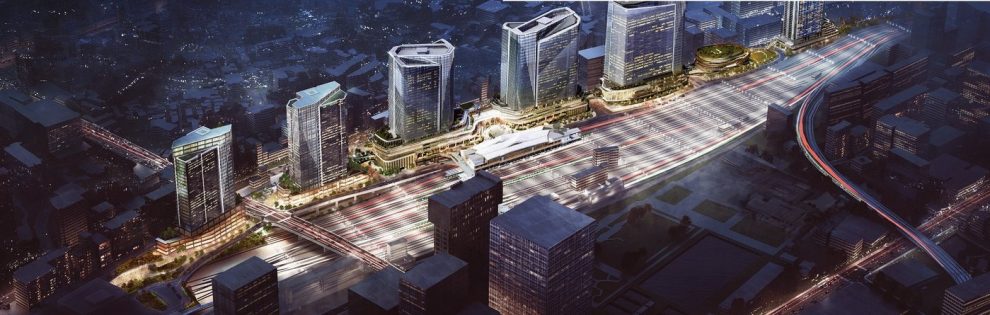
Hudson Yards, move over. A narrow strip of land next to one of the busiest rail stations in metropolitan Tokyo will become an entirely new, internationally focused neighborhood with the development of Global Gateway Shinagawa.
Now under construction, the redevelopment of the northern part of the train station comprises 13.6 million square feet of development to be built in phases through 2024. The goal for the developer, East Japan Railway Company, is to create an urban environment that will invite international companies to create new businesses, and symbolize both Japan and its openness, said master planner and concept designer Pickard Chilton.
“Our client Japan Rail was very clear about creating a vibrant public realm,” said William Chilton, a principal of New Haven, Connecticut-based Pickard Chilton, which was awarded the assignment after an international design competition. “The drivers of the project, besides its stated uses, are a part of a larger vision. It’s a place for the world to come together. We are creating a community within the development itself.”
An important goal for Shinagawa’s office space will be the incubation of new businesses. Coworking space is planned.
“It’s almost a curated tenancy,” Chilton said. “They’re looking for specific types and businesses that are buying into the larger vision of the project’s goal. It’s building community internally and externally in regards to its relationship to the neighborhood.”
Much like Japan itself, the project will be long and narrow. The 32-acre development includes the construction of eight buildings linked together via the one-mile length of the site, an “archipelago” of construction of sorts. The buildings will provide office, retail and residential space as well as cultural facilities, and will serve as the foreground for a series of public parks and plazas all interconnected by an elevated one-mile long pedestrian promenade. The redevelopment will have a diverse mix of uses and cohesive architectural identity and integrate with the new Takanawa Gateway Station, designed by Kengo Kuma & Associates.
Located in the Konan district (the south end of central Tokyo), Shinagawa Station has become an increasingly important transit hub since the launch of bullet train services in 2003 and the addition of a commuter line in 2015. Today, it’s one of the largest railway stations in the country, and it will be home to an advanced rail system served by a maglev (magnetic levitation) train, which essentially floats over the track. In some ways, the project is reminiscent of New York’s Hudson Yards, which also was built on railway property, Chilton observed. Shinagawa, however, is larger in land area than the original Hudson Yards. However, buildings will not be as tall, as the project is on the flight path to Haneda Airport.
“The land in Tokyo is very valuable, so by streamlining operations at the railyard, they were able to take a sliver of the land and redevelop an absolutely transit-oriented mixed-use development,” Chilton said.
He added that East Japan Railway executives traveled the world, visiting multiple properties while researching their goals for the project. “Working with clients with that clarity and vision is quite incredible. They’re so inquisitive about best practices.”
The property also parallels Route 15, a major north-south road, giving it greater access to the rest of the region. The firm has designed a retail strip for a portion of the area, creating an intimate contemporary shopping experience unusual for the city. Tokyo Bay is on the other side.
“It’s a development of its time. This is a bit of infill development between Tokyo Station and Haneda Airport,” Chilton explained. “As Haneda expands, it will help create a new, more efficient system. And the maglev will have a huge impact on travel in Japan.”
Part of the railway will temporarily be operational when the city hosts the 2020 Summer Olympic Games, but full operation is expected by 2024. The master plan has recently been reviewed and certified by Japan’s Prime Minister Shinzo Abe.
“A vibrant public realm is central to the project and key to the success of this type of urban redevelopment,” Chilton added. “The Global Gateway Shinagawa project prioritizes sustainability and public-oriented landscape and will attract people of all ages, seamlessly connecting public space with retail, office, and transportation uses.”
The firm is collaborating with JR East Design Corporation, Nihon Sekkei, Inc., and Nikken Sekkei, Ltd., which serve as the executive architects and engineers. Global Gateway Shinagawa will begin construction in 2020 with initial phases opening in 2024. A cultural center and more development will bring completion to 2030.
In addition to leading the Design Code and Master Plan for Global Gateway Shinagawa, Pickard Chilton is designing Block IV, centrally located within the development and fronting the train station. Within two 30-story towers connected by a seven-story podium, the mixed-use complex comprises over 4.9 million square feet and will be dominated by office space, but it will also include a five-star hotel, conference spaces and retail.
The development can also provide lessons for U.S. designers and builders, Chilton noted.
“I could set my watch by the way the rail system in Japan operates. The cars are clean as a whistle,” Chilton said. “We can learn about the value of robust infrastructure and taking a long view. I’ve rarely seen a traffic jam there — the public infrastructure is so good.”
Global Gateway Shinagawa is Pickard Chilton’s second major project in Tokyo, as the studio recently announced the groundbreaking for the Y2 Project, located across from the south portal of the historic Tokyo Station. Tokyo-based real estate developer Mitsui Fudosan is developing the innovative urban mixed-use high-rise development. The 3.1-million-square-foot (290,000 square meters) state-of-the-art building includes offices, a Bulgari Hotel and an elementary school atop a retail podium and below-grade transportation hub.