
From protecting a NASCAR event on July 4 and quite probably averting a major mass school shooting to, now, detecting those who may be harboring COVID-19, Antlia Systems has focused on providing its clients with high-tech safety with a personal touch.
Founded in 2017 by Amy Yu and Michael George and named for a Southern Hemisphere constellation, Chicago-based Antlia was first dedicated to more traditional security measures, such as metal detectors. It quickly became known for its rapid response and customer service, the two said.

“One of the things that differentiates us is how quickly we respond to our clients,” said Yu, one of the few women in her college engineering program. “We get so many calls that begin with, ‘We need to reopen next week.’”
That’s a lot of time compared with some client requests Antlia received last year. NASCAR was expecting some 3,000 people at an Independence Day event, yet it couldn’t find the necesssary metal detection equipment. A day before the event, a call to Antlia saw Yu and the company track down four units and drive six hours to get them to the site. Antlia worked with an even tighter time frame when a high school received a call threatening a shooting six hours before graduation ceremonies. Antlia quickly installed two metal detectors, and the celebration took place without incident.

Today, the company’s screening systems are used in many different public, private and nonprofit environments nationally including government buildings, sports and entertainment venues, offices, airports and more. Clients include the U.S. Federal Reserve Banks, Kohler, Marie’s Salad Dressings, Clark Construction, the City of Chicago, the greater Chicago area Bellwood School District and the South Bend Housing Authority in Indiana.
However, with the onset of COVID-19, the two saw an opportunity to provide a different type of security.
“Our original interest was providing physical security with better quality,” George said. “When the global pandemic hit, we were asked about biological security. We already manufactured detectors. The question was how would we adapt them to serve for wellness in buildings.”
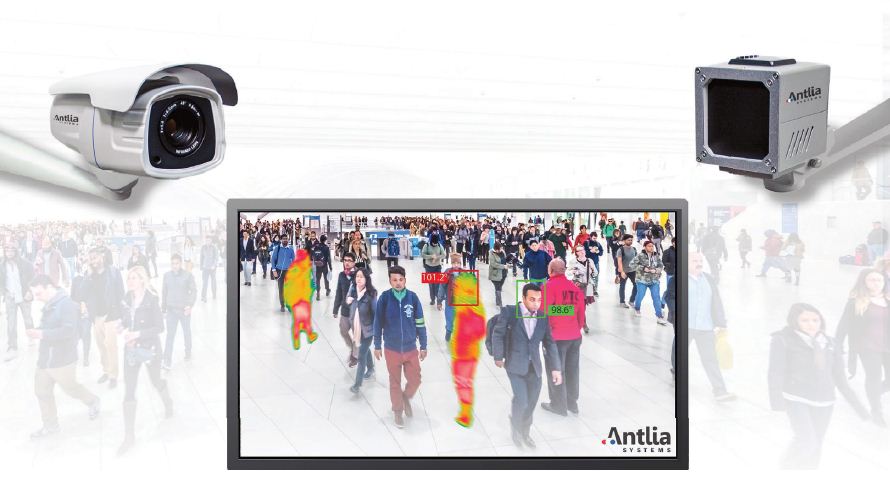
Fever is the most common symptom of COVID-19; temperatures can be checked as individuals enter residential buildings, public transit hubs, lobbies and offices to slow the spread of the disease. As a result, Antlia pivoted its focus to offering a suite of thermal detectors by adding customizable, thermal cameras and freestanding temperature detectors (including a model that can check the temperatures of up to 50 people at once) in real-time to metal detectors.

“Prevention and early detection are vital to public safety; identifying abnormal temperatures is a key aspect of returning to everyday life,” Yu observed. “We quickly vetted a reliable suite of non-contact thermal detection sensors designed with the most advanced technology.”
Antlia System’s temperature screening products are fully functional out of the box, can be customized and optionally integrate with existing building management systems, the company noted. Systems include: a Contactless Thermal Detection Box, a measuring device suitable for retail small business applications that can be mounted to a wall or pole or stand on a desk; the contactless Thermal Detection Kiosk with Facial Recognition, which can identify employees and guests as they enter a building or office, check temperatures and confirm they are wearing mask in under a second; the High Volume Thermal Camera System, a hybrid infrared and visible light camera system that can scan large groups of up to 50 people simultaneously with a pinpoint ±0.3 degrees of accuracy in high-traffic areas such building lobbies and transit hubs and an Integrated Walk-Through Thermal and Metal Detection Gate for facilities that need to screen for both fever and weapons.
Of these, the thermal kiosk has proven most popular because of its versatility, George reported, as it can survey for weapons and viruses quickly and accurately.
“It’s still a metal detector, after all,” George said. “You don’t want a sick person coming to the office. It’s one of the things you can control.”
Clients are simply trying to find a way to return people to the office safely, he continued. People trying to return may not even know that they’re sick. George noted that one client reported that a potential building visitor had a 101-degree fever.
“He just didn’t believe it,” George said. “This protects everyone in that building.”
The company manufactures in China and to a smaller extent the U.S., and Antlia has continued to produce equipment despite disruptions to the supply chain. And even after COVID-19 becomes a not-so-fond memory, the thermal sensors can still help those overseeing public spaces track usage and health concerns.
“When the global pandemic hit, we immediately expanded products to address new health and safety concerns,” George said. “Thermal detection is the solution to returning to work. Non-contact thermal detection allows businesses to reopen safely and demonstrate their commitment to health.”