




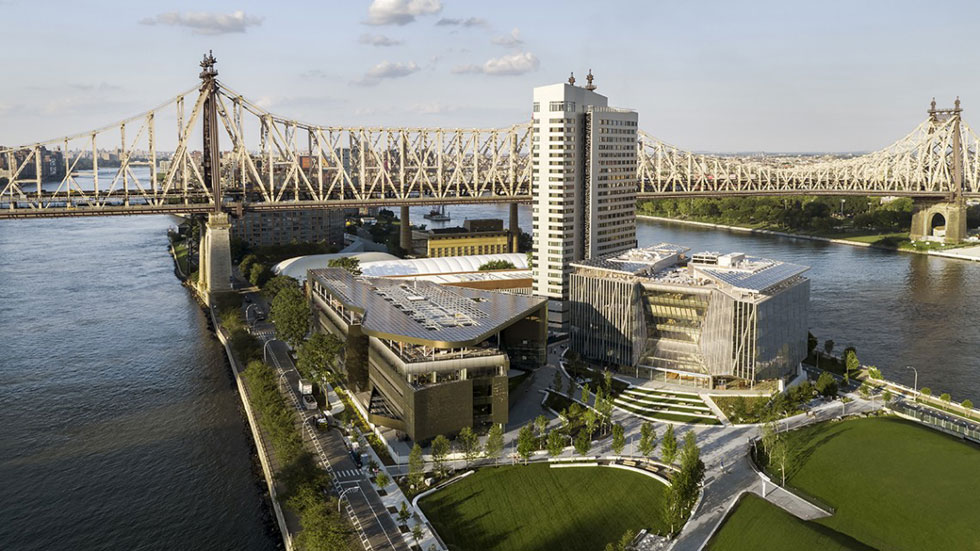
Cornell Tech recently opened a new campus on Roosevelt Island, the narrow strip of land perched upon New York City’s East River. The campus is the result of Cornell Tech’s victory in former Mayor Bloomberg’s competition, with esteemed universities such as Stanford submitting proposals to secure a spot on the coveted Roosevelt Island space. Ultimately Cornell won out, securing several pieces of New York real estate at essentially no cost, along with $100 million in infrastructure upgrades.
But the architecture and design of Cornell Tech’s new buildings is what really has people talking. Cornell claims that its buildings are the most environmentally friendly and energy-efficient in the world. A bold statement, but one that Cornell’s architects and designers can back up.
Three of the buildings at Cornell’s Roosevelt Island campus recently opened their doors to the public: the Emma and Georgina Bloomberg Center (The Bloomberg Center), designed by Morphosis; The Bridge, designed by Weiss/Manfredi; and The House, designed by Handel Architects.
The Bloomberg Center
Described as the home base of the new campus, the Bloomberg Center is designed by Thom Mayne of Pritzker Prize-winning firm Morphosis, and is the first academic building on campus. The new building is four stories tall and is 60 percent opaque and 40 percent transparent. The Bloomberg Center is also completely clad in a warm, bronze-colored metal. Its roof is a sweeping lily pad shape, facing the public plaza of campus. The roof also features 1,465 photovoltaic panels that generate energy for the building. This is in pursuit of a net-zero energy goal, in which the building uses as much energy as it and the rest of campus generates.
The Bridge
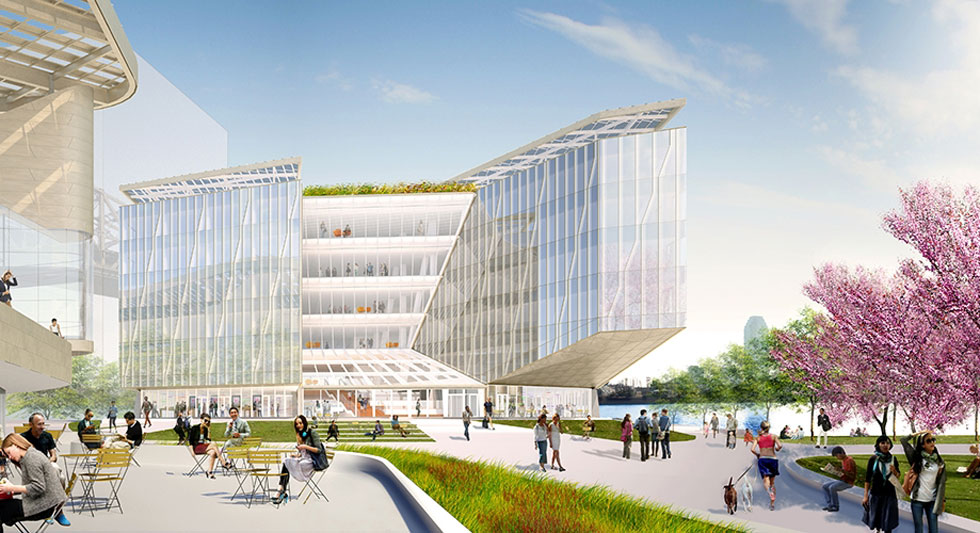
The Bridge is designed by Weiss/Manfredi and is a unique co-working space in which companies from diverse industries can lease space alongside Cornell’s academic teams. Cornell itself only occupies one-third of the six-story building, with the remainder occupied by other tech industry ventures, commercial space, and student startups.
Like The Bloomberg Center, The Bridge also features a glassy façade, and its unique bowtie shape fosters a collaborative environment between industries and academia. It also has a 24,000-square-foot trellis. Companies already committed to the space include Citigroup, Twi Sigma Investments, and Ferrero, with space still available for leasing.
The House
The House is designed by Handel Architects and is the largest high-rise passive house in the world, meeting the rigorous passive house energy efficiency standards. The building sits within a highly insulated envelope, using triple-glazed windows to maximize natural lighting. There are also geothermal-powered heating and cooling systems, and a single utility expense for electricity among residents.
The House is projected to save 882 tons of carbon dioxide per year, and sets a new precedent for sustainability and energy efficiency in real estate. It’s something Cornell is looking to brag about as well, as screens on the first floor tell visitors exactly how much energy the building has saved on that particular day.
Photo Gallery






Add Comment