



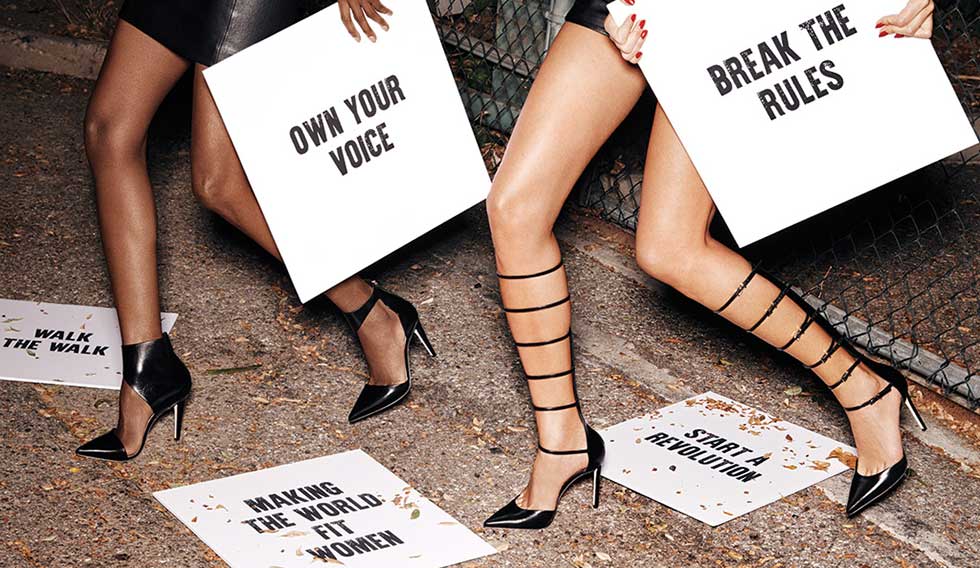
What does the fashion industry look like post #MeToo?
In just over a year since allegations against Harvey Weinstein were published in The New York Times, the #MeToo movement has run rampant over almost any and every industry imaginable, leaving in its wake a fiery debate over how to validate accusations and thousands of frustrated women.
And while many companies and industries have been fast reacting to allegations of sexual misconduct, the one industry that has remained relatively slow moving is the fashion industry.
Many prominent industry players accused of abuse are still working, and others have vehemently denied any wrongdoing. Stylist Karl Templer as accused of
“intrusive physical approaches with models” in February, and was subsequently dropped by several brands, including Dior. But then this year, Dior used Templer for their Fall 2018 women’s wear ad campaign, and Alexander Wang used him to style its June pre-collection runway. In The New York Times, photographer Mario Testino said that his multiple accusers “cannot be considered reliable sources,” and in The Boston Globe Patrick Demarchelier said that “people lie and they tell stories.”
What then, if anything, has changed?
For many, the change has been symbolic. Rebecca Minkoff skipped NYFW in February and instead unveiled her collection in a series of portraits featuring the organizers of the Women’s March, Zosia Mamet, and more. Myriam Chalek, a French-born designer, cast sexual abuse survivors as models in a one-off NYFW runway show. And Stacey Bendet, the creative director and CEO of Alice + Olivia, pulled inspiration for her Fall/Winter 2018 collection from “the women’s movement past and present” and the roles that women have played at key historical moments.
But when it comes to actual change, only a few have stepped up to the plate. Condé Nast, LVMH, and Kering, three behemoth industry leaders, have publicly established their own codes of conduct regarding the treatment of models. Condé Nast’s Code of Conduct stipulates that all models must be 18 years old; any shoot requiring nudity, sheer clothing, lingerie, swimwear, animals, simulated drug or alcohol use, or sexually suggestive poses must be signed off in advance by the subject; no one involved in the shoot may be under the influence of drugs or alcohol; and a private dressing space must be provided to every subject on set.
LMVH and Kering’s charter has similar stipulations, also including guidelines on using models over a certain size, providing access to food and drinks, providing transportation if shoots run past 8 p.m., and allowing models to make direct complaints to a brand in order to “[pay] particular attention to ensuring good working conditions.”
While Kering and LVMH approached other companies in Europe and the United States to join their model charter, for example, none signed on. But other big brands, including Phillips-Van Heusen, the group that owns Calvin Klein and Tommy Hilfiger, and Oscar de la Renta, are working on their own versions of the charter. And Ralph Lauren has extended its employee protections to cover contract employees, which includes models.
Following the release of these standards, the Council of Fashion Designers of America (CFDA) partnered with Model Alliance to extend these principles to all designers showing at New York Fashion Week.
But are these guidelines really enough?
According to Sara Ziff, founder of Model Alliance, a research and policy organization that focuses on modeling rights, the answer is no. “It’s important to recognize that we’re talking about systemic problems, which go beyond the offhand remarks. This is a business that is essentially still largely unregulated, where there are no industry standards. Industry standards and codes without enforcement mechanisms in place are not standards. They are aspirations,” she told Business of Fashion.
While Kering and LMVH have publicized the changes to their codes of conduct, many others haven’t, and the differences between them (and why there are differences), are unclear. As a result, there remains no consistent bar for professional conduct, or agreement as to who adjudicates it.
“I’d say the change is in the acknowledgement of the problem. But the behavior hasn’t changed that much because there is not currently a system in place to address these concerns. Which is precisely what we are working to accomplish through the Respect Program, which is an initiative that would create not only industry-wide standards, but also enforcement mechanisms to uphold those standards,” Ziff continues.
Model Alliance’s Respect Program asks companies and brands to sign a legal agreement that says they will take action if a complaint is filed and use an unbiased third party to investigate, and also provides a 24/7 hotline that models can call in to anonymously without fear of repercussions.
For many women who are victims of sexual assault, the unfortunate reality of reporting their abuser results in being passed over for jobs, losing their current job, or being blacklisted from certain companies. And this is likely something heightened in fashion, an industry that thrives in many ways on its ability to turn the other cheek.
“People should be able to file grievances without fear of being blacklisted and people should not have their careers ruined because they’re accused of things they haven’t done. It goes both ways. And that’s why it’s so important to have independent, professional, impartial investigations,” Ziff explains.
“We’re conditioned to stay silent. I’m just going to say that. We’re conditioned to say, ‘Oh yeah, that [stuff] happens,’” adds Karen Elson, English supermodel, musician, and Save the Children ambassador.
Another organization fighting against misconduct in the fashion industry looks to put more responsibility on the modeling agencies to protect their models. Responsible Trust for Models provides an educational curriculum for models and uses the British Standards Institute (which is recognized in 120 countries) to administer and audit a certification system, currently being constructed, for agencies.
Regardless of who is taking responsibility for the transgressions within the fashion industry, the fact of the matter is that someone needs to do it. Because while models don’t use their voices on the runway, they still have them. And they need to be heard. So whether that means stopping working with an elite photographer or providing extra safeguards for the wellbeing of models, the industry needs to prove it’s listening.


Add Comment