




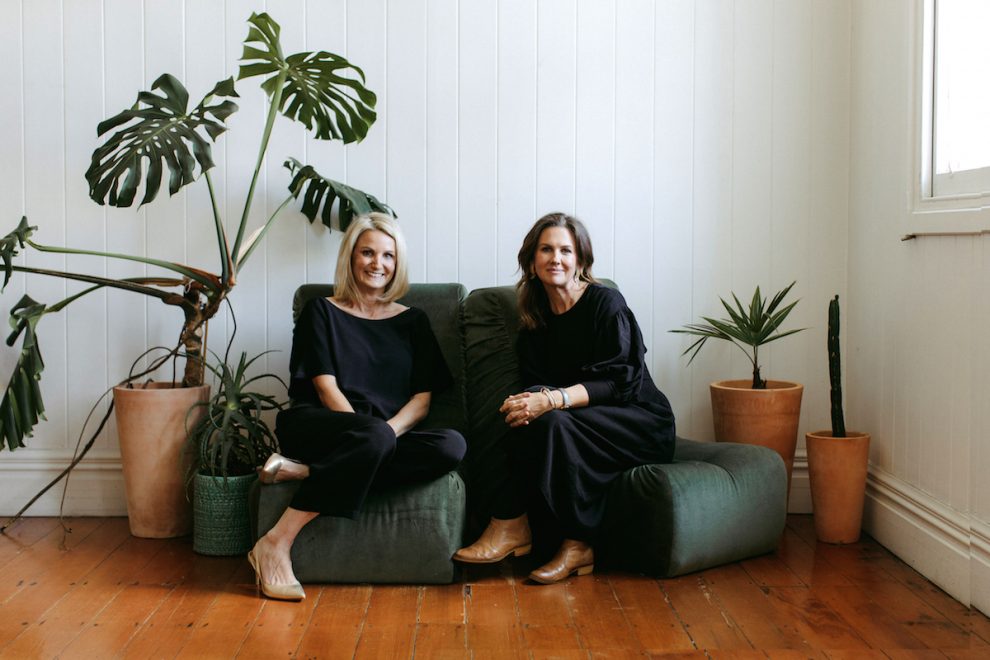
Insights from the founders of The Better Packaging Co.
With e-commerce on the rise, Rebecca Percasky and Kate Bezar, co-founders of The Better Packaging Co., knew there had to be a better way to get orders to customers. Their New Zealand and Australia-based team is trying to steer vendors away from single-use plastic and replace unsustainable packaging with biodegradable solutions. The co-founders spoke with the Fashion Mannuscript about how they do what they do and why.
Tell me about your backgrounds in science.
KB: We do have degrees in chemistry and related disciplines, but neither of us had actually used them for a long time. We took quite divergent career paths — Becs into technology and program management, [me] into management consulting and publishing. Then, about four years ago, when Becs was head of operations at a start-up developing e-commerce fulfillment technology, she saw first-hand the sheer scale of e-commerce and its extraordinary growth. Coming from an environmental mindset, she could see the resulting impact on the amount of single-use plastic packaging required to send all those orders and wondered if there was a more sustainable way.
RP: It was then, when we began to get into the nitty gritty of what compounds different materials are made of and how quickly they are able to biodegrade, that our chemistry backgrounds really became useful. The reality is that plastic is a material engineered to last hundreds of years — that’s what makes it so darn useful — but unfortunately, it’s come to be used for thousands of applications that don’t actually need it to last that long. Generally, it only needs to last for one, maybe two uses and then disappear or be recycled. Plastic packaging should be used for very long-term storage and protection, no more.
KB: Our chemistry backgrounds help to cut through some of the greenwashing by giving us a true understanding of the full product lifecycle. For example, our comPost range is partly made from plants, but it also needs another resin to give the material its flexibility. Currently, this resin (Polybutyrate Adipate Terephthalate, or PBAT) is made from petroleum. Petroleum is not a renewable resource, but it is natural and not inherently “bad.” It’s what it’s engineered into that can have long-term, negative repercussions for the environment. It can either be made into traditional plastic (containing toxic additives, which will not break down for hundreds of years) or a “bioplastic,” which is non-toxic and will biodegrade naturally in months under composting conditions — it’s even ok for worms! That said, we are working to make sure that more of our packaging is derived from plant-based and therefore renewable materials, and that really excites us.
What inspired you to tackle this market problem?
RP: We both care deeply about our environment and are horrified by the damage the human race is doing to it at such a rapid, almost irreversible pace. We both can’t stand wasting anything and see opportunities for better solutions everywhere. We also understand that we can’t fix the world’s problems alone — we have to bring others along with us, and that’s where our passion for design and communications also comes in. We would like to think we’re creating a movement towards clever, more sustainable solutions to breaking the world’s single-use plastic addiction.
What are your compostable materials made from?
KB: Our comPost range (which makes up the majority of our products) is made of totally biodegradable and compostable materials: corn starch, polylactide (PLA) and PBAT. PLA is a bio-based, biodegradable material made from renewable plant material. It’s the plant sugars that make our products smell a little bit like maple syrup when they are first made.
What makes compostable bags/packaging better than a recyclable bag?
KB: Two key reasons; first, even if a plastic bag is technically recyclable, there is only a very small chance it will actually get recycled. Across the world, recycling rates for “soft” plastics vary considerably. New Zealand has one of the highest rates, but even in Australia, less than 0.1% of all soft plastics actually get recycled. In many countries, the infrastructure is completely non-existent. As well as that, 33% of all plastics end up in nature and, once there, will be there for a very long time, causing untold damage.
How do the prices of your products compare to traditional plastic?
RP: For smaller companies not buying plastic mailers at significant scale, there is not a lot of price difference at all. At larger quantities, where companies are able to buy in bulk, plastic becomes super-cheap, and we find it harder to compete on cost.
Several smaller companies have said that using eco-friendly packaging is just too expensive for a small business model. How do you combat that problem?
RP: In the past, that has definitely been the case. A core part of our mission has always been to make sustainable packaging solutions accessible and affordable to businesses of all sizes. We produce it at scale and then pass those savings onto smaller companies.
Who uses your packaging?
KB: In Australasia, we work with Volcom, Fila, Clarins, Maybelline, ‘L’Oreal and Garnier. In the U.S., we also work with cult zero waste brand Loli Beauty and numerous swimwear brands, like Stone Fox Swim and Monday Swim.
Have you seen an increase in demand as more people have turned to online shopping?
KB: Since our core business is the design and production of sustainable packaging for e-commerce, and with most of the developed world stuck at home, online shopping has gone bananas. After an initial dip, sales of our packaging actually increased exponentially through lockdown. We believe this will flatten off somewhat as offline retailers open up again and we’re able to shop physically, but a step-change has been made with brands who weren’t previously selling online now doing so, and people who hadn’t shopped much (if at all) online now doing so.
What else can companies or individuals do to reduce their waste or carbon footprint?
RP: One of the simplest and highest impact things is to make sure your food and garden waste doesn’t go to landfill. Almost 50% of all rubbish sent to landfill could be composted. When we send organic matter to landfills, it creates methane, an extremely potent greenhouse gas, and the opportunity to return the nutrients in that matter to the soil is lost.
What is in store for the future of Better Packaging?
KB: So much! We have just released home compostable hanging garment bags and pallet wrap, and in the next couple of months, we will launch a range of re-usable courier mailers called SWOP (which stands for “the Sustainable Way of Posting”). These are designed to be used many, many times and are particularly suitable for brands who have their own closed loop — for example, those offering rental products which need to be returned or refillable products — and also for intra-company deliveries.
For more information, visit
betterpackaging.com/USA.


