




By Debra Hazel
Denim is back—but did it ever really go away?
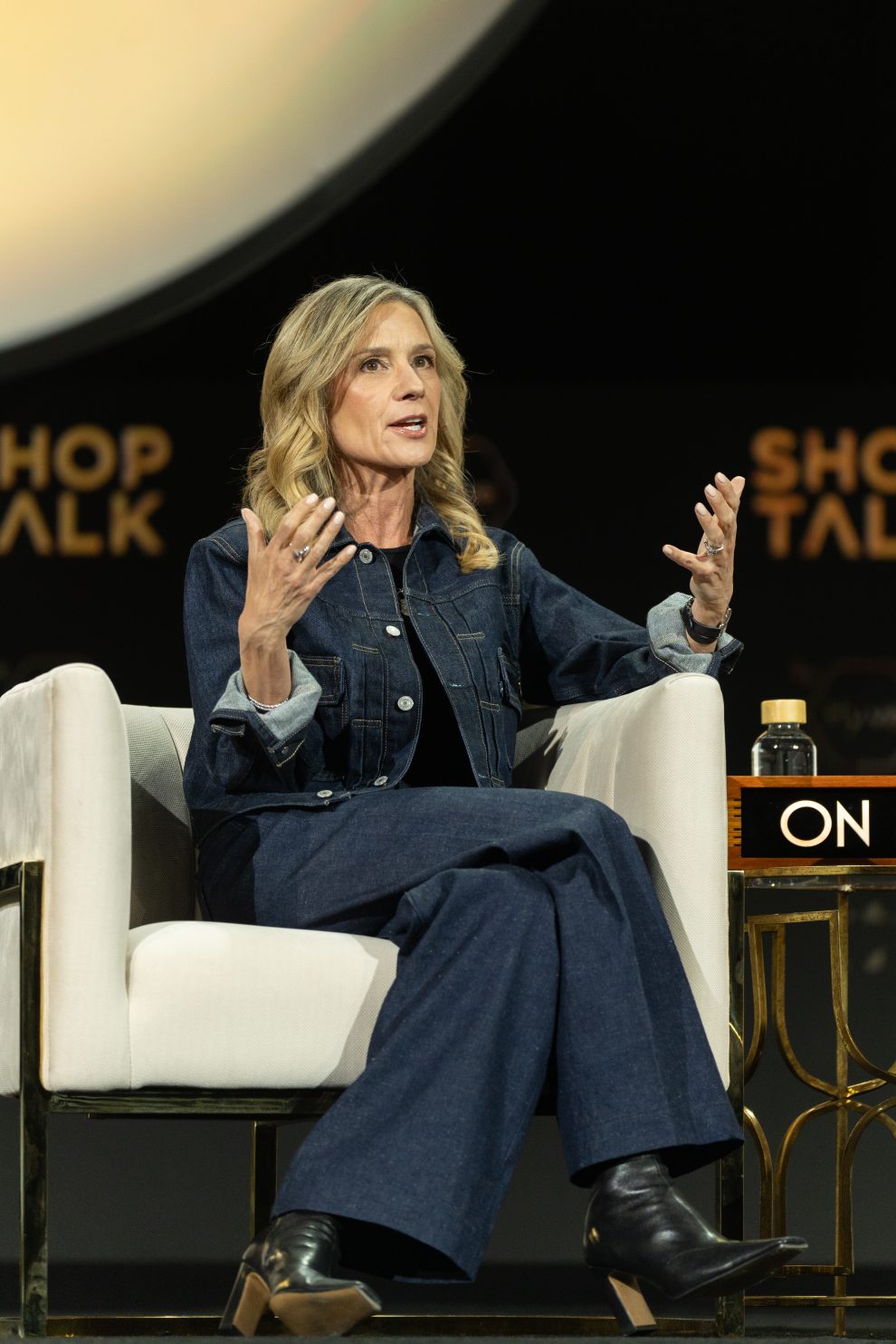
Iconic denim chains—one more than a century old, the other older than 50—discussed their legacies and reinvention plans at Shoptalk 2025, held in March in Las Vegas.
“We invented denim, and denim is having a moment,” said Michelle Gass, president and CEO, Levi Strauss & Co. “[We’re] here with 170 years of history and we protect that but have so much innovation ahead.”
As it turns out, even a 150-year-old company still needs to expand its product line. In her early travels as CEO, Gass noted that the company lacks a denim skirt as iconic as its pants—and tops that pair well with its various jeans rises.
“It’s really expanding the entire denim universe,” she said.
That includes store count.
“There’s lots of opportunity there,” Gass said.
Levi’s is even a part of the history of Gap, noted Richard Dickson, president and CEO of Gap Inc. in a separate conversation at the conference.
“Gap started August 1969 in San Francisco. In the context of the time, we had a store that sold Levi’s records and tapes,” Dickson recalled.
Gap’s point of view is to help its customers express their personalities, Dickson explained.
“It is the definition of being customer-centric,” he said. “In the case of our brands, we offer the best product at the best price with a narrative you feel attached to.”
The company is planning major capital expenditures to streamline its narrative to its customers after promoting heavily on price in recent years.
“We’re running a more disciplined business,” he said. “We’ve been running while we’ve been transforming. We’re putting a lot of thought to where we’re putting our investments—always evaluating various different ways to get value to our shareholders.”
Both, ironically, have been celebrating the past even as they invent the future. Gap is looking at the next set of icons to be photographed in its clothing.
“We take a lot of pride in our legacy,” Dickson said. “But who are the originals today? Today’s cultural curators?”
Meanwhile, Levi’s current ad campaign remakes classic ads from the 1980s, with a chapter two coming shortly.
“That’s what brands need to do—respect the heritage but push for more,” Gass said.
In addition to benefiting from history, Levi Strauss’ marketing continues to remain fresh, Gass noted.
“We like to talk about being at the center of culture; one could say we shape it,” she said, discussing a current campaign with Beyonce that is the result of decades of collaboration, first when she was with Destiny’s Child, when Levi’s was the rare brand to sponsor the group, then later as a solo artist. Her most recent album, “Cowboy Carter,” has a song entitled “Levii’s Jeans.”
The company also continues its evolution by increasing its direct-to-consumer (DTC) relationships, which now comprise nearly 50% of its business, by diversifying its product lines and its retail footprint.
“We are evolving to be a DTC-first company, not DTC-only,” Gass said. “Wholesale will still be important.”
But some things don’t change. Gap continues to focus on value and customer emotion.
“In the case of our brands, we offer the best product at the best price with a narrative you feel attached to,” Dickson said.
Even in today’s uncertain environment, Levi’s will endure, Gass said.
“We’ve been around for 170 years—invented the blue jean 150 years ago,” she noted. “The brand has weathered lots of storms.”


