




As the global textile industry intensifies efforts to address microplastic fiber pollution, Intrinsic Advanced Materials (IAM) announced expanded adoption of CiCLO technology across performance apparel, outdoor and protective workwear. New product introductions from leading brands in Europe, Canada and the United States demonstrate growing momentum for synthetic textiles engineered to reduce the persistence of microplastic fibers in the environment while retaining the durability, performance and recyclability of fabrics.
Synthetic fibers now account for more than 65% of global textile production, making solutions to address microplastic fiber pollution an urgent priority for global textile producers across the performance apparel supply chain.
CiCLO technology is a textile ingredient embedded in polyester and nylon fibers during production, enabling the material to biodegrade at rates comparable to wool when it enters the environment. When CiCLO polyester or nylon is exposed to seawater, soil or wastewater sludge, microbes can break down the fibers, leaving behind only natural elements. Long-term comparative studies conducted by third-party labs show that CiCLO fibers fully biodegrade in under four years compared to conventional fibers that remain intact.
In Europe, Fruit of the Loom has incorporated CiCLO polyester into its Iconic Premium and Iconic 250 Sweats collections, including sweatshirts, hoodies and joggers designed for comfort, durability and everyday wear.
“With our two new sweat collections, it was important to us to offer added value and differentiate ourselves from the competition. We succeeded by using CiCLO technology. What’s more, our distribution partners and consumers rely on us when it comes to products they wear every day, and with that scale comes responsibility,” said Christian Lanvermann, senior marketing manager for Fruit of the Loom Europe. “Integrating CiCLO technology into these collections allows us to introduce an ingredient innovation directly into core apparel categories. It is a practical way to continue delivering comfort, durability and value while helping address the growing concern around microplastic fibers.”
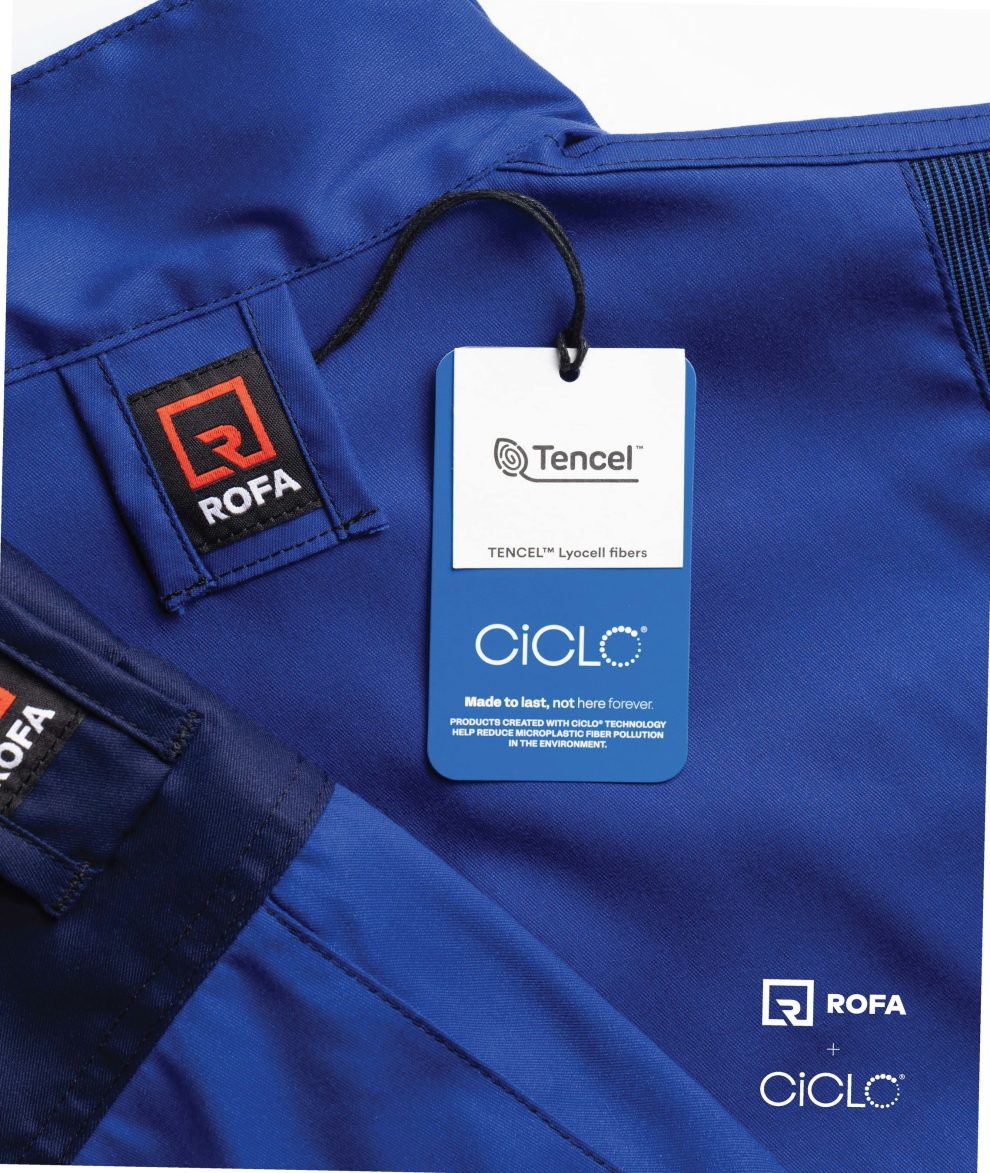
In the industrial apparel sector, Rofa is integrating CiCLO technology into the “Move Easy” workwear line, designed for maximum movement, and the “Hivis Light” warning-protection line, designed for high-visibility safety garments.
“Industrial workwear is built to last and must perform under extreme conditions,” said Cornelia Jäger, manager of product development for Rofa. “Adopting CiCLO technology allows us to maintain the durability and safety standards required in protective workwear and warning-protection clothing while taking a responsible step toward addressing the long‑term environmental persistence of synthetic fibers.”
In the United States, Black Diamond Equipment has introduced the Rift Fleece collection featuring CiCLO technology designed for comfort and outdoor performance.
Additional market adoptions include athleisure apparel at Costco and Walmart, featuring men’s and women’s shirts and pants under the Mondetta brand, distributed across the U.S. and Canada.
“CiCLO delivers a proven, scaled and affordable solution for the entire existing textile supply chain,” said Cheryl Smyre, vice president of Intrinsic Advanced Materials. “Helping brands move beyond intention into speedy adoption is unlocking the power of collaboration and partnership. We are experiencing an industry urgency to solve the environmental impact of unavoidable microplastic shedding from synthetic textiles. Responsible material innovation is at a new level, and we are committed to supporting our brand partners as they introduce durable and sustainable products across market segments. Let’s do better together, for people and planet.”
The momentum for CiCLO technology follows its recent recognition at the Textile Recovery Summit in San Diego, where it was voted as the winner of the Innovation Stage. Reflecting on this industry shift, Andrea Ferris, CEO and co-founder of Intrinsic Advanced Materials, noted that brand partners are increasingly looking beyond traditional sustainability models. “We are seeing a real shift with brands, where producer responsibility and circularity are increasingly understood as cohesive strategies that bring more responsible materials and products to market from inception, extending beyond closed-loop recycling alone,” said Ferris.
The expansion of CiCLO adoption comes at a time when frequently evolving trade policies highlight the importance of a solid global infrastructure. Fibers and yarns made with CiCLO technology are available from certified manufacturers globally, supporting agile supply chains and enabling brands and mills to scale their use of CiCLO technology more efficiently across production networks.


