




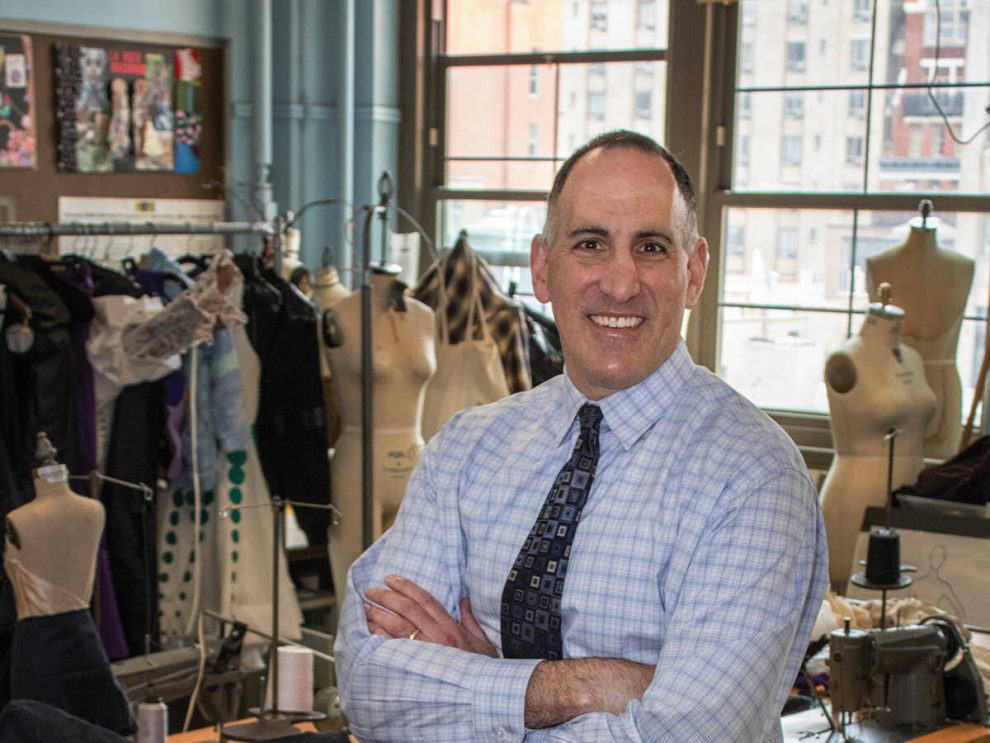
Every morning, Daryl Blank stands at the entrance of the High School of Fashion Industries (HSFI) and greets each of the school’s 1,400 students as they arrive. “I want all our students to feel welcomed and cared for when they come to school each day,” he explained. In his 16th year as principal, Blank has devoted nearly three decades to the institution—first as a teacher and sports coach, then as an assistant principal.
Nestled in the heart of Chelsea, HSFI is one of New York City’s best-kept secrets—a school that has been shaping the city’s fashion landscape for a hundred years. Founded in 1926, it has served generations of students from all five boroughs, giving them the skills to turn a passion for fashion into a career. As the school celebrates its centennial in 2026, Blank reflects on what that history means. “One hundred years demonstrates incredible staying power,” he noted. “It is incredible to think about the thousands upon thousands of students and families that we have positively impacted.” But he is equally focused on what comes next. “I feel a tremendous amount of pressure to ‘carry the baton’ so that HSFI can continue to thrive for the next 100 years.”
A proud product of New York City public schools himself, Blank sees in today’s students the same hopes that brought the school’s earliest attendees through its doors. “I believe our students are here at HSFI for the very same reasons as those immigrants 100 years ago,” he said. “We have four years to get our students ready for life after the High School of Fashion Industries.”
A Century in the Making
After World War I, the garment industry was the largest employer in New York City. But when restrictive immigration laws cut off its traditional supply of workers, the industry faced a crisis: it would have to train new generations if it were to survive. In 1926, educator Mortimer C. Ritter, aided by industry mogul Max Meyer, founded Central Needle Trades High School in two classrooms in a factory loft on West 31st Street. Within a few years, the school had outgrown this venue and moved to a former elementary school on 24th Street between 7th and 8th avenues.
At this time, Central Needle Trades was considered an “extension school,” releasing boys and girls between 14 and 18 from their jobs for part of the day each week to build their occupational skills and learn basic English, mathematics and civics. By 1936, with the garment industry desiring workers with more than an elementary school education, the school began to resemble a traditional four-year high school. Such was the importance of the garment industry to the city’s economy that the City Council authorized $3.5 million to build a new school—one that Mayor Fiorello La Guardia praised as “a model school in the field of education.”
The new 10-story building, which opened in January 1940, mirrored the garment industry buildings around it, with retail outlets on the first floor selling wares made by students and manufacturing workshops above. Most of the student body was composed of the children of immigrants, seeking their share of the American Dream through careers in the garment industry. The building also housed a post-high school institute that by 1951 had become the Fashion Institute of Technology, with Ritter serving as its first president.
A centerpiece of the new building was a state-of-the-art auditorium whose landmark murals depict the rise of the union movement within the garment industry, from the Triangle Shirtwaist Factory fire to the era of cooperation between unions, management and government brought about by President Franklin Roosevelt’s New Deal. Over the years, fashion luminaries including Tommy Hilfiger, Tim Gunn and Joseph Abboud all passed through its doors.
The school has always been a reflection of the city around it. In 1956, Central Needle Trades High School became the High School of Fashion Industries. Over the years, the school thrived and adapted, with dedicated teachers helping students navigate the social and cultural changes of each passing decade. And as the industry itself changed from one of manufacturing to one of design, marketing and merchandising, so did the offerings of the school. From the 1960s through the present day, the school has continued to welcome newcomers from all over the globe—like their predecessors when it first opened—looking to fulfill their dreams through careers in fashion. “I view my responsibility as the person to create the conditions for our students to achieve these goals,” said Blank.
HSFI at 100
At HSFI, every student graduates with real-world experience in one of six career and technical education majors—many of which culminate in a public showcase that takes students beyond the classroom and into the city.
Fashion design, one of the school’s oldest majors, gives students the skills to take their vision from concept to product—from illustration and patternmaking to draping, sewing and textile printing. Seniors showcase their final thesis garments at the Industry Fashion Show at Gansevoort Plaza in the Meatpacking District. Visual presentation is a unique, highly creative major focused on how products are merchandised to promote sales, making use of the school’s own department store-style windows and culminating in a winter holiday window display created in collaboration with industry professionals. Photography, taught at HSFI for over 25 years, provides students with extensive experience with the equipment, techniques and digital applications for the versatile medium.


