




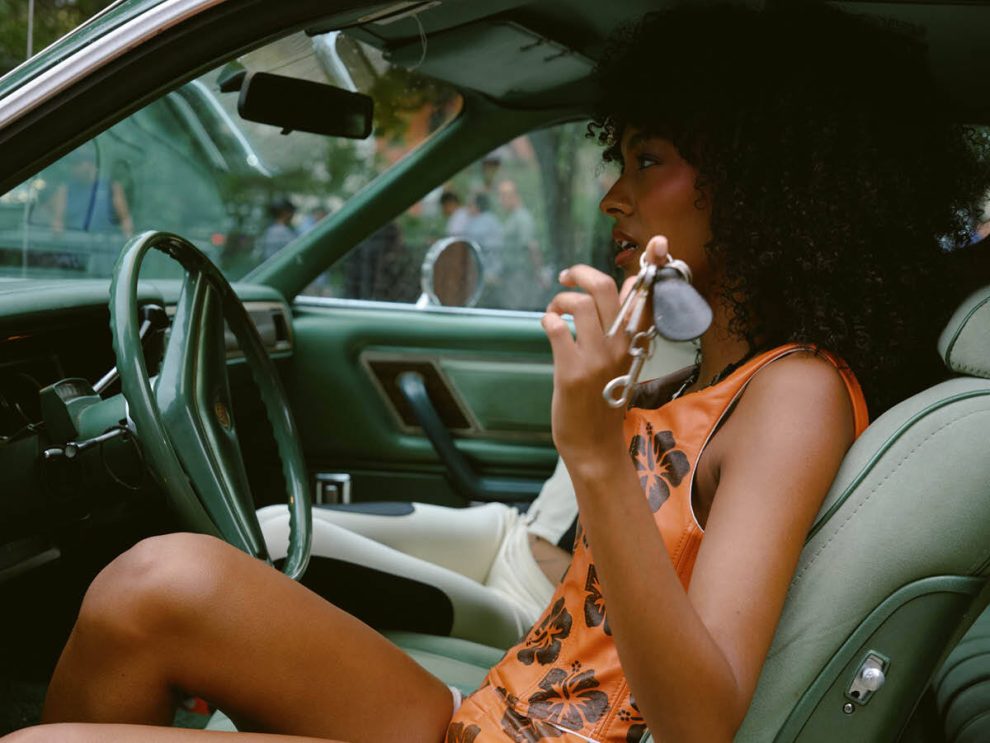
On a late-summer afternoon in New York’s Lower East Side, a car wash became an unlikely fashion stage.
Just before the official New York Fashion Week kicked off, models dressed in the latest collection from New York-based label Ayama Studio stood alongside vintage cars outside the Time Again bar, washing windshields, scrubbing windows and turning an ordinary stretch of downtown New York into something considerably more theatrical. Music, fashion and the energy of the neighborhood converged as guests gathered to celebrate the launch of Collection 003—transforming the block into one big party just ahead of the Labor Day weekend and New York Fashion Week.
It was an appropriately unconventional introduction to Ayama’s latest collection.
Founded by designer Maya Goldberg, Ayama Studio has developed a distinct point of view around strong silhouettes, distinctive details and pieces designed to exist outside the traditional fashion calendar. Rather than defining the label through conventional seasonal collections, Goldberg approaches Ayama as a continually evolving world. Collection 003 is the brand’s third collection and fourth drop, but it is deliberately not categorized as Spring/Summer 2027. Ayama is seasonless by design, with pieces intended to feel timeless rather than tied to a particular moment on the fashion calendar.
That philosophy also informed the way Goldberg chose to introduce the collection.
“I wanted to create a complete world around the collection rather than simply present the clothes,” Goldberg said. “It was exciting to bring this collection to life in a way that feels authentic to my process without the confines of the fashion calendar.”
For Ayama, that meant stepping outside the traditional showroom, runway or presentation format and into the street. The car wash was not simply a backdrop for the clothes; it became part of the collection’s universe. Vintage cars provided the physical setting, while models in Ayama looks transformed an everyday activity into an unexpected fashion performance. The result felt less like a conventional launch and more like stumbling onto a New York scene that happened to have been populated by fashion models.
“Why not? Do car washes still exist?” Goldberg said about the concept. “I love a little bit of hot nonsense.”
That sense of humor and spontaneity is central to understanding Collection 003. Beneath its playful presentation is a collection that represents a meaningful expansion of the Ayama vocabulary.
For its third collection, the label introduces swimwear and ready-to-wear, opening up new categories while retaining the strong silhouettes and distinctive construction that have become central to the brand. The expansion allows Goldberg to explore a more sensual and playful side of Ayama, while continuing to investigate the relationship between the body, movement and clothing.
At the center of the collection is a tension between opposing materials and sensations. Softness meets structure. Flexibility meets rigidity. Technical surfaces are contrasted with tactile fabrics, while stretch materials such as spandex are placed alongside leather.
The contrast is both aesthetic and physical. Spandex brings flexibility and a second-skin quality, while leather introduces structure, durability and a more architectural presence. Rather than treating those qualities as contradictions, Goldberg uses them to create a dialogue between the two.
“Leather is basically a second skin anyway,” she said.
That idea of clothing as a second skin becomes particularly relevant with the introduction of swimwear. The body remains central, but the collection does not approach sensuality as something delicate or precious. Instead, there is an underlying confidence and physicality to each piece, reinforced by the combination of stretch fabrics, sculptural silhouettes and leather.
Collection 003’s palette further develops that tension. Jewel tones and cooler shades move throughout the collection, creating contrast against the tactile surfaces and technical qualities of the materials. Richer hues bring depth and sensuality, while cooler tones reinforce the collection’s sleek, contemporary quality.
Yet the clothes remain grounded in Ayama’s larger philosophy of versatility. Goldberg is interested in creating pieces that can move between environments rather than existing solely within a prescribed fashion moment. The result is a wardrobe that feels considered but not overly precious—clothing designed to become part of an individual’s world rather than simply represent a single season.
That distinction is important to Ayama. While the fashion industry continues to operate around increasingly compressed cycles of seasonal launches, Goldberg is building a label around the idea that clothing can exist on its own timeline.
Collection 003 is therefore less about forecasting a particular season than about expanding the Ayama universe.
The new swimwear and ready-to-wear pieces sit alongside the label’s existing language of distinctive silhouettes and details, creating a collection that feels simultaneously familiar and new. There is a sense of experimentation, but it is experimentation with a clear point of view rather than novelty for its own sake.
The decision to launch the collection through an immersive event further reinforces that approach.
Ayama has previously presented on the official New York Fashion Week schedule, placing the brand within the larger ecosystem of New York fashion. But Goldberg’s latest presentation suggests a desire to move beyond the expectation that every collection needs to be translated into a traditional runway or presentation.
Instead, the launch became an experience that could only happen in New York: models washing vintage cars on a Lower East Side block, dressed in clothes that themselves play with the boundaries between structure and movement, softness and strength, everyday dressing and something more theatrical.
It was fashion, but it was also performance, street culture and a party.
That distinction mirrors the way Goldberg thinks about Ayama itself. The brand is not simply a collection of clothes; it is a world with its own visual language and attitude. By placing Collection 003 directly into the streets of New York, Goldberg allowed that world to interact with the city around it.
The vintage cars were particularly effective in creating that dialogue. Their physical presence introduced a sense of nostalgia and character, while the models and clothes brought the scene into the present. Against the Lower East Side backdrop, the combination felt distinctly New York—slightly gritty, slightly glamorous and intentionally unexpected.
There was also something deliberately democratic about the setting. A traditional fashion presentation can create a clear divide between audience and collection. At the Ayama car wash, that boundary became much less defined. The street itself became part of the event, and the people passing by became potential participants in the spectacle.
It was a fitting way to introduce a collection built around the idea of freedom from convention.
For Goldberg, the goal was never simply to make another seasonal collection. It was to continue building Ayama on its own terms, allowing the clothes and the experiences surrounding them to develop organically.
Collection 003 demonstrates what that can look like: new categories, stronger contrasts, a more sensual perspective and an increasingly complete Ayama world.


