




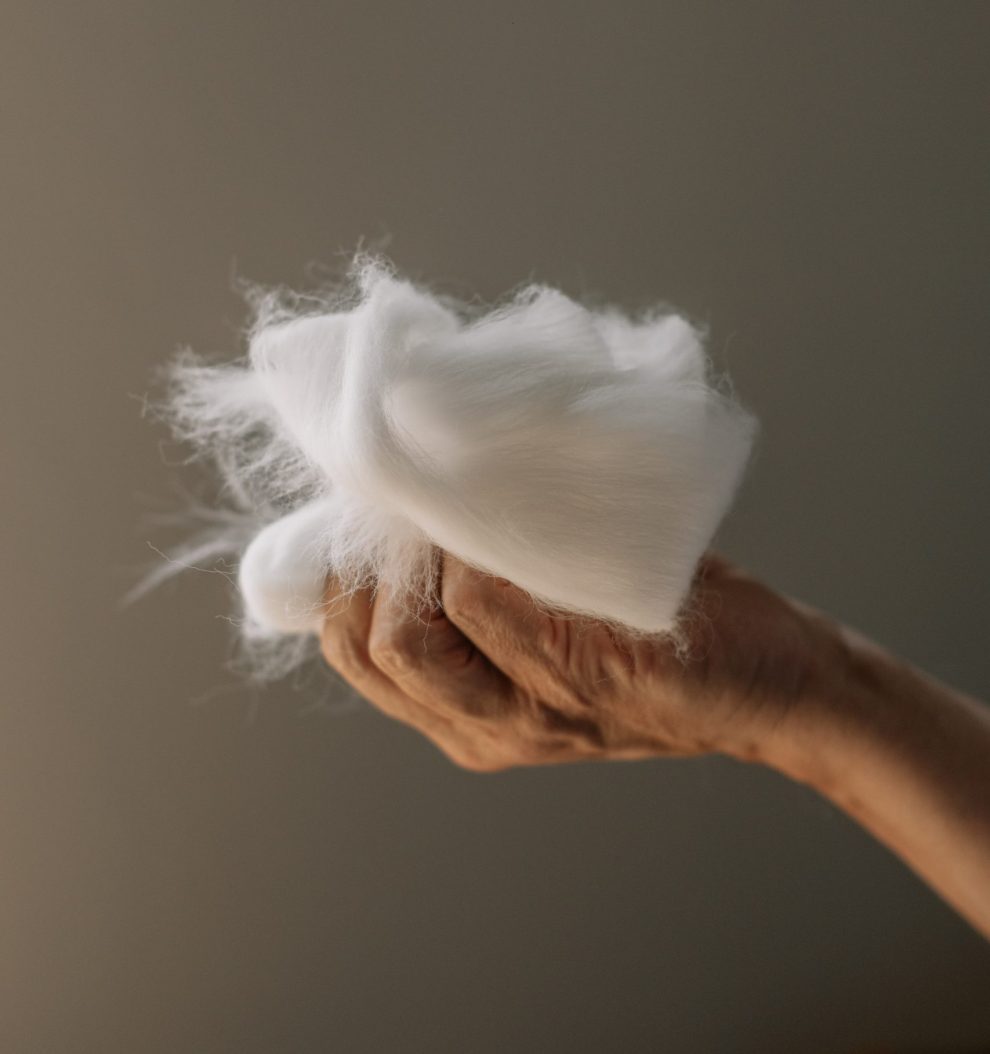
A new fiber category is coming to the American apparel market, as the U.S. Federal Trade Commission (FTC) has approved Renoa, a first-of-its-kind regenerated fiber developed by Everbloom. This marks the first new apparel fiber classification the agency has approved in almost 25 years. The decision establishes Renoa as its own fiber category and paves the way for textile products containing Renoa to be labeled and sold in the United States.
Developed in Everbloom’s New York City lab, Renoa is the world’s first fiber regenerated from keratin-rich textile offcuts and waste, including down. Made in the United States using domestic resources, Renoa transforms these materials into a novel fiber engineered for luxury aesthetics, consistency and scalability. It delivers the premium handfeel, breathability and softness associated with cashmere and wool while enhancing durability and longevity without compromising performance.
This FTC approval marks a historic milestone and signals significant innovation for the textile industry. While hundreds of new fabrics and textile blends have entered the market, creating a new FTC-recognized apparel fiber category requires demonstrating that the material is fundamentally distinct from existing fibers through a rigorous regulatory review. Beyond the regulatory milestone, Renoa is also the world’s first fiber developed using a proprietary artificial intelligence platform.
The milestone comes at a time when much of the U.S. fashion industry’s manufacturing base has shifted overseas. According to the American Apparel & Footwear Association, about 97% of clothing and footwear sold in the U.S. are imported, with much of the production concentrated in Asia.
“Renoa is the result of years of work by our material and computer scientists, chemical engineers and fashion designers to craft a circular fiber that combines the best of biology and human ingenuity to optimize handfeel and performance while dropping seamlessly into existing industrial infrastructure,” said Simardev Gulati, co-founder and CEO of Everbloom.
Powering Renoa is Braid.AI, Everbloom’s proprietary artificial intelligence platform that combines predictive modeling with thermoplastic protein engineering to optimize the transformation of keratin-rich proteins into high-performance fibers. By forecasting key fiber characteristics, including softness, strength, texture and dyeability, before production begins, Braid.AI dramatically accelerates material development and improves manufacturing stability, scalability and precision.
Because keratin-rich textile waste naturally varies in composition, creating a consistent, scalable fiber has historically been one of the industry’s biggest technical challenges. Braid.AI predicts how each protein stream will behave during production, enabling Everbloom to optimize production parameters before manufacturing begins. The result is a faster, more precise development process that reduces what once required two months of laboratory testing to just two weeks.
Those AI-driven insights are then translated into Everbloom’s patented production process, which begins by purifying and refining keratin-rich textile waste into its purest protein form. Through advanced engineering, those proteins are structurally enhanced and transformed into high-performance fibers compatible with existing yarn-spinning infrastructure and textile supply chains. The result is a new category of apparel fiber that combines the desirable qualities of luxury natural materials with the consistency and scalability required for modern manufacturing, all while enabling machine-washable cashmere and wool blends that bring easy care to luxury apparel.
The need for new material solutions is increasingly urgent, as the fashion industry accounts for roughly 10% of global greenhouse gas emissions and generates more than 20 billion pounds of keratin-rich textile waste each year. By transforming that underutilized waste into high-performance fibers, Renoa offers brands an alternative to resource-intensive raw materials.
“The global fiber market is more than a $1 trillion industry and has run on the same fossil-based chemistry for half a century, while most of the manufacturing base has moved to Asia,” said Gulati. “By combining our proprietary AI platform, Braid.AI, with advanced manufacturing, we’ve created an entirely new category of fiber and a real chance to rebuild America’s textile base around it.”
Independent assessments by Boundless Impact Research & Analytics show that Renoa uses more than 99% less water than silk production, 50% less than cashmere, and 30% less than wool. Renoa also generates up to 92% fewer greenhouse gas emissions than biorecycled polyester, silk, cashmere and wool. By transforming existing waste into a high-performance fiber, Renoa reduces reliance on grazing land and animal farming, helping protect fragile ecosystems and lessen the environmental burden of conventional luxury fiber production.
The approval follows Everbloom’s 2025 launch and a funding round led by Hoxton Ventures, with participation from SOSV, Breakthrough Energy, Endgame Capital, Clocktower Ventures and its latest investor, the Partnership Fund for New York City. With FTC approval secured, the company will continue scaling production and expanding partnerships with mills, manufacturers and global fashion brands.
“New York City is home to one of the world’s most iconic fashion industries, and Everbloom is using technology to fundamentally reshape how that industry operates,” said Maria Gotsch, president and CEO of the Partnership Fund for New York City. “By transforming a common agricultural by-product into high-performance fibers that rival wool, silk and cashmere, they’ve found an elegant solution to a real environmental challenge. We’re proud to be a part of Everbloom’s seed round and to support the next generation of sustainable materials innovation in New York City.”
With the new approval, brands can now label and commercialize products containing Renoa in the U.S. market. Several commercial programs featuring Renoa are already underway, and additional brand and manufacturing partnerships are expected to be announced in the coming months as commercial production scales.


