




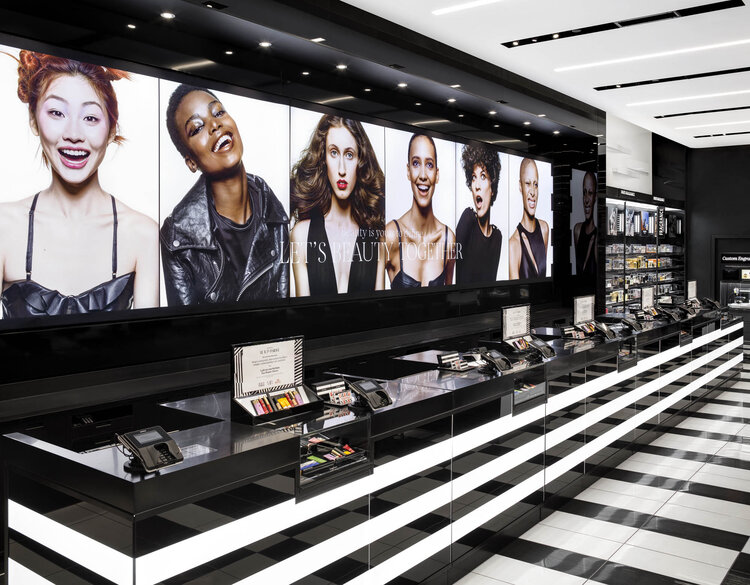
It’s unusual when retailers will offer the results of an internal study to the public at large (which, of course, includes its competitors), but that’s what Sephora U.S. has done with “Understanding Racial Bias in Retail,” a commissioned examination of conscious and unconscious biases in the industry.
The latest in a series of efforts that the retailer says underscores its pledge to mitigate racially-biased experiences and unfair treatment for shoppers, the report also provides a blueprint for changes the retailer will make to become more open and diverse. The plan includes increased diversity in its product offerings and workforce, more inclusive marketing programming and greater accountability through the institution of updated employee conduct policies. In June 2019, the company closed all of its U.S. stores for several hours to conduct inclusion workshops for its employees. The training also included employees in distribution centers and its corporate offices.
“At Sephora, diversity, equality and inclusion have been our core values since we launched a new kind of beauty retail destination in the U.S. over 20 years ago — but the reality is that shoppers at Sephora, and in U.S. retail more broadly, are not always treated fairly and consistently,” said Jean-André Rougeot, president and CEO of Sephora Americas, in announcing the report results. “We know that we’re in a strong position to influence positive changes in the retail industry and society at large, and it’s our responsibility to step up. We’re committed to doing all we can to make our U.S. retail experience more welcoming for everyone. … We know it will be a journey, but we’re committed to holding ourselves accountable to this mission for the benefit of our clients, our employees, our communities and the retail industry at large.”
Comprised of academic literature reviews, cultural insights analysis and comprehensive qualitative and quantitative research, the national study was conducted over a year-long period, beginning in the fall of 2019 and ending in late 2020 and was designed to measure the issue of racially-biased experiences in U.S. retail and to identify opportunities to end unfair treatment.
The report comes at a time when corporate values are ever more important to shoppers. In a 2019 analysis of inclusivity and diversity (I&D) in retail, Accenture reported that 42% of ethnic minority shoppers, and 29% of all shoppers, would switch to a retailer committed to I&D. A number of retailers, including Walmart, Macy’s, L Brands and Ross stores have named chief diversity officers, and the National Retail Federation, which held its Big Show virtually in January, offered a series of sessions on diversity within the industry, covering marketing, amplifying Black businesses and hiring practices. But from the Sephora report’s results, there is still much work to be done.
The problems, the report reveals, are on both sides of the sales counter. Two in five U.S. retail shoppers have personally experienced unfair treatment on the basis of their race or skin tone, while one in five employees report having personally experienced unfair treatment based on their race at their place of work, either from customers or coworkers. Black retail shoppers are two-and-a-half times more likely than white shoppers to receive unfair treatment based on their skin color (44% vs. 17%), while Black, Indigenous and people of color (BIPOC) shoppers are two times more likely than white shoppers to receive unfair treatment based on their ethnicity (30% vs. 15%). One in three retail employees have thought of quitting when they experienced racial bias and unfair treatment (31% for all employees; 37% for Black employees).
Diversity fails from the very beginning of the shoppers’ journey. Three of four (74%) of retail shoppers said that marketing fails to showcase a diverse range of skin tones, body types and hair textures. It continues inside, with insufficient stock of items owned by and made for persons of color, an observation made by 78% of respondents.
In addition, there’s a genuine disconnect between sales associates and shoppers. BIPOC retail shoppers are three more likely than white shoppers to feel most often judged by their skin color and ethnicity (32% vs. 9%). White shoppers, on the other hand, are more likely to cite factors like age (27% vs. 12%) or attractiveness (13% vs. 7%), as the primary basis of the treatment they face. Meanwhile, three in five retail employees cited behavioral attributes rather than physical attributes when determining how to approach or interact with shoppers. The result is that BIPOC customers are more likely to shop online to avoid in-store bias.
Instead, retailers can focus efforts to make the shopping experience more inclusive and welcoming for all. The findings show that BIPOC shoppers have needs that hold greater importance in helping them feel welcome compared to white shoppers in creating a positive in-store experience, including promptly being greeted and offering assistance when shoppers enter the store, telling shoppers about new products, offers and services and having store associates who “look like me.”
Sephora’s plan encompasses marketing practices such as doubling its assortment of Black-owned brands, advertising and featuring Black-owned brands through a dedicated tab on its website, cultivating BIPOC-owned and -founded brands and continuing to diversify its influencer group. In-store, the company will launch a new greeting system across all stores, create new training modules on client engagement for Beauty Advisors and improve client feedback systems. The company also pledged to build new recruiting and career development programs for employees of color.
“We’re proud of the work we’ve done thus far to make diversity, equity and inclusion a priority for the company,” Rougeot said. “We are stronger as a retail community when we are serving the needs of all of our shoppers and hope other retailers will join us, with the ultimate goal of advancing inclusivity and improving the retail experience for all.”


