




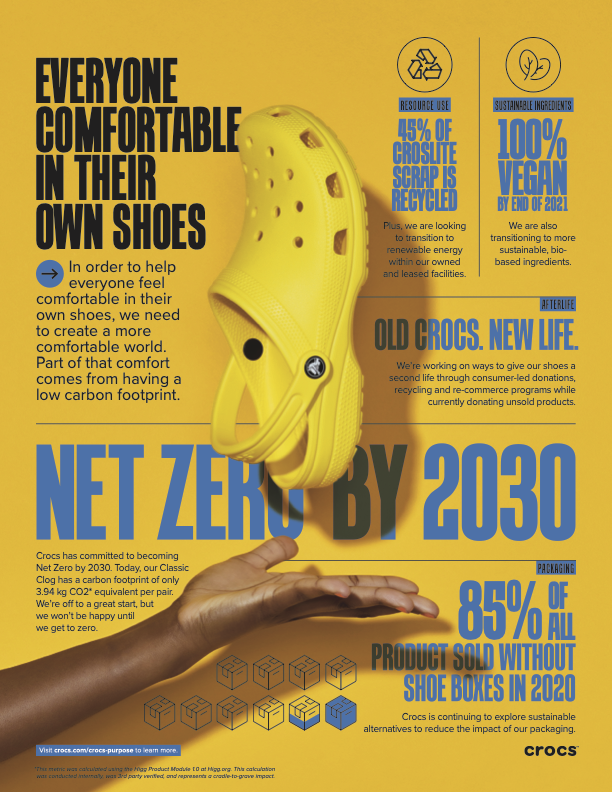
Crocs’ journey will address the entire value chain with a strategic focus on sustainable ingredients, packaging, product afterlife and resource use
Crocs, Inc., a global leader in innovative casual footwear for women, men and children, announced a major step in its sustainability journey – a commitment to becoming a net zero company by 2030. As a brand that believes everyone should be comfortable in their own shoes, Crocs is taking action to create a more comfortable world, considering every piece of its business and searching for impactful ways to reduce environmental impact and waste.
Crocs’ inherently simple approach to design, the materials it uses and how its shoes are manufactured mean that their Classic Clog already has a low carbon footprint today. To achieve its 2030 goals, Crocs is taking it a step further with a strategic focus on sustainable ingredients and packaging, as well as investments in resource use and innovative product afterlife solutions.
At 3.94 kg CO2 eq. per pair of Classic Clogs*, Crocs shoes already have a low footprint and by the end of 2021, Crocs will be a 100 percent vegan brand. Currently, Crocs is finalizing its approach to a more sustainable bio-based Croslite material, the predominant material in its footwear. Currently, 85 percent of all Crocs shoes were sold without boxes in 2020, reducing the brand’s impact on environmental resources. Crocs will continue to explore sustainable alternatives for all other elements of its packaging.
To keep shoes on feet and out of landfills, Crocs donates thousands of pairs of unsold shoes to those in need. While Crocs explores a circular supply chain, the brand is also working on ways to give Crocs shoes a second life through consumer-led donations, recycling and re-commerce programs. Currently, 45 percent of all Croslite material production scrap is recycled. Crocs will continue to explore ways to minimize its impact, including transitioning to renewably sourced energy in its offices and distribution centers. Where this isn’t possible, Crocs will purchase carbon credits to offset any remaining emissions, leveraging the most impactful sources available.
“Taking action to reduce our environmental footprint by implementing more sustainable practices across our entire business is the right thing to do for Crocs,” said Crocs CEO Andrew Rees. “As a company, we are deeply committed to accountability and we’re confident that we have the right team, the right innovations and the right partners to help us achieve our net zero ambitions by 2030.”
In addition to reducing its environmental footprint, Crocs remains committed to its brand purpose as a vocal advocate for community and inclusivity, creating a welcoming environment for everyone, rooted in governance, transparency and accountability. As part of this mission, Crocs continues to provide shoes, funds and time in times of need through its Crocs Cares program while ensuring that the brand welcomes all one-of-a-kinds both internally and externally.
*This metric was calculated using the Higg Product Module 1.0 at Higg.org. This calculation was conducted internally, was third-party verified, and represents a cradle-to-grave impact.


