




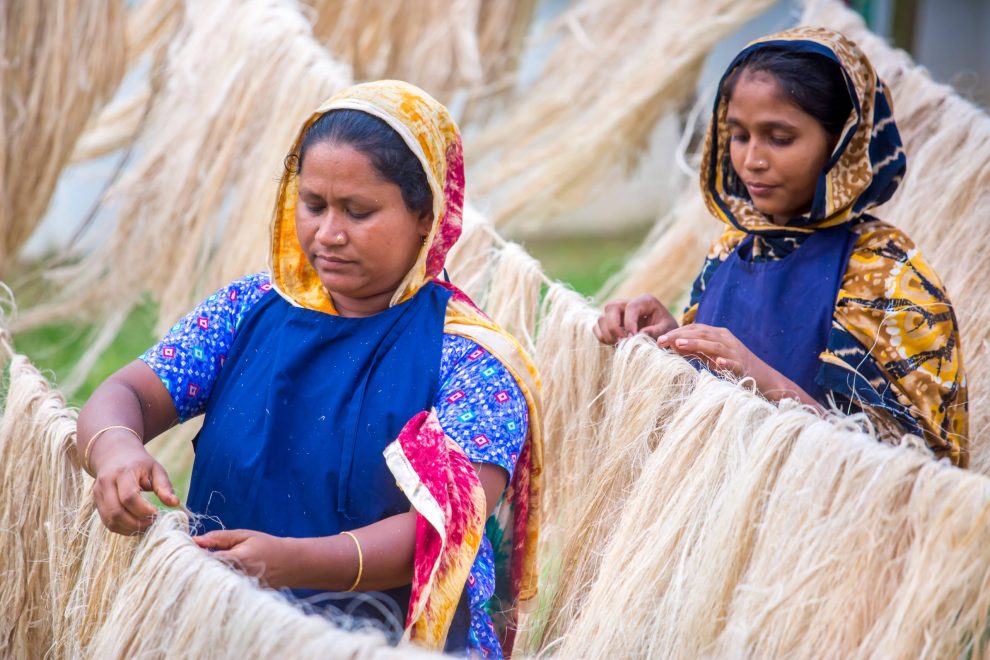
Women working in the Bangladesh garment industry have been heavily affected by the COVID-19 pandemic and the associated disruptions in the sector, according to the findings of an international study published in January. The research, which sets out a series of industry and government policy recommendations, focused on the experiences of Bangladeshi workers employed in the ready-made garment (RMG) industry, which supplies clothing and fashion products to multinational companies across the Global North, including many well-known U.K.-based High Street brands.
The study, published by researchers at the University of Aberdeen and trade justice charity Traidcraft Exchange U.K., shows that the immediate impact of COVID-19 and some of the actions taken by retailers —such as canceling orders, refusal to pay for work in progress and demands for discounted prices — disproportionately impacted the vulnerability of women workers by contributing to an increase in gender violence, abuse and economic hardship. Traidcraft Exchange is an international development charity which uses the power of trade to bring about lasting solutions to poverty. The charity runs development programs in South Asia and Africa, works directly with businesses to improve their supply chains and does advocacy and campaigning in the U.K. to promote justice and fairness in international trade. It works closely with specialist fair trade company Traidcraft plc.
The study found the pandemic exacerbated interrelated vulnerabilities in economic, job, food and housing security, as well as health and well-being, with women workers struggling to support themselves and their families.
The RMG industry is the mainstay of the Bangladesh economy, accounting for 85% of export earnings, about 20% of gross domestic product (GDP) and directly employing about four million workers, with more than 12 million people in total dependent on the sector. The in-depth research saw face-to-face interviews carried out with female and male garment workers, factory managers, industry leaders and trade unions over the course of eight months between November 2020 and July 2021, as well as discussions with a number of development agencies and international advocacy non-governmental organizations (NGOs). It found that some employers refused to let workers return after lockdown, and most who did return said they had been forced to sign new contracts, losing access to benefits and protection they had previously accrued.
The research also found an increase in intimidation and threats, violence and restriction of movement. Legal protection for women workers is limited, as are the grievance mechanisms in place. Those which do exist were said to be often disregarded with impunity by many factory owners and managers. Compliance audits carried out by companies were found to be largely ineffective, with around 20% of social compliance auditors not including women’s equal rights issues in its audits, and 40% not auditing the right to trade union recognition.
“The majority of workers in the RMG industry in Bangladesh are women who are young, poorly educated and from rural areas with few alternative employment options. They are especially vulnerable to exploitation,” said Project Lead Muhammad Azizul Islam, professor in sustainability accounting and transparency at the University of Aberdeen Business School. “During pandemic time, workers could not afford to be sacked. These devastating impacts were heightened and, in some cases, directly caused by retailers and brands selling into the U.K. and other markets in the Global North.”
The country is signed up to the international frameworks for promoting gender equality, including employment, however, the research has found there are significant gaps in the labor laws in Bangladesh. Even when international frameworks have been incorporated into domestic law, they are disregarded by many employers and rarely enforced.
A unique collaboration between business researchers, social science scholars and social and civil society organizations, the research has identified a number of policy recommendations for Bangladesh and U.K. governments, as well as Bangladeshi manufacturers and U.K. retailers.
“U.K. retailers and brands should consider only sourcing products from suppliers with policies and mechanisms in place that protect workers’ rights and address gender harassment, abuse and gender discrimination. They should also require independent audits — covering both manufacturers and sub-contractors — to include this as a priority,” added Islam.
Fiona Gooch, senior private sector policy advisor with Traidcraft Exchange U.K., said, “U.K. fashion brands’ purchasing practices are among the most abusive and least regulated in the world. A key recommendation in this report is that the U.K. set up a fashion watchdog to stop abusive practices in its supply chains. This would help protect garment workers in Bangladesh and other countries, including the U.K., from having to risk working in abusive and unsafe situations, where conditions sometimes resemble slavery.”
The project was funded by the Modern Slavery and Human Rights Policy and Evidence Centre (Modern Slavery PEC) through the Arts and Humanities Research Council (AHRC) as part of the funding call for research on the impact of the COVID-19 pandemic on modern slavery. The Modern Slavery and Human Rights Policy and Evidence Centre was created by the investment of public funding to enhance understanding of modern slavery and transform the effectiveness of law and policies designed to address it. The Centre commissions and co-creates high quality research with a focus on policy impact and brings together academics, policymakers, businesses, civil society, survivors and the public on a scale not seen before in the U.K. to collaborate on solving this global challenge.
“This research adds to other evidence published by the Modern Slavery PEC and others and confirms that the pandemic has particularly affected already vulnerable groups,” said Professor Alex Balch, director of Research at the Modern Slavery PEC. “Businesses and governments need to do more to address particular risks that women face in the garment industry, often producing clothes sold on high streets across the world.”
The research team comprised of Professor Muhammad Azizul Islam, Professor Pamela Abbott and Dr Shamima Haque of the University of Aberdeen, Fiona Gooch of Traidcraft Exchange U.K. and Salma Akhter of Dhaka University.


