




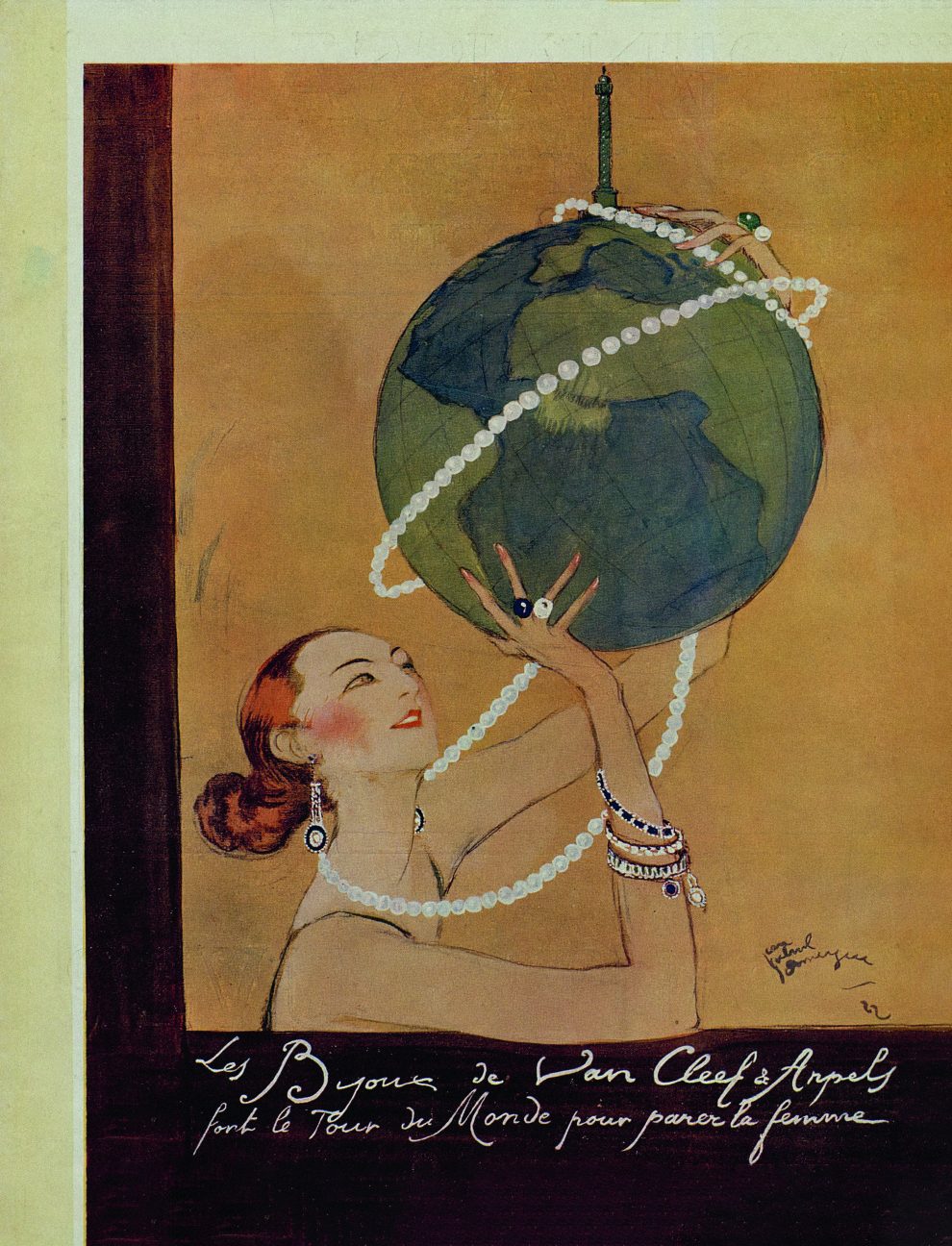
This year, L’École, School of Jewelry Arts, supported by Van Cleef & Arpels, is celebrating the centenary of the International Exhibition of Modern Decorative and Industrial Arts and featuring a major art movement of the twentieth century: Art Deco.
This style, which emerged in the 1900s and reached its heyday in the 1920s, left a lasting mark on art forms often overshadowed by the fine arts, including fashion, design and jewelry. L’École is honoring the movement with an exhibition at the Hôtel de Mercy-Argenteau, on display through June, offering a majestic exploration of the pearl, a material favored in Art Deco jewelry design.
We are all familiar with pearls. Sought-after since ancient times, they still inspire the great modern jewelers. But how many people know that they were at the heart of an intense trade between the Persian Gulf and France from the late 19th to the mid-20th century? How many remember that they were at the center of the luxury industry and Parisian culture for decades?
Organized by L’École, School of Jewelry Arts, the exhibition, “Paris, City of Pearls,” recounts the forgotten history of this amazing artistic, commercial and human adventure.
From the late 1860s to the late 1930s—a period corresponding to France’s Third Republic—a majority of the pearls fished in the Persian Gulf were gradually brought to France, sold in Paris and mounted by the top jewelers of the Place Vendôme. Account books, telegrams, archive documents and period photographs testify to the scale of this trade. Routes across land, sea and then sky were opened, major figures emerged in both the Persian Gulf and France, fortunes were made and the pearl trade sparked an unprecedented economic boom. As new trade routes were developed, links were forged between people and cultures—from the France of the first third of the 20th century to the Persian Gulf countries, referred to by the French at the time as the “pearl coast.”
As well as celebrating almost a century of shared history, this exhibition sets out to show the extent to which both natural pearls and the cultured pearls that arrived in France in the 1920s inspired not only Parisian jewelers but also artists in the broader sense. They all seem to have been driven by the same passion for pearls, whatever their means of artistic expression—opera, painting, photography, poster design, illustration or cinema—to the point that the pearl became one of the symbolic forms of the Roaring Twenties.
Seeking to penetrate the final mysteries of these biominerals, the exhibition embraces a crossover of history, art and science. This wide-ranging vision of knowledge is at the heart of L’École’s mission. Founded in 2012 with support from Van Cleef & Arpels, L’École invites the public to learn about the history of jewelry and the skills involved through classes, talks, publications and exhibitions in Paris and elsewhere in the world.
Through supporting research and enabling the rediscovery of this extraordinary Parisian pearl saga, L’École, School of Jewelry Arts confirms its determination to contribute not only to an awareness of the culture of jewelry but also to deepening knowledge.
The exhibition, “Paris, City of Pearls,” presents a hundred pieces from about 20 of the most prestigious lenders, such as the Paris Museum of Decorative Arts, the Petit Palais (City of Paris Museum of Fine Arts), heritage collections from Van Cleef & Arpels, Cartier and Fred, and the exceptional Albion Art private collection.
After a gemological introduction on the origins of pearls, the exhibition traces the history of jewelers’ passion for pearls from the late 19th century to the present day through six parts:
- The pearl and its secrets
II. Pearls and the East
III. 1900: Conquering the market
IV. The 1910s: The pearl as a symbol of modernity
V. 1925: Pearl mania in Paris
VI. The pearl trade from then to now
The exhibition’s scenography, designed with a sensory approach, awakens visitors’ senses—sight, hearing and touch. A visual guide giving access to an additional iconography of about 80 drawings, illustrations and other visuals extends the visitors’ immersion in the world of pearls and their discovery of the imagery around the pearl, from the Belle Époque until today.


