




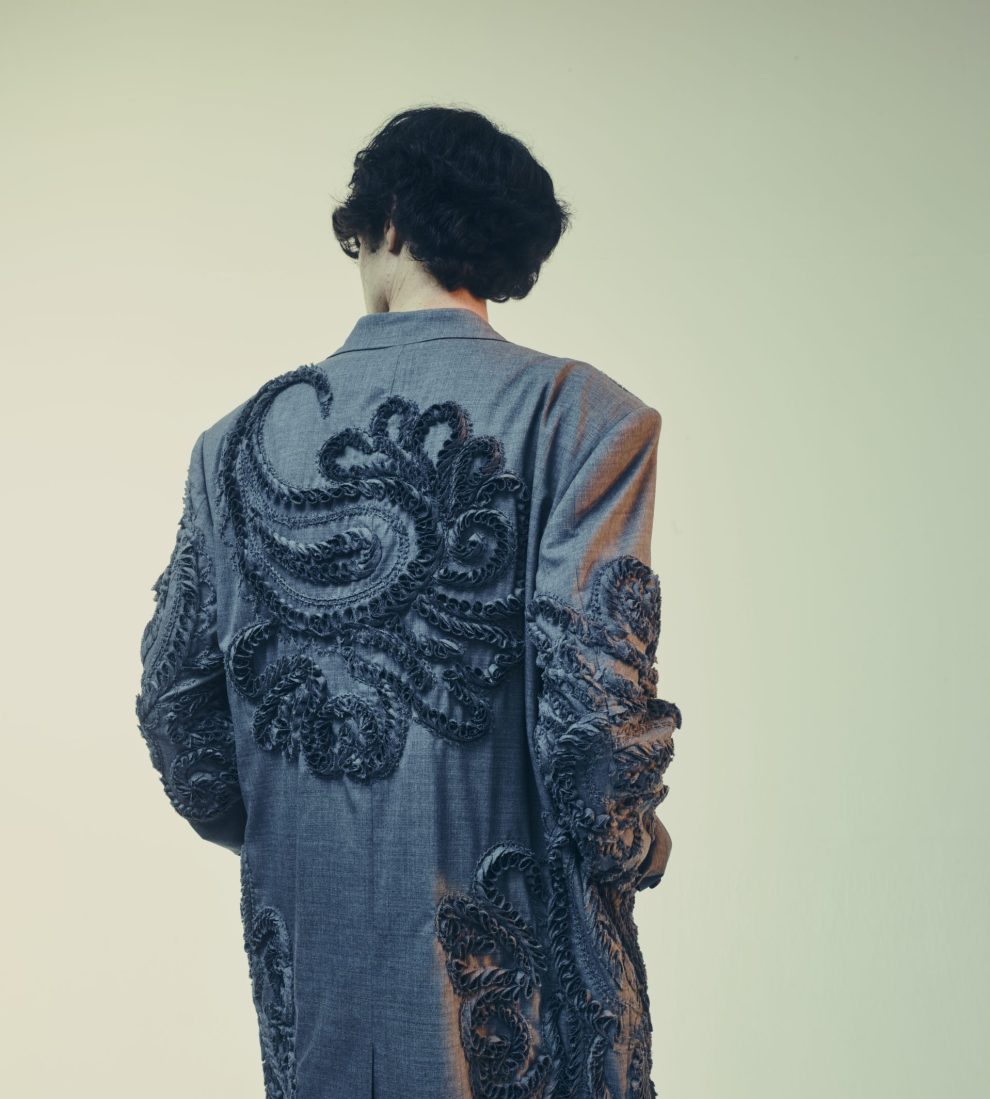
As the international menswear calendar turns once again to Paris, anticipation builds for designers whose work continues to shape the global conversation around fashion. Among them is Taakk, the Tokyo-based menswear label founded by designer Takuya Morikawa, who will return to the Paris Fashion Week men’s schedule in January 2026 to unveil his Fall/Winter 2026 collection. In parallel, Taakk’s Spring/Summer 2026 collection arrives in stores in February, offering a timely moment to reflect on the brand’s philosophical core and its latest exploration of clothing as both art and everyday necessity.
Established in Tokyo, Taakk has steadily earned its place on the international stage through Morikawa’s singular approach to design—one that balances technical experimentation with poetic restraint. A graduate of Tokyo’s prestigious Bunka Fashion College, Morikawa spent eight formative years at Issey Miyake, where his understanding of fabric, form and innovation was sharpened under the guidance of one of Japan’s most influential fashion houses. Since launching his own label, that foundation has evolved into a distinct design language rooted in curiosity, craftsmanship and quiet disruption.
Morikawa’s achievements reflect the industry’s recognition of that vision. Taakk has received numerous honors, including Best New Designer at the Tokyo Fashion Awards in 2014 and 2017, the Fashion Prize of Tokyo in 2019—awarded by the Tokyo Metropolitan Government and the Japan Apparel Fashion Industry Council (JAFI)—and a finalist position for the LVMH Prize in 2021. Yet accolades have never been the end goal. Instead, Taakk has remained focused on the slow, deliberate pursuit of what Morikawa describes as “the essence of creation.”
That pursuit is at the heart of Taakk’s Spring/Summer 2026 collection, titled “The Common Baseline of Art and the Ordinary.” The season continues an ongoing dialogue within the brand: Where does art end, and where does everyday life begin? Rather than framing the two as opposing forces, Morikawa positions them as coexisting realities— ntertwined, inseparable and constantly informing one another.
“We are in the midst of a journey,” Morikawa explained. “A journey in pursuit of the essence of creation.” For Spring/Summer 2026, that journey manifests as a meditation on dualities: utility and expression, familiarity and surprise, comfort and challenge. The result is a collection that feels grounded yet quietly provocative—clothing that does not demand attention but rewards it.
At first glance, silhouettes appear recognizably wearable: tailored jackets, relaxed trousers, layered shirting and lightweight outerwear suitable for daily life. Look closer, however, and Taakk’s signature sensibility reveals itself. A seam subtly twists off course. A fabric behaves unexpectedly against the body. A surface that appears simple reveals depth through texture, translucency or shadow. These moments of “quirk,” as Morikawa describes them, become points of curiosity—gentle disruptions that reframe the familiar.
This tension between the known and the unexpected is central to the collection’s emotional impact. Taakk does not seek shock value; instead, it creates garments that slowly unfold through wear and experience. The clothes ground the body while simultaneously awakening the senses—an approach that aligns with Morikawa’s belief that true creativity exists not in extremes but in the space between them.
Fabric innovation remains one of Taakk’s defining strengths, and Spring/Summer 2026 is no exception. The collection is built through close collaboration with Japan’s master artisans—specialists in weaving, dyeing, embroidery and textile processing, whose knowledge has been refined over generations. Together, Morikawa and his team challenge conventional definitions of fabric, reconstructing materials into new forms that blur the boundary between textile and artwork.
“When one looks at a piece of our clothing, it may appear intentional in every aspect,” Morikawa said. “But for me, it is only a fragment of imagination made visible—one moment captured from years of experimentation.” That philosophy underscores the brand’s process: garments are not conceived as final answers but as points within a much larger continuum of inquiry.
This openness to experimentation allows Taakk to continually redefine what modern menswear can be. The brand’s multidisciplinary approach—informed by art, architecture and material science—resists trend-driven narratives in favor of timeless exploration. Each collection builds upon the last, not through repetition but through evolution.
As menswear month begins in Europe and Taakk prepares to present its Fall/Winter 2026 collection in Paris, Spring/Summer 2026 serves as a compelling reminder of why the brand commands such global attention. It is not simply about innovation for its own sake but about asking essential questions: How do we live with clothes? How do they make us feel? And how can fashion quietly reshape our relationship with the ordinary?
With “The Common Baseline of Art and the Ordinary,” Taakk offers no definitive answers—only beautifully considered possibilities.


