




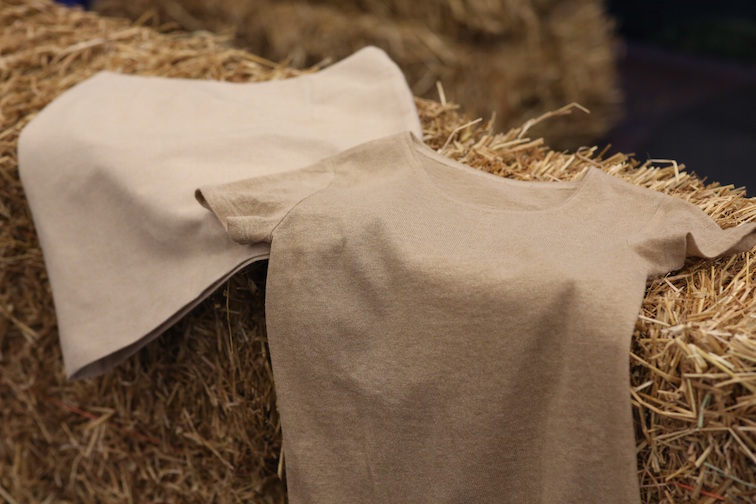
Fortum and Spinnova showed the world’s first clothing made from agricultural waste, namely wheat straw, at the Textile Exchange Sustainability Conference in Vancouver. The showpieces included a knitted t-shirt, as well as a jacket and skirt made of a woven fabric on organic cotton warp.
Fortum, a major European energy company building business options in the circular economy, together with the sustainable fibre technology company Spinnova, have introduced the first prototype product born out of their joint development using wheat straw in the production of highly sustainable textile fibre.
The prototype material is unique due to its extremely low environmental impact from raw material extraction, processing and manufacture, verified by life-cycle analysis (LCA).
“We are very excited to present this revolutionary textile,” said Heli Antila, vice president of biobased solutions at Fortum. “Today, wheat straw is mostly discarded or even burned in the fields. As it can now be used in numerous textile applications, this opens up huge possibilities globally. This cooperation is a tangible step towards Fortum’s strategy to build options for significant new businesses that improve resource efficiency and provide smart solutions for a cleaner world. We would like to invite more key industry players to join us in this journey.”
The parties announced their partnership earlier this year after testing various biomasses. The showcased straw was first processed with highly sustainable fractionation technology, developed by Fortum’s associate company Chempolis Oy. Spinnova’s technology, presently in a piloting phase, turns microfibrillated cellulose (MFC) directly into fibre mechanically without any dissolving or harmful chemical processes. Fibres of the now showcased clothing were produced in Spinnova’s pilot facility in Finland, which also means that Spinnova’s technology can be applied to various biomasses without further technology development.
“We are all very proud of this amazing collaborative accomplishment,” said Spinnova’s CEO Janne Poranen. “This was a very fast journey from the first trials to real, appealing fabric materials. This shows that wheat straw-based fibre is well on its way to being a drop-in product of the most sustainable kind.”
Fortum and Spinnova plan to establish sustainable fibre production in Fortum’s future biorefineries that will use residual biomasses, such as agro waste. The biomass will be processed into materials for bioproducts of lignocellulosic origin, as well as cellulosic products. The refineries will be based on fractionation technology, enabling highly resource-efficient utilisation of wheat straw and resulting in significantly lower environmental impact compared to other processing technologies.


