




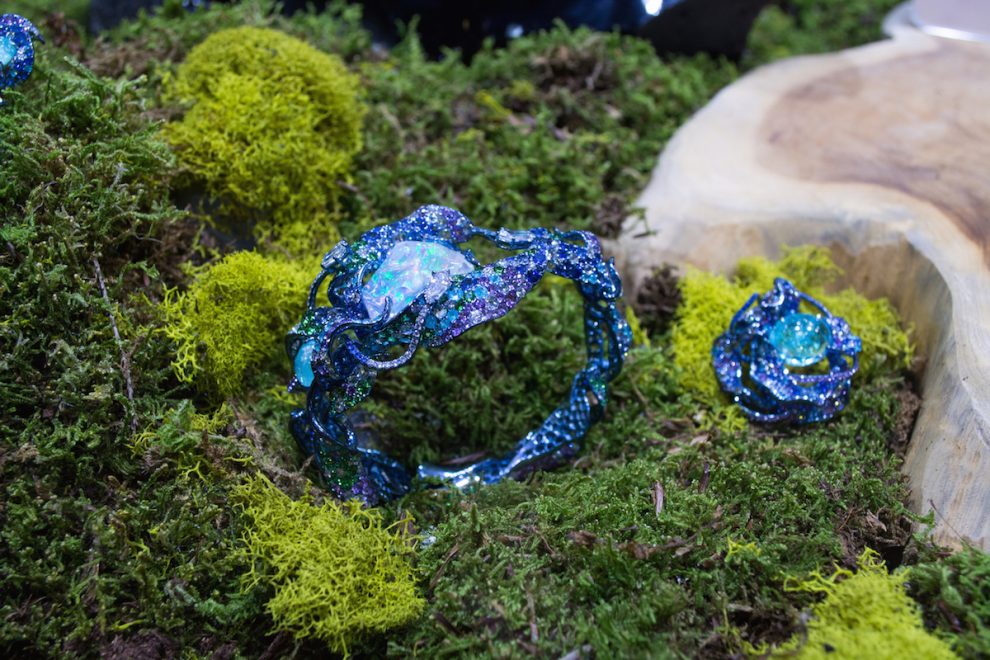
Initiatives in Art and Culture’s (IAC) 21st anniversary fashion conference, devoted to the color blue, was held to support the group’s project partner, the School of Fashion at Parsons School of Design.
“For the 21st annual Fashion, Jewels + Design Conference, IAC focused on blue, believing that this particular hue — the color of sea and sky — is one of the most elemental, and therefore powerful, purveyors of color,” said Lisa Koenigsberg, president of IAC. “We were honored to welcome and discuss the work of great designers, jewelers, journalists, design pioneers and other authorities to consider blue, which, as a color, is a signifier so direct no text is required.”
The elegant space hosted a blues ensemble, playing jazz and setting the ambiance for an alluring weekend of activities. Kimberly Chrisman-Campbell, author of “Worn on This Day,” provided a sneak peak of her book, which features 365 days of style and provenance, sharing the stories of outfits that made history.
“We are deeply appreciative of the engagement and support of our project partner, the School of Fashion at Parsons School of Design,” Koenigsberg continued. “Additionally, we express our warmest thanks to Louis Vuitton for an informative and elegant evening, and to 3 x 1 and Vogue Italia Salon Art + Design for providing enriching experiences to attendees. This year, as has been the case for two decades, the conference fused a focus on materials, craft, and authentic experience with a concern for ethical practice and responsible sourcing, using a cross disciplinary approach.”
Cameron Silver (Fashion Director, Halston) and Andrew Gelwicks (celebrity stylist) also captivated with the blockbuster in conversation, “It’s Chic to Repeat.” Together, they discussed the proliferation of clothing on the earth (100 billion garments for 7 billion humans) and the need to focus on re-wearing rather than constant acquisition. Instead of focusing on who wore it better editorials, they suggested, media should discuss who styled something better. Wearing a garment repeatedly is a celebration of ownership, and there was a lively discussion about the relationship between having a signature style and re-wearing.
Talks at The New School continued with Roland Ricketts (professor and associate dean, Eskenazi School of Art, Architecture and Design, Indiana University). A indigo farmer trained in Japan, he explored farming, dyeing and fading of the blue hue, from its historical to its present significance. After, Stan Herman (fashion designer) and Bridget Foley (executive editor, WWD), discussed Herman’s body of work; Herman is renowned internationally for designing corporate uniforms for companies such as Amtrak, JetBlue, TWA, Federal Express, United Airlines and more. His signature uniforms are designed for longevity, everyday wear and comfort, usually featuring many pockets and often incorporating the color blue.
Next, Brandon Avery (VP, Global Innovation) and Jessica L’Abbe (Senior Director, Materials and Graphics) of Converse spoke. Considering innovation through two lanes — functional and emotional — the company discussed dedicating resources to partnerships and incubating ideas. The Converse Renew program was introduced as an ongoing initiative seeking to develop new, innovative and sustainable ways of creating product. For example, Converse experimented with creating denim sneakers with upcycled textiles, and is currently working on creating a line of Chuck Taylors from recycled plastic.
Dana Thomas (author, “Fashionopolis: The Price of Fast Fashion and the Future of Clothes”) also discussed sustainable technologies being used to produce better fashion. She highlighted outstanding companies with traceable supply chains, which are using ecological power, refusing to purchase from suppliers sourcing from the rainforest and otherwise imperiling environments and which are using reclaimed materials. Thomas discussed strides being made in sustainable indigo farming, as well as a greener way to distress denim on a mass level.
Grant Mobley (U.S. trade lead, Diamond Producers Association) shared a video highlighting the transformation of a diamond. Discussing the relationship between diamonds and emotions – most notably, love – the symbolism of the precious gems was shared, as were insights into the particular rarity of blue diamonds and their resultant privileged place.
Kade Johnson and Sergio Guadarrama (fashion designers, Celestino) presented “Celestino Couture: Fluidity, Artisanry and Sustainability.” Politically active and socially aware, Celestino is passionate about making a statement — with dresses pushing boundaries, such as the confines of traditional definitions of gender, being used as a means of providing access to theatre classes for marginalized kids, and as a vehicle for promoting issues, such as reproductive rights. In the fashion industry and the world, Celestino feels it is important to “exist without oppressing another person, no matter where they come from.”
“Oftentimes, we look at [our garments] as a form of a warrior garment for a woman,” said Johnson. “She’s strong, she’s confident, she’s powerful, no matter what she’s wearing.”
The talk entitled “Blue Notes” discussed how the blues, and the men and women who make it, influence other forms of artistic expression — from fine art to fashion. Arthur Elgort (fashion photographer) and Hank O’Neal (photographer, author and jazz impresario) shared anecdotes from the jazz industry, celebrating style, photography and the beauty behind the blues.
Then came “Blue: Human Patrimony. Extracting and Transforming Precious Substances into Objects of Desire,” with Michael Peters (CEO, Trusted Gems & founder, Panjshir Valley Emeralds) and Elle Hill (CEO, Hill & Co. Fine Jewelry Launch and Growth Experts). Fashion designers Zandra Rhodes and Anna Sui spoke with Joan Agajanian Quinn (former West Coast editor, Interview), about their experiences having museum shows, their mutual admiration of each other’s work, on inspiration, and about working primarily in textile design, as opposed to fashion design. Ann Sui designs locally and prints overseas, whereas Zandra got her start hand screening prints with her boyfriend at their London studio, saying “the print created the shapes.”
“I am very, very, very pleased to be a part of the November fashion conference,” said Quinn. “I have been coming to New York, not only for the fashion conference, but for Lisa’s jewelry conference as well. I am astonished twice a year at the scope of content, the cultural importance and the high caliber of participants and lectures that are socially relevant. She is brilliant in the way she puts things together.”


