




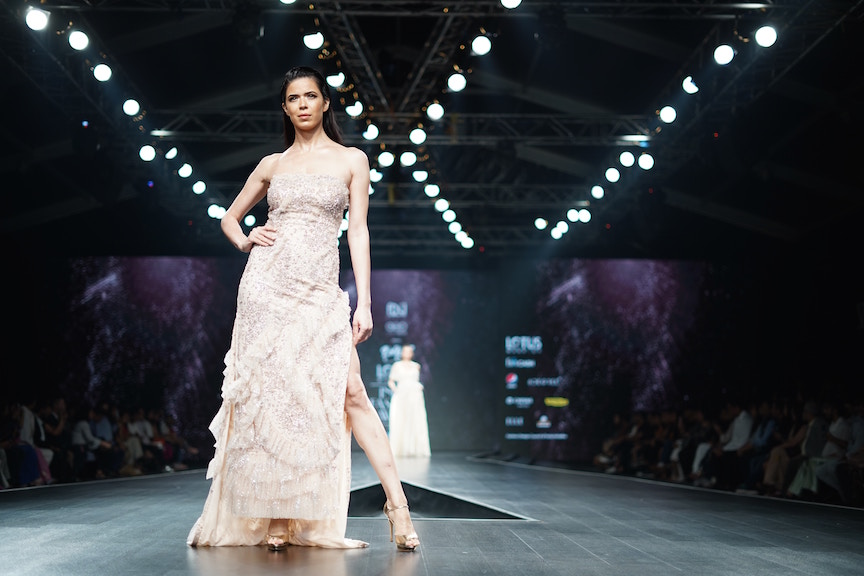
In honor of “the Women’s Issue,” let us salute the women of fashion (not to fret, gentlemen! Next month’s article will honor the men). If it were not for these women, the American fashion industry would still be that of simple garment manufacturing.
During both World Wars I and II, the lack of fashions coming from Paris compelled the United States to create its own foundation which would become uniquely American. This crisis led New York apparel manufacturing companies to transform from cut-and-sew operations into fashion business models following their own instincts rather than the edits of Paris designers.
Jessie Franklin Turner (1881-1956)
Turner was one of the first American designers to create unique designs rather than copying Paris fashion. She began her career as a lingerie buyer for Bonwit Teller in 1916. While there, she worked in Bonwit’s custom salon creating designs for its well-to-do customers. By 1923, she opened her own shop. Turner was known for flowing tea gowns and exotic evening dresses completely of her own design. French designer Paul Poiret dubbed her as “the only designer of genius in the United States.”
Edith Head (1897-1981)
Meanwhile, on the West Coast, Hollywood was creating an escape from the war and hard economic times through movies. In these make-believe stories, actresses could distract themselves with the wonderful costumes of Edith Head. Head designed for such iconic actresses as Mae West, Dorothy Lamour, Elizabeth Taylor and Joan Crawford. Although her career never took her away from the motion picture studio, she inspired young designers for many decades to come.
Hattie Carnegie (1886-1956)
Carnegie’s career began in 1909. She was known mostly as hat designer. Carnegie didn’t know how to cut or sew, but she had an eye for style. In response to the Second World War, she designed a dress published in Life magazine that home sewers could make for $5 but would cost $175 if made by Carnegie. She is best known for “the little Carnegie suit,” which featured a buttoned-up jacket with a small, face-framing collar, a nipped waist and a straight over-the-knee skirt. Toward the end of her career, she designed uniforms for the Women’s Army Corp (WAC) which were so timeless, the designs remained in use until 1968.
Vera Maxwell (1901-1995)
Maxwell started her career in fashion as a model and a sketch artist in the late 1920s. She designed for many years for other manufacturers until 1949, when she opened Vera Maxwell Originals. Her designs featured after-ski clothes, tennis outfits and riding apparel. Maxwell was part of pioneering group of American designers known for more relaxed American clothing. By 1950, she was also designing evening wear. Maxwell is best known for being the first designer to use Ultrasuede.
Adele Simpson (1903-1995)
As a child, Simpson performed in vaudeville as a dancer. She was technically trained at Pratt Institute and began working as a ready-to-wear designer. By 1949, she formed her own company, introducing medium-priced clothing. Simpson’s designs were adapted from French couture, and her label was highly visible in many prominent U.S. retail stores. Simpson dressed three First Ladies: Lady Bird Johnson, Pat Nixon and Barbara Bush.
Claire McCardell (1905-1958)
McCardell studied fashion in Paris and began designing in 1930. Most designers shunned the more basic fabrics, like denim and calico, but McCardell turned these fabrics into her claim to fame. She popularized the American style of clothes that were practical but still fashionable, becoming known as the inventor of American sportswear. She pioneered matching separates. Not influenced by European designs, she used art and streetwear for inspiration. Some of her innovations were sashes, spaghetti string ties, menswear details (which would become a trademark) and the modernized dirndl skirt.
Bonnie Cashin (1908-2000)
Cashin’s career began in theater costume design. In 1937, she reluctantly accepted a job working in a sportswear manufacturing company. She hesitated in taking a job where the profit margin was so important. During World War II, Cashin designed military uniforms for women. By 1949, she had designed her first sportswear collection under her own name, with which she popularized American sportswear. She also created the first-ever designer flight attendant uniform for American Airlines. Cashin is credited with creating the layering concept and the use of leather, mohair and hardware in her designs.
Pauline Trigère (1908-2002)
Trigère’s father was a tailor, and her mother was a dressmaker, so one could say she was born with fashion in her blood. Born and trained in Paris, she fled to the U.S. to escape the looming Nazi threat to France. In 1942, Trigère launched her first collection. She did not sketch but rather cut and draped from fabric directly to the body. Trigère was one of first designers to use cotton and wool in evening wear. She is best known for the jumpsuit, the sleeveless coat, the reversible cape and the embroidered sheer bodice. Trigère dressed such famous women as Grace Kelly, Jacqueline Kennedy Onassis, Elizabeth Taylor and Evelyn Lauder.
These female pioneers of the American fashion industry are only a few of the many individuals who had a vision of the American woman’s lifestyle. In most cases, they sought to present their own interpretations of fashion, which was much different from the formality of the European designers. Perhaps their greatest contribution, however, was to make fashion available to all and not only to the wealthy clientele of the European couture.
Linda Tucker, EdD
Apparel Merchandising & Management
Cal Poly Pomona
213-324-5914
lindabtucker.edd@gmail.com


