




As most people know, fashion and climate change are two closely related topics. In a paragraph posted in November of 2019, the MR Magazine staff wrote:
“The rallying cry to combat global climate change has been sustainability. Critics of this overreaching fashion buzzword have illustrated that this one-size-fits-all solution is akin to putting a bandage over a gaping wound. Even with more environmentally sound practices moving forward, the only true solution is to limit the sheer volume of new clothes being produced every year. Currently, textile production is the world’s second most-polluting industry after the oil industry, producing over 100 billion items of new clothing per year. This means that just over 13 new pieces of clothing are being produced for every one person on Earth. Thus, sustainability really could [be] perceived as a way to maintain an ecological status quo built upon an over-consumption model expected to grow 63% by 2030.”
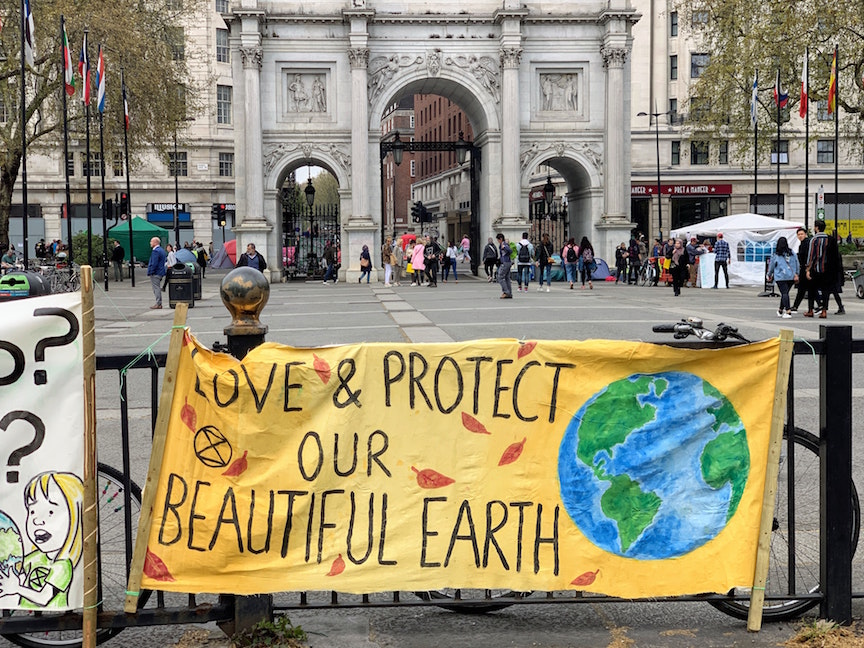
The paragraph referenced Alex Banks’ recent article in Highsnobiety, in which he explained that the UK’s Extinction Rebellion (XR) is a group of climate activists in 72 countries who demanded that the UK government declare a climate emergency, reduce carbon emissions to net zero by 2025 and form a citizens’ assembly to oversee these changes. Banks explained that the group, in order to highlight their causes, turned to non-violent forms of civil disobedience, including blocking Pont de Sully bridge over the Seine in Paris, chaining a group of protesters to themselves outside of Angela Merkel’s Chancellery in Berlin and assembling groups outside of the New York Times building, calling for the publication to rethink its stance on sponsoring one of the world’s biggest oil industry conferences. In London, people glued themselves to trains and protested Fashion Week.
Banks noted that Sara Arnold, a prominent spokesperson for XR, saw great value in the funeral-themed protests at London Fashion Week.
“The influence at London Fashion Week has the power to galvanize the support we need on the streets to get our demands passed,” Arnold said.
Banks also said that Alec Leach, a former fashion editor at Highsnobiety who now runs Future Dust, an Instagram account highlighting the most stylish and ecologically-responsible fashion items, believes that XR’s fashion boycott is not only beneficial, but it forces consumers into a more meaningful relationship with their clothes.
We turn now to another aspect of sustainability: the “casualization” of clothing. Kaarin Vembar published an article in Retail Dive in November 2019 called, “SKU’d: The worlds doesn’t need Ann Taylor.” In it, she writes:
“Anne Taylor has always been a store where a shopper could find a black shirt, a sheath dress or a navy blazer. The items have always been basics, but office staples that were universally appropriate and well-constructed and could be mixed and matched with a larger wardrobe. Then, the office changed. … The casualization of clothing has permeated every area of our lives. Athleisure as a category has performed well consistently, while the lines between workwear and daily life have increasingly blurred. Additionally, apparel spending habits have drastically changed.”
Vembar goes on to cite a Deloitte report that states that in 1987, the average customer allocated about 6% of spending to apparel and services. By 2017, that allocation dropped to 3.1%, which Vembar interpreted to mean that all wardrobe staples can be worn in a number of situations.
“What was happening with the apparel was very different from the overall look and feel of the store,” she said when she visited an Ann Taylor store. “The location was very clean. Items on racks and tables were orderly, and the merchandizing was neat and welcoming. Staff was friendly and helpful to customers. It was only when you got up close to the product itself that the brand story was muddled.”
Some would say that we have too much clothing, and others say we have the wrong kind of clothing. But one thing is clear: if fashion is to continue on, we need to find a better (read: more environmentally-conscious) way forward.
Benjamin S. Seigel, Esq., is of Counsel to the firm of G&B Law LLP. He can be reached at bseigel@gblawllp.com.


