




Why the spirit of this animal-centric brand can’t be tamed
Latif Hamilton might have fulfilled the universal childhood dream: “I want to work with animals.” As the co-founder and CEO of Spirithoods, he found a way to combine his creative energy, his studies in entrepreneurship and his absolute love of nature.
“I feel like everyone does [love animals], but when you start exploring the animal kingdom and nature as a whole, you know — everyone’s inspired by the majesty of a lion or a lynx, you know; everyone has that affinity,” he said.
Based on Spirithoods’ popularity with festival-goers, Hamilton might be right. The brand began after Hamilton’s friend and co-founder, Alexander Mendeluk, debuted an unusual hat on a night out.
“He was wearing one of those things that they used to make for Burning Man back in the day — so a furry hat, basically, just a wonky, hand-made, furry hat — but he wore one out and had a wild time. People were asking where he got his hat.”
The idea for the brand grew from that night, though Hamilton and Marley Marotta, marketing director and the company’s third co-founder, are the only two remaining of the original team. Since then, the Los Angeles-based label has grown to a team of eight quirky animal-lovers.
“We draw our inspiration from animals. From the moment of our inception, that was a huge part of it,” Hamilton said. “Part of it is giving somewhat of a voice to animals that can’t speak for themselves, and we had a huge desire to show the world that you could have an alternative to real fur.”
Spirithoods’ mission manifests in the 10% donation that the brand makes to wildlife conservation groups, such as Pandas International, the Snow Leopard Conservancy, Panthera, Predator Defense and Polar Bears International.
“The awareness campaigns are really big for us,” Hamilton said. That’s why the brand recently partnered with Animal Tracks Inc., another Los Angeles-based group that supports animals rescued from the black market.
“I went out to Animal Tracks and met the team out there, and they were just fantastic. So I ended up doing an auction — and we’ll do another one for them as well — and we donate 50% back to the non-profit organization.”
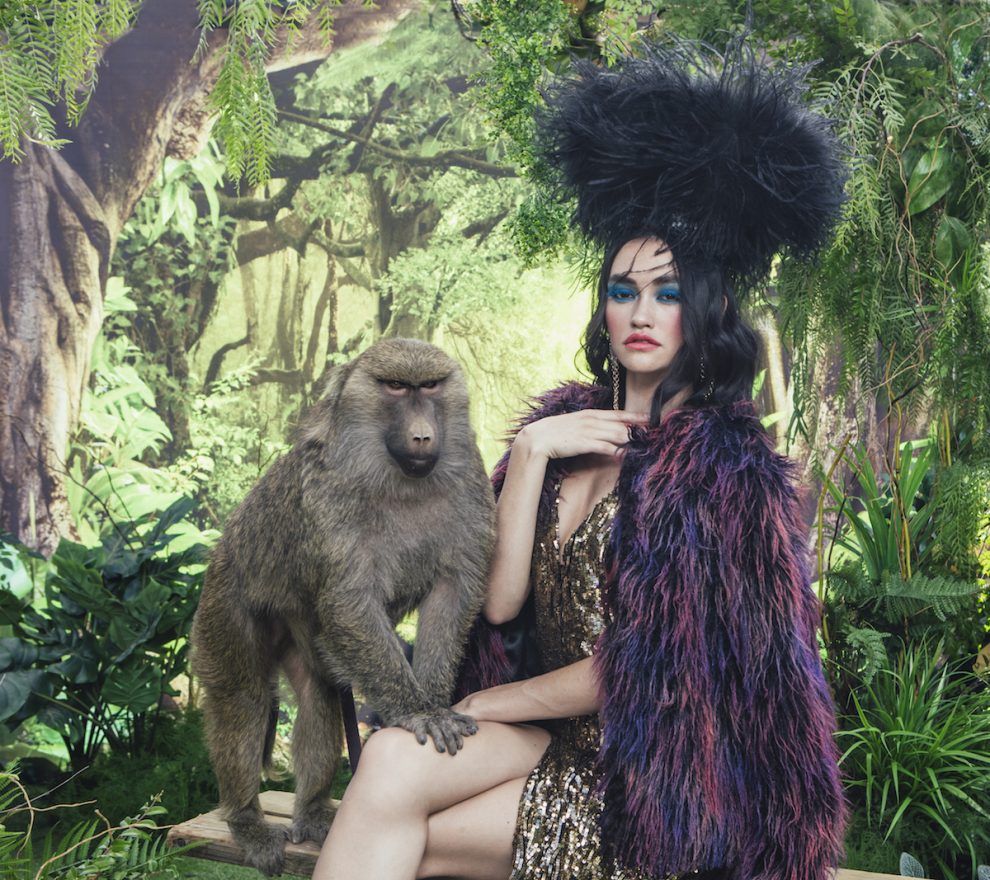
Hamilton was also quick to note that the shoot was done in a “very humane way,” since the animals were in front of the camera only for short periods of time, and flash was not used.
In a stylistic sense, Spirithoods is focused on individualism and kitschy fun.
“Part of our mission is to help people live or actualize a more self-expressed lifestyle and have fun and be playful,” Hamilton said. “When you wear Spirithoods out, you’re going to make friends. Like, it’s impossible not to comment on a certain product, so you build relationships and communities.”
As a unisex brand (that also makes home goods and, coming soon, products for pets), Spirithoods has looks for everyone, though Hamilton reported that about 70% of its consumers are women.
“It used to be like 85% to 95% was women, but men have started to be a little bit more bold in their style,” he said. “We’re a unisex brand, and we’re one of the few brands that do service men in the faux fur world.”
Hamilton also finds that customers are inspired by the same animals that he and his co-founders use for design inspiration.
“Our style names are derived by animals generally, so we have a gray wolf, and a black wolf, and a black panther, a snow leopard, so I feel like on one hand, some of the styles are popular based on coloring, and sometimes, it feels like even the name of the animal is relevant,” he said. “People are naturally drawn to wolves as majestic animals, and so if we have a product that’s a ‘wolf,’ and we’ve got another product that’s a flamingo or… I don’t know, that’s not ‘majestic’ in the eyes of the consumer, that can have an effect as well.”
Although Spirithoods has not been officially PETA-certified (yet), it has won the animal cruelty-free award from PETA for several years in a row, Hamilton noted.
And with festival season on the horizon, Hamilton is starting to think about neons and louder prints.
“We’ll also do really funky things that are inspired by the ‘80s, ‘90s, inspired by hip-hop, California vibes, like the palm trees and the desert,” he said. “A lot of it is probably about nature, to be honest, and the rest of it is weird trends.”


