




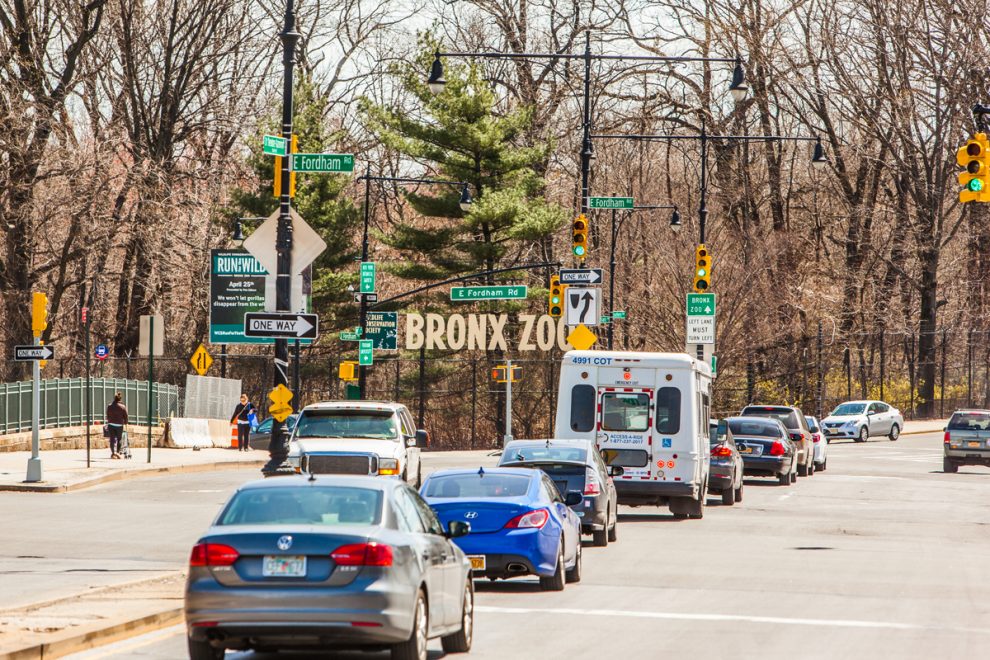
The Federal Reserve, despite tepid economic growth, is expected to continue tightening monetary policy, eventually leading to higher interest rates. While an uptick in borrowing costs should dampen loan origination throughout New York City, The Bronx should mostly buck the trend as alluring property prices and a favorable retail environment keep the spigot for real estate financing wide open.
The U.S. economy expanded at the slowest pace in three years in the first quarter, with gross domestic product, the value of all goods and services produced, rising a paltry 0.7% annualized rate. Most economists, however, expect the economy to rebound in the second quarter as seasonal factors subside. A strengthening labor market has the Fed, following years of lackluster growth, confident that the economy is strong enough to withstand the impact of higher rates.
Remarkably long-term, 10-year Treasury yields have mostly been trading in a 2.30-2.60% range in 2017. Reduced expectations for higher growth and inflation, as well as geopolitical events, have prevented yields from piercing a two-year high of 2.61% reached in March. Nevertheless, rates are widely seen as headed higher, especially if the Fed opts to downsize its massive portfolio of bonds later this year.
At between 3.500-3.875%, interest rates on five-year multifamily loans are roughly 50-75 basis points higher than where they were a year ago. Despite this increase, the lending environment will likely remain favorable, and higher rates should “normalize” market conditions, with sellers possibly motivated to lower prices to lure buyers who are more capital-constrained.
For most of the past decade, historically low interest rates fostered ferocious demand for New York City real estate, but the multifamily market, mirroring 2016’s trend, continued to cool off in the first quarter, according to Ariel Property Advisors’ recently released “Multifamily Quarter in Review 2017.” Dollar volume dropped to its lowest level in four years, as large institutional-level transactions all but vanished. Transaction volume, however, remained on pace with the previous quarter.
The Bronx fared well in the first quarter, with 33 transactions totaling $275.07 million in gross consideration, representing a 27% increase in transactions and 47% jump in dollar volume quarter-over-quarter.
Bronx capitalization rates–a widely used metric used to gauge the value of a property relative to its income stream–remain the highest in New York City, standing at 4.99%. That is significantly higher than Northern Manhattan, Queens, Manhattan and Brooklyn, which had cap rates of 3.74, 3.85, 3.87 and 4.40%, respectively, according to Ariel Property Advisors’ multifamily report.
Because of the borough’s higher cap rates, investors, in pursuit of higher yields, have increasingly turned to The Bronx as they get priced out of other sub-markets. Due to the loftier cap rates, lenders have been able to finance more on a loan-to-value (LTV) basis than costlier boroughs.
In fact, Bronx properties have generally been able to achieve LTVs in the 70%-75% range, whereas other boroughs’ LTV typically get topped at 55%-60% because of their lower cap rates.
For example, Ariel Property Advisors’ Capital Services Division arranged a cash-out refinance loan for a 10-unit, mixed-use building on 3rd Avenue in the Bathgate section of The Bronx where the LTV was a lofty 80%. The division organized a five-year hybrid, non-recourse, Freddie Mac Small Balance Loan at a rate of 3.6% within 15 months of the owner acquiring the property.
Favorable Retail Landscape Lures Lenders
The national environment for the retail sector is more challenging than ever, with first quarter GDP data showing that consumer spending–which accounts for two-thirds of the economy–grew at a measly 0.3% annual rate, its slowest since the fourth quarter of 2009.
With retail establishments seemingly closing by the dozens every day in other boroughs, The Bronx has not been hit as hard. That’s because many of the tenants are Mom & Pop stores, with longstanding regular customers, making them less sensitive to the challenges facing many traditional and national retailers. This unique backdrop has made lenders less cautious about mixed-use or commercial properties in The Bronx versus other parts of the City.
Another reason why lending has been more aggressive in The Bronx is because average retail rents are much closer to residential rental levels than in other boroughs. As a result, commercial income might make up only 15% of the income of a mixed-use building versus 30-50% it could comprise in other areas. Lenders, therefore, take on less risk on properties with commercial tenants.
The Bronx’s quaint retail backdrop and advantageous income composition has spurred a surge in commercial lending in the area. Indeed, in 2016, Bronx lending on commercial and mixed-use acquisitions was up 11% year-over-year, while Manhattan and Brooklyn saw mortgage volume fall for these same properties at a rate of 70% and 24%, respectively.
In fact, lending for all property types in The Bronx has exploded in recent years. Signature Bank and New York Community Bank, the top two lenders in the borough in 2016, notched a collective dollar volume of nearly $310 million last year, up a startling 64% from 2015’s $189 million, and an astonishing 288% above 2014’s $80 million.
Meanwhile, The Bronx’s economy has improved decidedly in recent years, with New York State data showing employment in the borough rising to 619,400 in March, up 6% from a year earlier. The unemployment rate stood at 5.7% in March, substantially below its year-ago level of 7.4%.
As more and more people opt to work and reside in The Bronx, institutional and private investors will likely continue to seek capital financing in New York City’s uppermost borough. Rising rates should have senior lenders pulling back as properties qualify for smaller-sized loans, but that should also drive stronger demand for loans higher up the capital stack, such as mezzanine debt, preferred equity, and common stock. Overall, Fed monetary tightening reflects a robust economy, and therefore we expect capital markets to remain strong, allowing investors ongoing access to attractive and reliable financing.
Brendan Price
Director, Capital Services
Ariel Property Advisors
212-544-9500, ext. 5271
bprice@arielpa.com
Aryeh Orlofsky
Senior Vice President, Investment Research
Ariel Property Advisors
212-544-9500, ext. 21
aorlofsky@arielpa.com




Add Comment