




Many real estate investors and potential real estate investors believe that huge increases in housing prices will eventually lead to huge decreases. A lot of those investors are wary of buying anything now, thinking they will get a smoking deal soon enough when everything drops like it did in the mid 2000s. While I can see the basic premise behind this thinking, it is not as easy as it sounds to simply wait for the housing market to crash before you invest. First off, we don’t know if there will be a huge crash, and if there is, how do you know when the bottom occurs? How long will it take for there to be a crash, and what if the crash only occurs in certain areas?
Will there be another housing market crash?
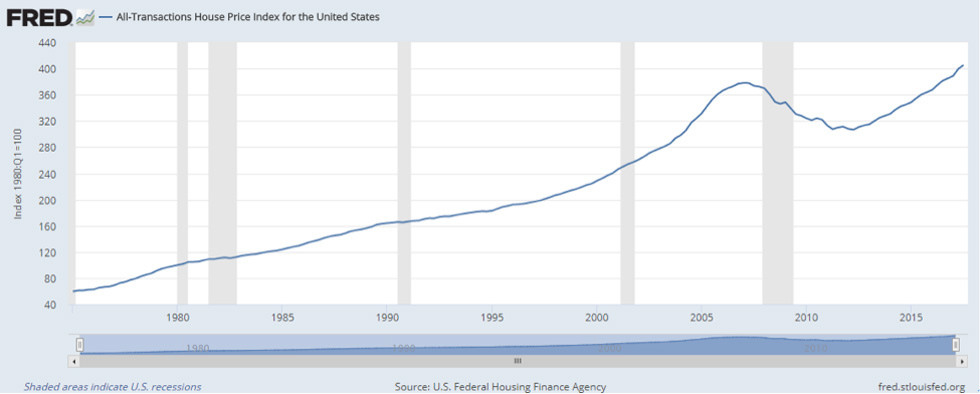
Many investors assume there will be another crash because prices have risen so much in so many markets. However, increasing prices does not necessarily cause a housing market crash, as over time housing prices have always risen just like the stock market. In fact, if you look at the historical housing market index, prices are not astronomically higher compared to average trends. They seem higher because we saw such a huge drop and then a meteoric rise in a very short period of time. If you actually look at the historical graph of the housing price index, we are not that far off from normal. As you can see in the graph above, except for the jump in prices and subsequent drop, the housing price index is right where is should be.
There are many other things that need to be considered when trying to figure out when another crash will happen. The last crash occurred mostly due to poor lending guidelines. Just about anyone with a pulse could get multiple properties in their name with little money down, but things are much different today, with much stricter lending guidelines:
Today, subprime loans account for $5 billion worth of loans, compared to $620 billion loans pre- crash. Additionally, the current average credit score for borrowers is 739, which is even higher than right after the crash in 2009 when the average was 686. And the lowest one percent of mortgages issued have credit scores averaging from 622 to 624. In 2001 the lowest one percent of mortgage being issued had credit scores of 490 to 510.
Yes, there are subprime loans available, but lenders are not giving out subprime loans anywhere close to as often as they were before the crash. Houses are being built at a fraction of the pace they were being built before the crash, which has caused low inventory. There are very few new houses, very few foreclosures, and that is causing prices to surge in some markets. Just because prices are increasing does not mean we are in for a huge drop.
If there is a housing market crash, how bad will it be?
The real estate market goes up and down, but we had a really bad crash in the mid 2000s. I am not saying we will never see housing prices drop again, but I do not think we will see the historic crash we saw 10 years ago anytime soon. One thing that helped bring us out of the last crash was real estate investors buying up distressed inventory. The investors who bought houses were mom-and-pop landlords to giant hedge funds spending billions of dollars. Those investors are still buying houses and will continue to buy houses, no matter what the market does.
If we see another crash, there will be thousands, if not millions of investors waiting to scoop up cheaper properties. I do not think real estate investors will ever let the market get as bad as it was because they are waiting for prices to drop this time.
Even though it would seem like the entire country saw prices drop in the last crash, there were some markets that were not affected, or affected very little. We all hear about California, Florida, Arizona, and even Colorado (where I live and invest), but Midwest markets saw very little drop in prices. Who knows for sure where and when the next drop in housing prices will be, because real estate trends are extremely local.
Should you be waiting for a housing market crash to invest in real estate?
I would not mind a drop in housing prices in my market in Northern Colorado. In my little town (Greeley) we have seen median prices jump from $110,000 in 2011 to $290,000 in 2017. I flip houses, I own rentals, and I am a real estate agent. The high prices have made it harder to flip, harder to buy rentals, and harder to sell houses. However, I am still investing in real estate because I do not see any significant changes coming anytime soon. Here are some things to consider when investing in hot markets:
- When I buy rentals I still want to buy for cash flow and hope for appreciation. In hot markets, this may mean buying in different markets, or different sectors, like commercial.
- If you are waiting to invest, how will you know when the bottom hits? It is really easy to say that we should have all bought hundreds of houses in 2011, but at the time many experts predicted prices would drop even farther and the real estate market would implode. It is not easy simply to invest when the market crashes.
- If you are waiting for the market to crash, how long will you wait? Will you leave your money sitting for one year, two, three, four, or more?
- What if the market you are waiting to invest in never drops or hesitates. There are no guarantees that every market will drop, or how far it will drop.
Conclusion
I wish I had a crystal ball, but I do not. Real estate has made me a lot of money, but not because I timed markets. I have been able to adapt to changing markets, lending guidelines, and market trends. There will always be opportunity in real estate, but it may not be easy to find exactly what that opportunity is. So instead of waiting for the perfect market, figure out what opportunities are present in the current market.
Mark Ferguson
Invest Four More, Founder
mark@investfourmore.com
www.investfourmore.com




Add Comment