
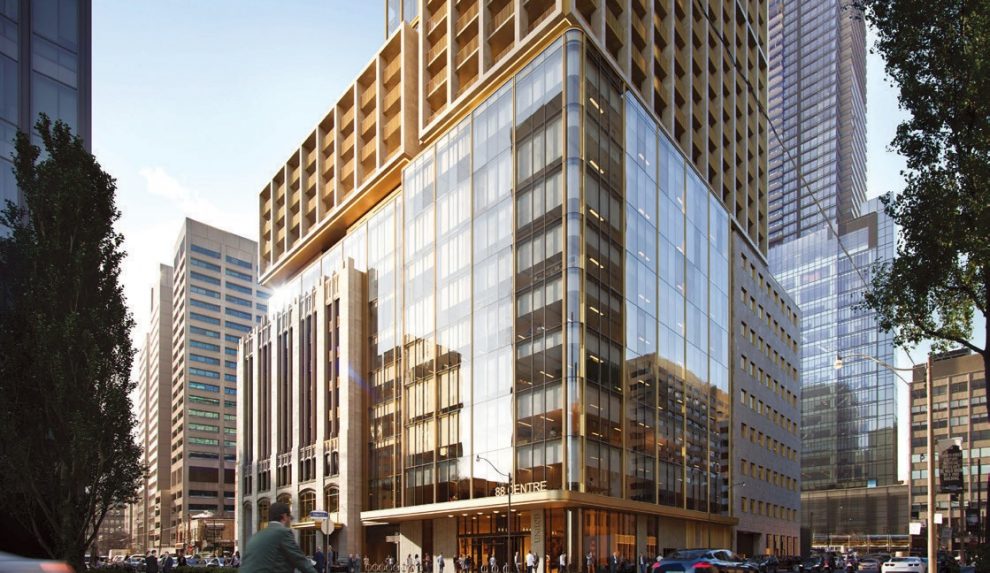
For decades in the 20th century, Toronto’s United Building housed the magazines and newspapers that chronicled the city’s, country’s and world’s history. In the 21st century, it will make development history, as developer Davpart turns the printing house into a 55-story high- rise mixed-use project. The result makes the United North America’s tallest architectural heritage retention development while preserving its illustrious past.
From 1910 to the 1980s, the United Building had been home to Maclean Publishing, and later Maclean Hunter, in time the largest Canadian publisher of trade journals, as well as Maclean’s Magazine, the Financial Post Newspaper and Chatelaine.
“You have all of these historical components,” said Davpart President and CEO David Hofstedter, who acquired the building in 2011. “This was the predominant publisher in the British Empire.”

Located at 481 University Avenue, it had been the first commercial building on the street, consisting of three stories of reinforced concrete with red brick and stone buttresses. As the business grew, the complex was expanded to multiple buildings, all incorporating other architectural styles. By 1961, the United was an entire city block bounded by University Avenue, Dundas Street, Centre Avenue and Edward Street.
“We have 0.81 of an acre in the heart of the cultural center of city with museums, art galleries, music centers and City Hall, which is just incredible,” Hofstedter said.
By the 1990s, though, the publishing company had moved and the building was a more traditional Class B or B-minus office complex of about 225,000 square feet. But in recent years, Toronto has grown, and the need for residential downtown is intense, Hofstedter explained.
“There is a huge shortage of residential, but also of all types of development to serve tremendous immigration,” he continued. “Until recently, the growth was outward. But a stop has been put to sprawl in favor of densification.”

A recent study by Ryerson University’s Centre for Urban Research found that Toronto is the fastest growing city in Canada and the U.S., gaining 77,000 net new residents between July 2017 and July 2018. (New York City lost 39,523 residents over the same period.) Despite high housing costs, Toronto (as well as Montreal and Vancouver) continues to attract millennials, according to an April 2019 report from the Royal Bank of Canada (RBC). As some millennials are now moving to suburbs for affordability, immigration is on the rise.
The United will be transformed into a transit-oriented development with 759 residences beginning on the 10th floor, topping 224,245 square feet of office space and 39,320 square feet of retail. The complex rests above the Toronto St. Patrick Station, giving it immediate access to the rest of the city. In fact, the building could have been even taller, but Davpart was required to maintain sight lines to City Hall.
“It’s not a huge component of retail, but we are seeing some strong demand,” Hofstedter said.
The residences will range from studios to three bedrooms, some with a den, flex or media room; some will be duplexes. Amenities will include a 24/7 concierge, party room with kitchenette, video gaming lounge, pool with fireplace, sauna and rain room, fitness center, sports lounge and a golf simulator. Exterior amenities will include a four-season reflecting pool with Warming pavilions and seating, bocce court, yoga deck, barbecues, dining, hot tubs, a dog run and Zen garden.

The tower will be set back from the main boulevard, and a colonnade at Dundas and University will create a pedestrian space. The United Building is located within walking distance to shops, cafes, hospitals, parks and nightlife, including Toronto City Hall, Chinatown, Ryerson University, the University of Toronto, Eaton Centre.
Market factors also come into play. Until recently, such a redevelopment may not have been financially feasible. But Toronto has seen growth that may even exceed that of New York City, Hofstedter said. Much like other gateway cities, Toronto is in the midst of a housing boom, as empty nesters return to urban living, young professionals are establishing themselves and foreign investors are taking a stake in a safe stable haven.
“For every millennial leaving a major Canadian city for more affordable digs in the same province, there are between seven and 12 millennials moving in from another country or province,” according to the RBC report.
With demand, prices have risen, allowing the CA$650 million project (excluding the land cost) to pencil out.
“The increase in prices has been so dramatic in the last year or two alone, even though this project is very, very expensive, given the donation to the city, the creation of the colonnade and more,” Hofstedter said.
The redevelopment timeline has been long, given the property’s historic status. Despite the modernization, the building will retain elements of its Beaux-Arts and Modern Classical design.

The United is designated under the Ontario Heritage Act and listed on the City of Toronto Inventory of Heritage Properties, requiring lengthy approvals. Hofstedter hopes to begin construction in April. DavPart must preserve three of the building’s facades, which must remain in place during construction. (In other regions, such facades could have been removed, preserved and reassembled.)
“We have to do a retention,” he said. “Too many pieces were being damaged and lost. So we have to keep the façade, shore it and have them suspended as we build up.
It’s going to be quite a feat, but we’re confident it will come together.”
In addition, the United will have three levels of subterranean parking, further complicating construction. B+H Architects is serving as prime consultant and design architects, with the team also including heritage consultants ERA Architects and Tomas Pearce Interior Design Consulting.
Hofstedter expects to get a final building permit in March and begin construction in April. Meanwhile, the residential sales office is already open and attracting good interest.
“People are picking up something in the heart of the city,” Hofstedter said, “And we have great architecture in a location that’s second to none.”