
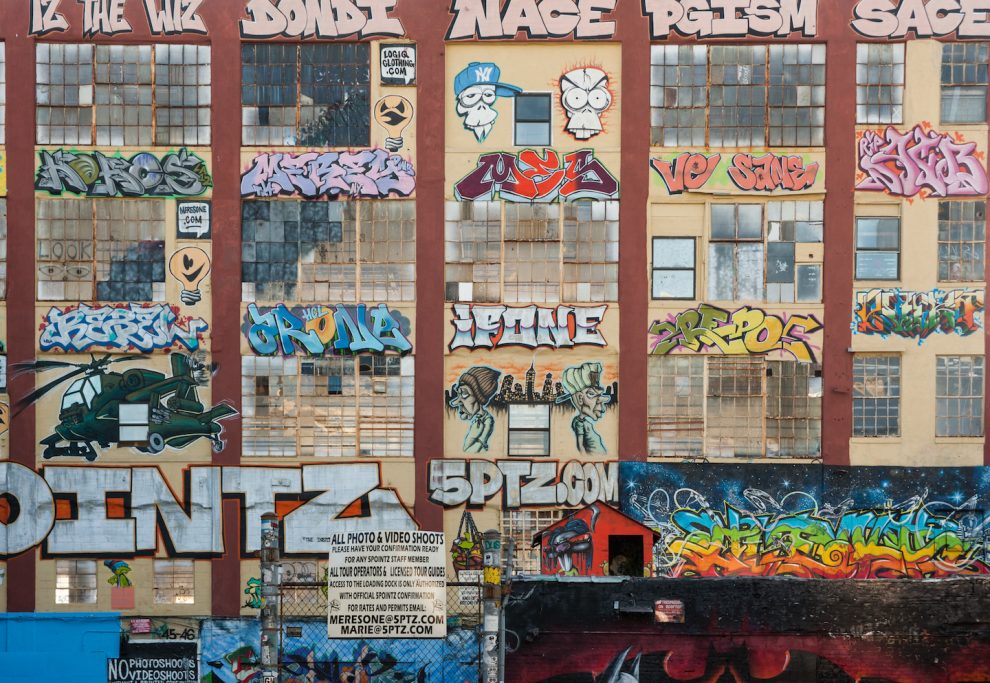
For years, the 5Pointz building in Long Island City provided a haven for graffiti artists with the owner’s consent. Those “aerosol artists” painted more than 10,000 artworks. Many, but not all, were later painted over and repainted by other “aerosol artists.” In 2013, the owner of the building wanted to develop it. The artists tried to landmark the building but failed. Then they sued to stop the demolition.
During the litigation, the owner covered the graffiti with white paint. The artists said the owner’s whitewashing violated the federal Visual Artists Rights Act (VARA) of 1990. That law limits a property owner’s ability to demolish artwork of “recognized stature.” A court can award damages of up to $150,000 per violation. The federal district court did that, awarding 45 artists a total of $6.75 million.
In February 2020, an appellate court affirmed that award. To read the 32-page decision, enter this in any web browser.
One can debate whether graffiti art can achieve “recognized stature,” but the courts decided it could. One can also debate whether work that is regularly but not always painted over should earn that label, but the courts decided it could.
The owner’s actions seemed to annoy the judges, because the owner had painted over the graffiti quickly and carelessly once the litigation was underway, without even allowing the artists to take pictures. Maybe if the owner had been nicer about it or used thicker and better white paint, the courts would have been happier. In practice, the owner probably panicked and just wanted to make the problem go away before it got worse — a decision that backfired.
The damages awarded in 5Pointz invite an immediate gut response: property owners shouldn’t allow any graffiti on their buildings. Very likely, they should not allow any artwork at all. That would probably amount to an overreaction, but it’s still probably the most likely response.
Owners who consider allowing installation of any form of artwork should remember the federal VARA law — take it seriously and keep it in mind before they proceed. They should also note that the courts have unambiguously defined VARA-protected artwork in a way that goes far beyond traditional old-fashioned expectations. In today’s art world, someone recently paid $120,000 for a banana attached to a wall with duct tape. Even if an owner contemplates allowing (or commissioning) any decorative element that might conceivably be considered artwork, they should think about VARA.
The good news is that artists can easily waive their rights under VARA. The building owner and the artist just need to sign a document that allows the owner to destroy the artwork as a result of its removal. Getting that piece of paper signed is not a difficult requirement. If the owner remembers to do it, that should entirely solve the problem. It’s just a speed bump, another nonintuitive legal requirement that unknowing property owners ignore at their peril. Maybe VARA penalties are a special tax imposed for failing to hire the right lawyers.
Conceivably, an artist asked to sign a VARA waiver might refuse. In that case, the owner can either find another artist or negotiate specific terms for a possible future removal of the artwork. In 99% of the cases, though, one can safely assume the artist will sign the waiver, so the parties will end up exactly where they would have been without VARA. It amounts to just another federal disclosure law requiring someone to sign a piece of paper to keep in the file.
Proper VARA compliance for 5Pointz would, however, have required the signing of a huge numbers of waivers followed by a continuing program to match the signed waivers to the artists on site. This probably would not have been practical. So a law designed to protect artistic endeavors would, if properly followed, probably have prevented the artistic endeavors at 5Pointz.
Anyone with a long-term interest in real estate, not just a property owner, should pay attention to VARA. For example, loan documents should, and often do, prohibit the borrower from installing permanent artwork without proper VARA waivers. Ground lessors have similar concerns.
VARA doesn’t require all that much in the typical case. It shouldn’t deter anyone from allowing installation of limited artwork in a building. But owners ignore it at their peril.
Joshua Stein
Joshua Stein PLLC
501 Madison Avenue, Suite 402
New York, NY 10022