
Salt Lake City is experiencing rapid growth, with a current population increase of 1.4% annually, according to the World Population Review. Attracted by the city’s relative affordability, youthful demographic, strong economy, abundant outdoor recreation and urban presence, more people are moving to the elevated city.
A growing destination flourishes with a vibrant mix of living areas, commercial spaces and entertainment venues that support the needs of its population. In a city with a rich history, thoughtfully designed new buildings that complement existing architecture can attract tenants and consumers, as it celebrates the city’s progressive spirit while honoring its heritage.
MVE + Partners entered the Salt Lake City market to help meet the region’s demand for mixed-use spaces. In turn, the architecture firm connected with Lowe Property Group to work on one of city’s most ambitious adaptive reuse projects — The Post District.
The Post District is dynamic, mixed-use development by Lowe Property Group, Blaser Ventures and Bridge Investment Group, spanning 13.14 acres in Downtown Salt Lake City, making it one of the largest developments of its kind within a mid-sized U.S. city.
Designed to blend adaptive reuse with new construction, the $144 million project draws its name from the area’s historic newspaper buildings. Located along the Interstate 15 corridor within a designated Opportunity Zone, the Post District offers a bustling setting for a harmonious mix of residences and commercial tenants.
MVE had the unique opportunity to serve as the master planner of the Post District Residences, an expansive development featuring five ground-up buildings comprising 580 residential units and 27,000 square feet of vertically integrated, mixed-use retail. The buildings are sited to allow for the adaptive reuse of existing structures, some of which have been left untouched for over a century.
Each of the five buildings possesses a distinctive character but collectively delivers a “sophisticated grit” that blends modern design with historic elements to create a vibrant, creative hub within a city block.
Supporting a Diverse Group of Renters
Part of developing within an Opportunity Zone is being able to design units that suit a variety of renter profiles. MVE viewed this as a chance to create a “complete neighborhood” through five different apartment offerings, ranging from $1,300 to $5,000 per month, that all embrace the character of the Post District. These include Post House North and South, The Register and 801 Flats (comprised of two buildings).
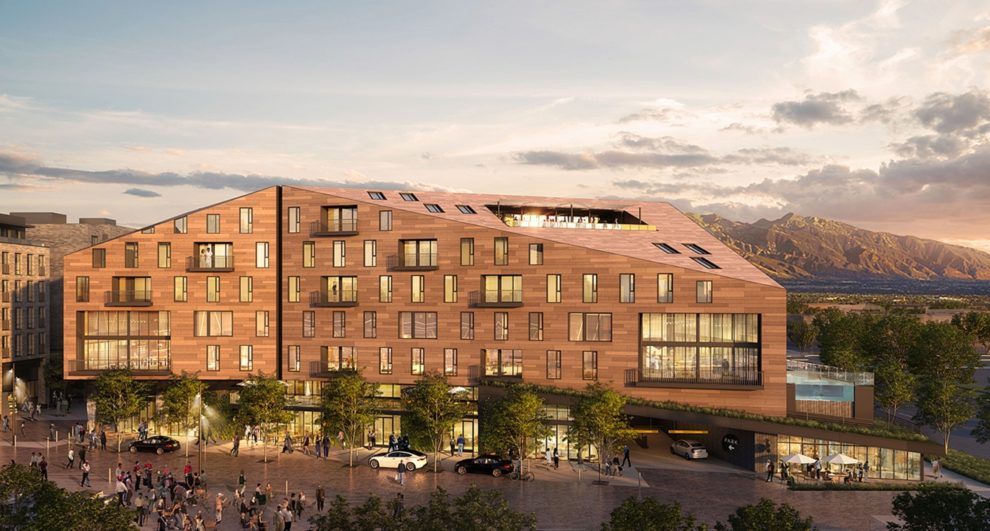
MVE served as the architect of both Post House buildings. These structures emulate the shape of the Wasatch Mountains on the city’s horizon while incorporating earth-hued colors and bricks from historic structures. Windows are arranged in asymmetrical patterns, distinguishing this building from its neighbors.
Collectively comprised of 474 units, both properties provide an elegant residential lifestyle with varying floorplans. However, a key differentiator between the two is their podium level decks. The Northern building has a space that emulates a park-like atmosphere whereas the Southern residence offers a resort-style pool experience.
Additionally, The Register brings 33 loft-style luxury apartments of different sizes within a building that was repurposed from a warehouse. 801 Flats also draws inspiration from shipping containers that pay homage to the historic freight rail spurs that run throughout the Granary District. This was adapted into 73 diverse units, comprised of one- and two-bedroom dwellings.
Following the completion of the residential portion in 2023, 70% of units were leased within a couple of months.
Planning Adaptive Reuse
Development projects spanning 13 acres are rare in Salt Lake City, largely due to the higher costs associated with neighborhoods in an urban setting. However, designing within an Opportunity Zone and incorporating adaptive reuse can provide ample cost savings.
In general, adaptive reuse projects can reduce costs by up to 15%. However, when developing a project in an area that has lacked economic activity for over a century, it can be eligible for tax credits as well, which provides robust design flexibility.
For the Post District, these cost savings provided leeway to create space for robust housing options and world-class retail and hospitality tenants on the ground floor of each building. Notable occupants include the award-winning Urban Hill Cafe, Sunday’s Best restaurant, Level Crossing Brewery alongside the establishment of the EVO Hotel SLC location (comprised of a completely adaptive reuse building) and Traeger Grills’ new headquarters. Many of these tenants are unique to the Post District or specifically requested that their Salt Lake flagship be in the area due to the creative and authentic local culture.
Challenges and Opportunities
While blending adaptive reuse with new construction presented certain challenges, the process ultimately enhanced MVE’s design expertise, particularly in finding innovative ways to integrate materials from the existing built environment.
One notable challenge was determining which existing structures could be used effectively to comply with building and seismic code. The Magna Earthquake of 2020 forged decisions to ensure buildings were resilient to unprecedented natural events. MVE leveraged its design expertise in earthquake-prone areas like California to design durable mixed-use buildings that could outlive other structures not originally designed with these principles in mind.
Another unique design feature was incorporating existing billboards into thePost District. As the project is positionedalong Interstate 15, there were ultimately six billboards present on-site. Even thoughbillboards can be considered an eyesore, there was an opportunity to integrate them into various parts of the project. Post House and The Register were strategically built around billboards, in a way that added to the industrial grit of the structures. The billboards also created an interesting juxtaposition of highlighting prominent upcoming announcements like the 2034 Winter Olympics in front of a project that represents Salt Lake’s history.
Continued Growth
As Salt Lake City continues to grow, there are many ways to incorporate adaptive reuse to create the next best structures of tomorrow. MVE broke ground on Silo Park in December 2024, located one block west of the Post District. Slated to be a “sister project,” this $300 million, mixed-use entity will incorporate the use of silo towers and two historic warehouses — also serving as a tribute to Salt Lake City’s industrial roots and Utah’s enduring significance in the production of wheat, corn and barley.
The first phase of the project will feature two six-story residential buildings with a total of 286 apartments and nearly 20,000 square feet of commercial space. Additionally, two historic warehouses will be converted for retail use, alongside the addition of off-site parking and ample green space.
The Post District is proof that adaptive reuse is a robust solution to meet increasing housing and retail needs, while offering ample cost savings. It also demonstrates how innovative projects can come to cities with the addition of new construction to enhance its presence, without erasing history.
Developers should know that the next best thing can start with what is already in front of them.