
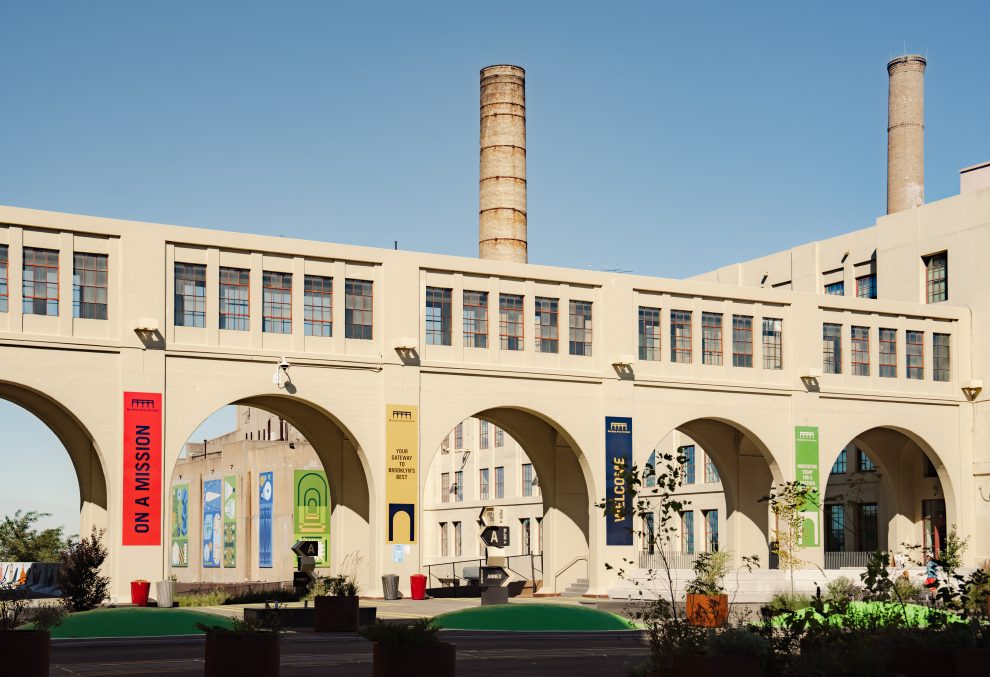
The Sunset Park historic industrial waterfront district in Southwest Brooklyn is undergoing a generational transformation. With more than $2 billion in combined public and private investment across 200 acres of previously underutilized industrial property, the New York City Economic Development Corporation (NYCEDC) is positioning the district as a hub for industry, innovation and inclusive economic growth.
These investments are designed to maximize long-term returns on public capital while stimulating private-sector growth and enhancing workforce development efforts across manufacturing, creative and innovative industries. The investment in Sunset Park bolsters the city’s efforts to develop a Harbor of the Future, a reimagined, East River-connected network of innovation and growth.
NYCEDC’s redevelopment strategy focuses on using targeted public investment to modernize aging infrastructure and unlock private investment. The district includes the Brooklyn Army Terminal (BAT), MADE Bush Terminal, South Brooklyn Marine Terminal (SBMT) and Brooklyn Wholesale Meat Market (BWMM).
Led by NYCEDC, the transformation prioritizes local job creation, sustainability and increasing public access. By combining upgraded public infrastructure with strategically repositioned industrial space, NYCEDC is activating the waterfront’s full potential. With over 130 businesses and more than 4,000 jobs — many filled by Brooklyn residents — the district reflects the community it serves. New open spaces, cultural and community programming and workforce development initiatives ensure that Sunset Park’s future is built with and for its people.
A key goal of this investment is to reconnect the surrounding community to the waterfron, both physically and through community programming and targeted, hyper-local workforce development efforts.
Brooklyn Army Terminal
Over the past decade, more than $500 million has been invested to modernize BAT. Built in 1919 and later becoming the nation’s largest military supply base during World War II, the 59-acre, 4.1 million-square-foot campus has been transformed under NYCEDC’s stewardship, exemplifying the agency’s commitment to generational renewal. Today, BAT is reimagined as a modern, institutional-grade industrial hub, offering premium large-format space to established manufacturers and opportunities for the green economy and innovation industries to incubate and expand.
The comprehensive renovation includes the introduction of approximately 450,000 square feet of new leasable space over the next several years. BAT’s enhanced infrastructure, significant campus-wide improvements, improved public realm, and other tenant-focused initiatives are all designed to support the more than 100 businesses that currently call it home, while focusing on local jobs and future growth in the industries of today and tomorrow.
This modernization strategy has diversified the tenant mix across high-margin sectors, including industrial manufacturing, food production, woodworking, and specialty fabrication. Current occupants include Jacques Torres Chocolatier, The Konery, Norwegian Baked, MOMO Dressing, Green Mustache, MakerSpace NYC, Rooftop Films, ArtBuilt, technology manufacturer Altronix, national retailer Uncommon Goods, nonprofit fabric recycler FABSCRAP, and New York Embroidery Studio.
BATWorks: $100 Million Climate Investment
A centerpiece of BAT’s ongoing transformation is BATWorks, a state-of-the-art climate innovation hub. The world-class BATWorks hub will provide start-ups with space for product research and development, as well as workforce training and job placement programming for New Yorkers. NYCEDC’s $100 million investment in BATWorks will help create over 600 jobs, serve 150 startups over 10 years and generate $2.6 billion in economic impact for the city. Developed with the Los Angeles Cleantech Incubator (LACI) and the Cambridge Innovation Center (CIC), BATWorks will be housed across approximately 200,000 square feet in BAT’s waterfront-facing Building A and will serve as a catalyst for New York City’s green economy.
In 2025, early BATWorks programming was launched through interim campus facilities, hosting workshops, convenings and partnership development ahead of the opening of the permanent hub in 2028. BATWorks will anchor the Harbor Climate Collaborative, a new network linking climate innovation sites across the Brooklyn Navy Yard and Governors Island. Together, these sites will support millions of square feet of climate-focused workspace and education facilities, strengthen New York City’s ecosystem and create pipelines into high-quality green jobs.
BAT’s sustainability leadership is reinforced by Sunset Park Solar, a community-driven clean energy initiative with UPROSE and Working Power. The 725-kilowatt array atop BAT, constructed in 2025, will provide affordable renewable energy, saving roughly 150 low-income households $1.24 million on bills while reducing emissions and protecting residents from energy cost fluctuations.
MADE Bush Terminal
Located less than a mile from BAT, the 20-acre MADE Bush Terminal (Manufacturers, Artisans, Designers and Entrepreneurs) is being reimagined as a modern center for innovative manufacturing and small business growth. Once a bustling shipping complex employing more than 35,000 people, MADE’s eight-building waterfront campus is being repositioned to honor its industrial heritage while building new economic momentum.
Building A at MADE offers 140,000 square feet of leasable manufacturing space for industrial businesses and artisans, along with 30,000 square feet dedicated to events and community space. Surrounding the building are five new acres of landscaped public space, featuring plazas, pedestrian pathways and an emphasis on waterfront connections.
NYCEDC recently secured over 20,000 square feet of leases with Pelle, Aripack and MushLume, bringing design-driven manufacturing, sustainable packaging and biodesign innovation to Sunset Park.
MADE is also benefiting from major public-space investments along the waterfront, which was cut off from the surrounding community for decades and is now being reconnected. In the summer of 2025, NYCEDC broke ground on Pier 6, a five-acre former maritime pier now being transformed into a new waterfront park that will stabilize the structure, incorporate managed shoreline erosion, reuse historic industrial elements and preserve natural habitat. When completed in 2027, Pier 6 will offer recreation space, waterfront access and dramatic views of Lower Manhattan and the harbor.
These upgrades complement the $38 million Bush Terminal Piers Park revitalization, adding tidal pools, sports fields, bike paths and waterfront trails, positioning the campus as a national model for equitable industrial waterfront redevelopment.
In 2025, NYCEDC also announced that the growth and opportunity at MADE Bush Terminal will be further complemented by a second Sunset Park ferry stop at the site, enhancing the campus and its surrounding industrial and residential users’ connections to and from the Brooklyn waterfront via water transit.
NYCEDC is launching the next phase of its transformation of MADE Bush Terminal through a new cultural partnership with Public Service, the creative studio behind Public Records, led by founders Shane Davis and Francis Harris. The partnership will re-envision and activate a 1,000-capacity venue on the campus, introducing a dynamic mix of public and private events, large-scale art installations, and live music. Drawing on Public Service’s proven curatorial and creative vision, the revitalized venue will feature the same multidisciplinary programming that has defined the success of the flagship space.
South Brooklyn Marine Terminal
Adjacent to these revitalization efforts is SBMT, one of the most significant renewable energy infrastructure projects in the country. Currently under construction across 73 acres, SBMT is poised to become one of the largest offshore wind port facilities in the nation. The site is being transformed through capital investments from the City, alongside more than $1 billion in private funding. The project has created over 1,000 union construction jobs to date, catalyzing economic activity and workforce development in the region.
Once completed, SBMT will support the staging, assembly and deployment of offshore wind components for the Empire Wind 1 project, which will ultimately deliver clean energy to over 500,000 homes and businesses in Brooklyn. SBMT will be the first place in the world to have port staging and assembly, operations and maintenance, and an onshore substation all in one location.
Brooklyn Wholesale Meat Market
BWMM comprises over 200,000 square feet dedicated to food processing, cold storage, and distribution. It serves as a hub for wholesale businesses working across meat, poultry, fish, and produce, playing a vital role in the region’s food supply chain. The market is currently operating at full capacity, reflecting strong demand for this type of infrastructure in New York City.
Public Investment as an Economic Engine
NYCEDC’s Sunset Park strategy demonstrates how targeted public investment can leverage private capital, create stable assets, and catalyze local economic growth. By transforming underused waterfront properties into financially viable hubs for manufacturing, innovation, and sustainable industry, NYCEDC is creating long-term economic returns. Sunset Park now stands as a clear model for how strategic public investment drives urban redevelopment.
NYCEDC’s work across Sunset Park builds on the city’s broader strategy to develop the Harbor of the Future—a reimagined network of innovation and growth across New York City’s waterways. The Harbor of the Future includes emerging innovation centers at the Hunts Point Produce Market in the Bronx, the South Brooklyn Marine Terminal, a modern maritime port and vibrant mixed-use community hub at the Brooklyn Marine Terminal in Red Hook, the Science Park and Research Campus (SPARC) in Kips Bay in Manhattan, new sustainable housing and public space on the North Shore of Staten Island, and an anchor research and educational partner with the New York Climate Exchange on Governors Island.