
For a long time, the office did not have to justify itself. It was simply where you went to work. In many cities, including New York City, that assumption no longer holds. When getting to work can take 45 minutes, an hour or sometimes more, people make a choice each morning about whether the trip is worth it. This has changed the role of the workplace in a fundamental way.
Value, benefits and unique experiences are what draw people to the office now rather than simply the habit of going into work everyday.
Employees are not looking for the office to mimic home, especially when many already have comfortable places to work remotely. They are looking for something that is harder to recreate on their own: better conditions for certain tasks, easier access to colleagues, stronger moments of connection and a workday that feels more productive because they came in.
That shift is especially visible in New York City, where hybrid work has settled into the new norm. Many employees come in for only part of the week, often converging midweek, and that pattern puts a pressure on workplace design. The space has to perform when it is full, support different modes of work over the day and give people a clear answer to a simple question: why here and why today?
Recent workplace reporting from Work Better NYC and Work Design has pointed to the same evolution, with offices increasingly expected to operate as intentional destinations rather than default settings for daily work.
One of the clearest reasons people still want to come together is collaboration, and collaboration is expected to occur anywhere in the office, anytime in every kind of space. Open plans taught many companies a difficult lesson: more visibility does not automatically create better teamwork. In fact, without the right balance, it can do the opposite, making conversation easier at the expense of concentration.
The most effective workplaces are more strategic than that. They create distinct settings for distinct kinds of interaction. Some spaces should invite spontaneous exchange and social energy. Others should support focused, decision-oriented meetings with strong acoustics, dependable technology and enough privacy to let people actually solve problems.
For one client, we made this distinction very explicit within a single space. We designed a large, flexible room anchored by a curved screen and fully integrated audio but intentionally layered it to support both modes of collaboration. During working sessions, the room functions as a high-performance environment with U-shaped layouts, clear sightlines and the ability to focus on content and decision making.
At the same time, the space can quickly transition into a more social setting with round tables or an open plan for informal gatherings, shifting the energy toward connection and relationship building. What makes it effective is not just the flexibility, but the clarity of use; the room supports deep, outcome-driven work when needed and just as easily creates the conditions for more spontaneous, social interaction without those two modes competing. This matters even more on the busiest office days. In New York City, when attendance concentrates in the middle of the week, offices need to absorb those peaks without becoming noisy, chaotic or difficult to navigate. Collaboration may be a major reason people come in, but it only adds value when the environment is set up to support it.
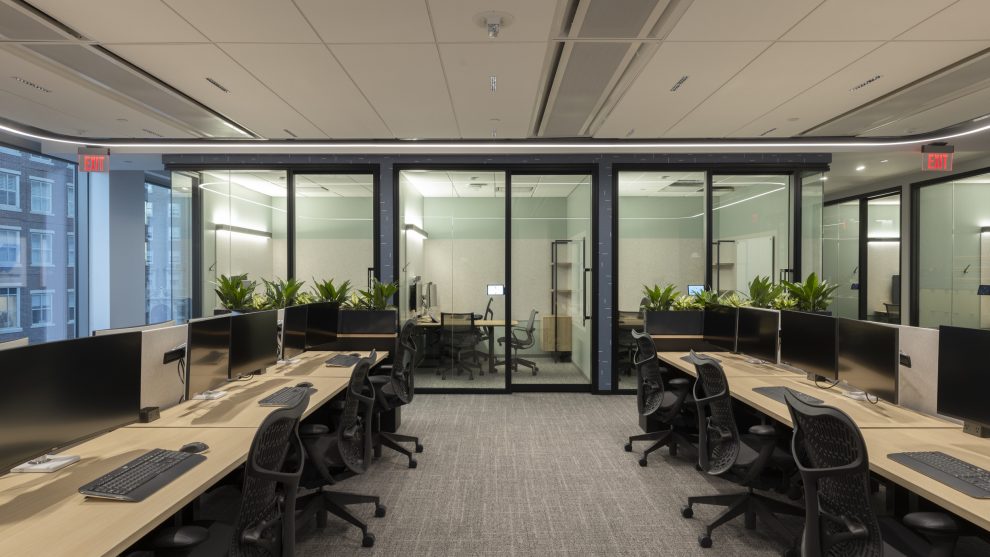
Just as important, and often less discussed, is the office’s role in supporting individual work. Many workplaces still fall short in this area. Employees may have informal lounge setups at home, but they also often have something else there: control. Control over sound, interruptions, lighting, posture and routine. The office now needs to offer a better version of work, especially for tasks that require uninterrupted concentration. That means desks that are comfortable and functional over long stretches, acoustics that reduce distraction rather than amplify it and a range of settings that recognize focus as something to design for, not squeeze in around the edges.
The challenge lies in balancing focused workplace settings with social spaces to create seamless flow throughout the workday. There is no one-size-fits-all solution, which is why this balance needs to be strategically explored and defined upfront for each organization.
In many ways, this is where the commute is won or lost. If the workplace cannot help people do their hardest work well, its value begins to decline. Reports on hybrid workplace performance have increasingly pointed to noise, lack of privacy and poorly supported focus time as recurring weaknesses in traditional office environments. But these are issues that can be resolved through careful planning.
There is also a more practical layer to all of this, and it matters. A workplace can have beautiful finishes, up-to-date amenities and an impressive lobby, but if people struggle to book rooms, launch meetings, find the right setting for a task or move through the day without friction, the experience breaks down quickly.
Good workplace design is partly about atmosphere. It is also about performance. Technology has to work the first time. Meeting rooms should feel intuitive. The office should make common tasks easier, not more cumbersome. When those basics are handled well, people feel it immediately, even if they never describe it in design terms.
In New York City, where competition for talent remains intense, that standard is only getting higher. High-profile developments have raised expectations across the market, and the so-called “JP Morgan effect” has become part of the conversation around what a workplace now needs to offer.
That does not mean every office has to chase spectacle or pile on amenities in hopes of appearing relevant. If anything, the opposite is true. The strongest workplaces are the ones that are more intentional: clearer about what they are offering, better at supporting how people actually work and less interested in adding features for their own sake.
“Worth the trip” is less about standout amenities and more about how seamless and purposeful the day feels. It’s about better-calibrated space types, intuitive technology and a strong hospitality layer that supports the full day. True value isn’t found in “more;” it’s found in less friction. We focus on making the workday more productive, more social and intentionally different from working anywhere else.
People come to the office for the energy, inspiration and the value created when teams gather with purpose. They come in because conversations move faster in person, because many efforts benefit from proximity, and because culture is still shaped through shared experience. But none of this means the workplace can coast on atmosphere. Experience and utility have to work together.
That is the real challenge for office design now. The workplace has to create meaningful opportunities for connection while also supporting focus, efficiency and ease of use at a high level. As hybrid behavior continues, offices will be judged less by how well their spaces align with actual needs.
The commute, in other words, has to be earned. And the offices that earn that trip will be the ones that help people work better, together and individually, from the moment they arrive.