




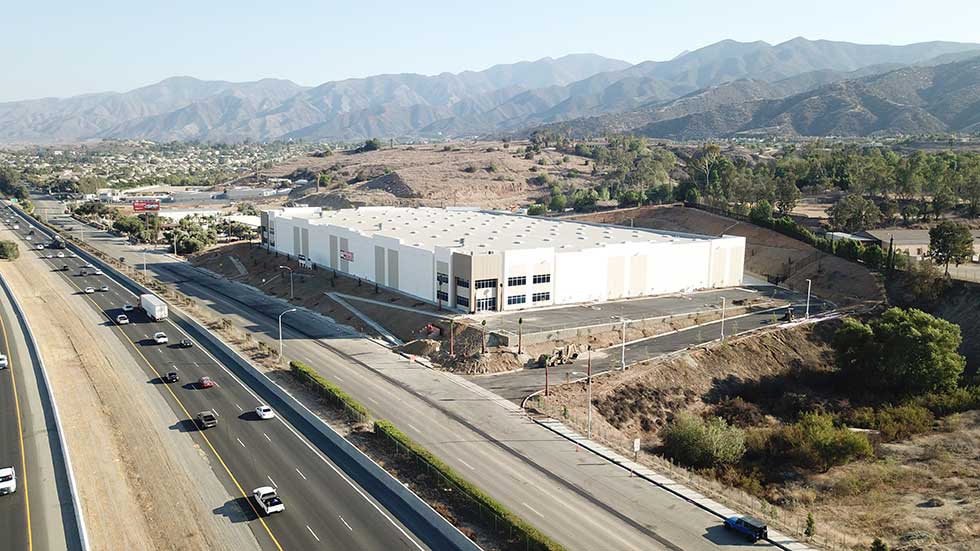
Industrial vacancy rates have never been lower. That might sound like an infomercial-worthy sales pitch, but, statistically, our jam-packed industrial climate is commercial real estate’s new reality. In major centers these vacancy rates are even more unbelievable—Los Angeles County has a less than one percent industrial vacancy rate, and Orange County’s vacancy rate sits at just two percent.

The altogether-too-obvious culprit here is e-commerce. But according to CapRock Partners’ co-founder and president Jon Pharris, the playing field runs a bit of a larger, more nuanced gamut—a gamut that does not begin and end with Jeff Bezos alone.
“Developers are trying to get as far ahead as possible to provide solutions,” Pharris said. “Even though over 20 million square feet are being delivered in Southern California alone . in 2018, demand is still outpacing supply.”
Founded in 2009, CapRock Partners is one of the largest industrial developers in Southern California, with a presence throughout the west in Arizona and Nevada and plans for further expansion in the Pacific Northwest. The company’s work with value-add industrial projects ranges from 15,000 to one million square feet, giving Pharris and his team a breadth of experience not often seen in the industry.
But according to Pharris, while demand is at an all time high and vacancies are at an all time low, we still haven’t seen anything yet.
“The migration of millenials buying e-commerce is only going to grow—we’re still catching up to Asia in that field,” Pharris said. “Especially as millennials age into prime buying times with higher discretionary income.”
The demand is putting the pressure on brick-and-mortar retail, particularly in CapRock’s home turf of Southern California where, according to CBRE, 40 percent of all deals are now tied to fashion and e-commerce in some way. In fact, it’s estimated that for every square foot of retail that is lost, three square feet of industrial is gained.
But the difference between these square footage stats is all in the location—retail closings are happening across the board nationally, but for new industrial space, location is a more focused affair. Last mile logistics, for example, have to be as close to a city center as possible to keep deliveries within a two-hour window.
“This is exactly what we cater our developments to. We benefit by being close to a large population, so when we design buildings, we design them with e-commerce in mind,” Pharris added.
However, that demand for last mile proximity is creating a conundrum in already claustrophobic major cities where speedy delivery times are the most in demand. After all, it’s not just big box buildings 500,000 square feet and up that are seeing an explosion of demand, but it’s centers as small as 50,000 square feet as well. So to keep up with consumers’ consistent desire for instant gratification, Pharris and his team have to get creative with a city’s existing square footage.
“Next day delivery is to a very large extent outdated,” Pharris claimed. “Now the focus is on same day delivery in urban population centers. This has created a new demand for 50-year-old functionally obsolete buildings that may have otherwise been torn down.”
For example, a vacant building in Los Angeles with a 16-foot clearance could still be usable for logistics, as e-commerce does not typically rack its product, so clear height is not as big of a consideration. In terms of big box spaces, malls are a very obvious consideration, as well as other retailers that are closing their doors such as Toys “R” Us and Sears.
In other words, e-commerce will be moving in to the very space that it has put out of business.
Perhaps the most telling test subject, Amazon, pushes its dropship fulfillment out to companies occupying buildings as small as a range from 20,000 to 50,000 square feet that are not Amazon branded. Additionally, CapRock works with clients who don’t occupy spaces that are more than 5,000 square feet. So while industrial is typically thought of as a far-off warehouse, in more and more cases, small warehouses are cropping up in city centers across the country.
“We work with a Fortune 1,000 company that signed the lease before e-commerce took off, now their business model has changed and they are absolutely thriving,” Pharris said of the still-booming business. “Today, much of their business is e-commerce.”
So while e-commerce continues to flourish, industrial is not quite the new retail. Brick-and-mortar retail will carve out its own niche in the market, as consumers still seek out and desire experiences that allow them to interact with and touch products. And as of right now, that’s not something your typical warehouse offers.
The retail apocalypse might be overblown, then, but the astronomical demand for industrial certainly is not. Indeed, with about two billion square feet in California alone, three billion square feet across the west coast, and a less than five percent vacancy rate for all of the above, it’s clear that the renaissance of click-and-buy product is far from over.




Add Comment