
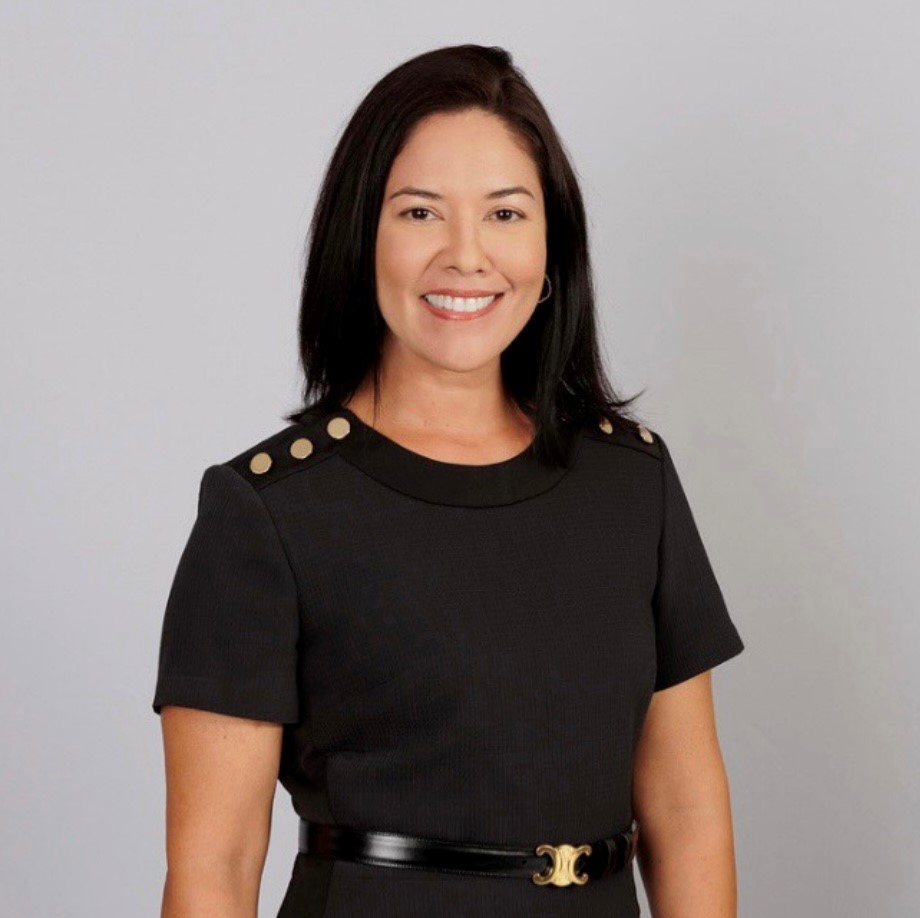
For more than a century, the Real Estate Board of New York (REBNY) has been the voice of the city’s real estate industry. And as the city’s skyline and the real estate industry have changed, so, too, is the trade association’s mission.
Helping to lead the way is Sandhya Espitia, the organization’s chief operating offi cer, charged with leading its organization-wide strategy and operations for programs, products and services, and bringing a new mindset to the association.
“REBNY’s power is its deep commitment to New York City real estate, which at times can be a silent engine, but we don’t stop working on mov-ing both the industry and the City forward,” Espitia said.
REBNY today is an organization undergoing its own shifts even as it navigates and leads the rapid changes facing New York’s commercial and residential real estate industries with what Espitia calls a “small but mighty” staff of just 52.
“It is a balancing act. The most important thing is that we understand that we are so interconnected,” she observed. “It’s a diplomacy walk every single day. Sometimes you shift from one party to another.”
Managing that walk is the culmination of a career path that has taken her from real estate to academia to association leadership. Her first job right out of college was in commercial real estate in Fort Worth, Texas, working with retailers and redeveloping distressed assets.
“I loved it. Real estate so essential to everything we do in an economy. But I always had an interest in working internationally,” she said.
After a year in retail leasing, she earned a master’s degree in international education and moved on to academia, first at Texas Christian University, and then at Harvard University. She focused on development issues in South America and then as a program development officer for the Americas, working with non-government organizations, technology programs, emerging economies and more.
But New York City beckoned and Espitia moved to the city in 2012. She kept her job at Harvard, where she was managing programs in seven different countries, and returned to Cambridge for one week each month.
“I was traveling to Cambridge and internationally a lot, but wanted to get my life started in New York and fully transition to a life here,” she said.
In 2013, she transitioned to a post created for her in new business development for the education and certifications department at the then-International Council of Shopping Centers (now ICSC), and reinvented initiatives in knowledge development for the global retail real estate industry.
“We saw that innovation was needed at the intersection of consumers, retail and real estate,” she said. “We traveled to different global regions to understand their pressing needs and created education and certification committees with local know-how, moving away from the traditional centralized approach of doing everything from the U.S.”
While at ICSC, Espitia was promoted to managing director of Latin America and the Caribbean. Her role ranged from being the Spanish spokesperson for the association, to creating a new Board of Trustees, from overseeing events and education, to translating ICSC’s research and proofreading publications for the Latin American retail real estate market. She built teams in New York City and Mexico City, negotiated the office lease and got on a plane often to be wherever she was needed. She grew the regional membership by 20% in one year.
“I was wearing every single hat you could wear. It was a formative experience,” she recalled. “I was pretty much running a company in a region.”
Two years later Espitia was promoted to vice president of education and certification globally. Travel was constant, developing partnerships and running the John T. Riordan School in the U.S., Latin America, Europe, the Middle East and Asia-Pacific. She also worked with various business schools, including the Wharton School at the University of Pennsylvania, where she hosted ICSC’s own University of Shopping Centers program, held annually in Philadelphia.
“Then I had my daughter, and I wanted to see her every day, which meant I needed to travel less,” Espitia said. “I realized I could take all these years of experience to one city and still make an impact. And I found REBNY.”
She joined REBNY in 2017 as a senior vice president of brokerage and felt the urgency to modernize the association.
“When I joined REBNY we had some organization-wide legacy issues affecting productivity, and I wanted to fix them, even though it wasn’t my job,” she recalled. “We needed new talent, better technology, a reliable database, performance accountability and deadline-driven processes.”
From there, her role naturally evolved into a chief operating officer, REBNY’s first, where she has continued to reinvent the organization. The Annual Gala has been reimagined with a younger, more diverse feel and food from top chefs, and now has corporate sponsorships, necessary to raise the funds needed to serve the 15,000-strong membership.
“While the iconic REBNY Gala was not part of my portfolio, I asked if I could take over the entire operation in 2018. Since then, we have transformed the event, and it now pays 25% of our operating expenses,” she reported. “We surpassed our fundraising goal this year, allocated 20% to support social impact initiatives in New York City, and the rest helps keep the lights on. It’s a very important event for us and I am proud of orchestrating its ongoing transformation.”
That’s just part of an overall shift in how a trade association must operate today, Espitia observed. It’s not just about networking and luncheons anymore. And even a non-profit must have a solid business understanding to help its for-profit members.
“Trade associations can struggle with legacy practices that become comfortable as they go through cycles,” she continued. “Today, associations need to deliver impact, not legacy. That means a focused policy agenda, products that solve problems and programs or events that are worth members’ time and money. It takes a learner mindset to keep things relevant. When associations become very good at learning and understanding industry issues, they are effective. The best association professionals I have met are learners, not knowers.”
While other real estate organizations serve just one sector or professional, REBNY must serve the entire ecosystem, she noted, from commercial developers and owners to brokers working in office and retail, engineers and the residential community, which constitutes 80% of its membership.
That’s why Espitia saw that REBNY needed to reconceive how it supports its residential brokerage members, and brought in Ninve James, a former executive with Realtor.com and a member of the New York City founding team at Trulia.com, as senior vice president of residential brokerage services and products.
Through a partnership with CoStar Group, James led the launch of the first consumer-facing search website and mobile app for REBNY’s Residential Listing Service.
“She also brought a business mindset to the association, which was important to match the needs of agents, a segment that represents 80% of REBNY’s membership,” Espitia said. “She transformed the way we do business in supporting residential brokerage firms and their agents. We needed industry expertise, and she brought a lot of that. We share this sense of urgency and speed that isn’t always known in the nonprofit sector. Sometimes we get shamed for being strong women and that’s okay.”
Another focus has been diversifying an industry that has remained stubbornly white and male. REBNY’s staff, on the other hand, is 70% female, including women across leadership levels.
“I am proud to work with incredible women at REBNY, from HR to finance, and from policy to social impact,” Espitia said. “We became intentional about diversifying the industry by creating a position that focuses on social impact. We hired Yvonne Riley-Tepie over two years ago to lead this effort. She’s been collaborating with different organizations, from fellowship to internship programs designed to support career growth for underrepresented groups.”
Influential women now coach other women, she continued.
“We have a new generation of brokers coming into the business, and we see talented women in need of visibility,” Espitia said. “On average, members in our committees, working groups, courses and fellowship program are 50% women, many of whom I’ve personally coached and learned from. Will our industry be completely diverse tomorrow? No. It will take some time. But we’re consistent in our efforts to diversify it and elevate women.”
As the industry changes, so will REBNY, Espitia said.
“Every era brings new challenges, and you must be a great athlete in changing your form and your skills if you want to win. My role has changed during my time here and that keeps me on my toes,” she said. “We are effective in what we do, whether we are loud or silent about it. REBNY has been around for 128 years as an engine that powers New York City’s economy through real estate. I am very proud to have a role in it.”