
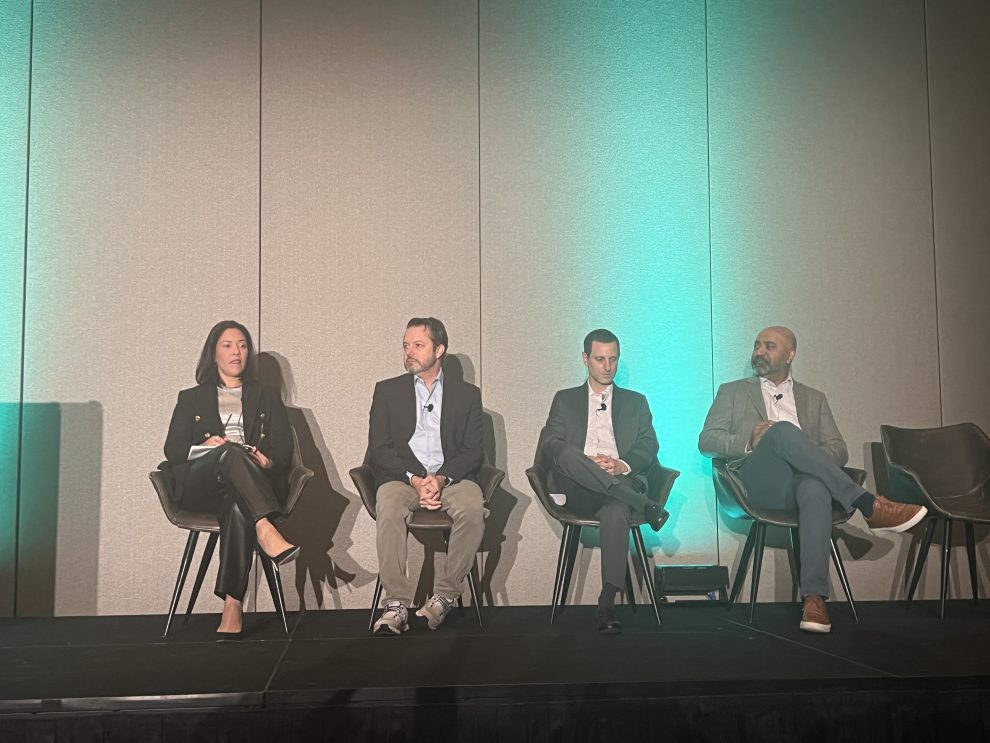
The understatement of the century is that New York real estate isn’t easy — but it’s worth the patience, effort and money, said speakers at the RETCon conference, held in March in Las Vegas.
The key is finding the openings in the market, building the right product and employing the right technology.
The biggest need and challenge, not surprisingly, is helping people find a place to live.
“New York needs tremendous investment in housing; unfortunately, we have not seen that in decades,” said Brian Peters, chief operating officer at Rose Associates. The 34,000 new units that came on line in 2024 is the same as in Raleigh, N.C. “It’s almost a tale of 2 cities. Among market apartments, we’re seeing rising rents and vacancy is very low. Rents at market units are extremely high — $120 per square foot per year.”
The best thing to be in New York City is a multifamily owner. Our portfolio operates at a 99.2% occupancy,” said Frank Monterisi, Jr., executive vice rresident at Related Companies. “But getting through the development is fraught with peril.”
Construction is difficult, he said, reminding the audience that Related’s Hudson Yards was built over an active rail yard.
“And the politics are scary; New York is very regulated. Costs go through the roof,” Monterisi said. “And it’s very litigious. Assembling sites can be very difficult. But you get through that to the other side, New York is a great place to be.”
Related’s new development on Roosevelt Island is seeing rents that are double that of its previous projects.
Those difficulties in building actually can be a competitive advantage for those who know what to do, said Tiago Correia, senior vice president of development at Extell.
“We’re very specifically focused on luxury new construction, so we’re somewhat insulated by that. It’s the nature of the condo business,” he said, acknowledging that “New York is notoriously tough, competitive and hard. I don’t know if any of us would have it any other way. That’s how our product stands out. The only way to hedge is for your project to be excellent.”
Related’s development at FM at Willets Point, across from Citi Field in Flushing, Queens, has taken nearly 15 years to begin construction, Monterisi noted. The 60-acre project, a joint venture with Sterling Equities, the New York City Football Club and the New York City Economic Development Corporation, will consist of a soccer stadium and 2,500 residential affordable housing units.
“We’re really proud of this project,” Monterisi said. “We’re building new housing in an area that needs new housing.”
There also is some need for new office space, which can offer the amenities that tenants now expect.
“We have tenants who are always looking for more space,” but the right space isn’t available, said , vice president of technology at Rudin Management. “Park Avenue is a construction site. Everyone is being patient.”
Location is also important — while some areas have seen immense vitality, other neighborhoods continue to struggle. Help is needed.
“The City of Yes program relieves some of the regulatory burden in the development process, Peters observed. “Also helpful is selective rezoning, such as in Midtown South, which is home to many 80-year-old office buildings. We’re trying to create an environment where office to residential can be done.”
But buildings have to have good bones, the right depths to be converted, and no tenants in place, Correia said.
“It’s really like the decathlon from hell, but it’s rather chaotic,” Correia said. “On any given day, we encounter a multitude of challenges. That’s what makes it fun for some of us but challenging.”
One thing that can help is technology, with AI reading and summarizing complex documents helping to manage buildings.
“Durst is doing more in predictive modeling,” said Mark Domino, director of digital at the Durst Organization. Robotics also can play a role — Durst has used robots for cleaning windows, under human supervision. “There is a reduction of engineering/labor roles, with not a lot of people going into those jobs. We’re looking into programs.”
There is still a long way to go for an industry that had historically been slow to adopt new technologies. But the potential is there.
“The way fintech transformed banking, the same has to be said in real estate in NYC,” said Mohamed. The way leases are negotiated, digital brokerage, definitely moved ahead
“AI has not had a significant impact in many places yet, but multifamily is an area where it can,” Peters said. “The next two to three years will see a tremendous evolution in the city.”
Tech also is expanding the commercial tenant pool.
“We looked up how many venture-backed businesses there are in Manhattan, and there are roughly 550,” said Stuart Bern, JLLT Managing Director, Americas Advisory Services. “Why are all these startups choosing the concrete jungle to be there home? It’s expensive. But there’s the best talent and access to a lot of diversity and capital. Specifically, within proptech, there is a lot of access to neat real estate, which drives innovation.”