
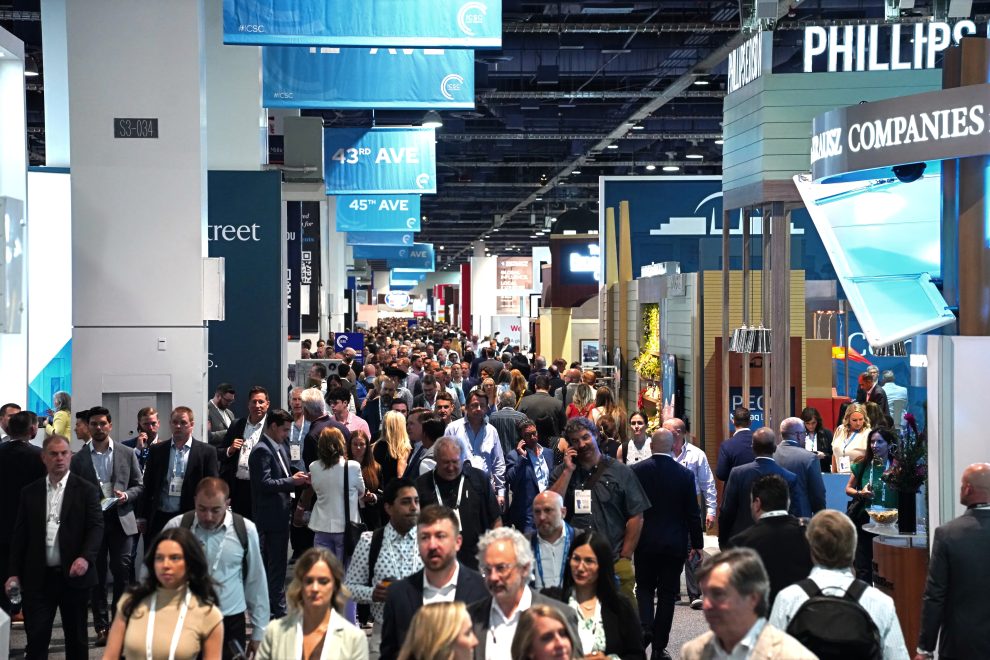
Retail occupancy remains strong and consumers remain resilient, but there are some concerns as the industry tries to grow, according to attendees at the annual ICSC@Las Vegas, held at the Wynn Las Vegas and the Las Vegas Convention Center from May 18 to 20.
New construction remains limited, benefi ting the sector in some ways, while also presenting challenges. As of the first quarter of 2026, some 64.2 million square feet of retail space was under construction in the U.S., down from about 70 million square feet a year earlier, and far below the 90 million square feet-plus during previous expansions, reported CoStar. The result is major competition for nearly every vacant space.
And ironically, the very strength of the sector — vacancy around 4% nationwide, resulting in strong rents — could get in the way of future success as retailers rethink their growth plans.
“The constrained supply right now has a lot to do with the lack of new construction,” said Ebere Anotuke, Americas head of retail research at CBRE. “The fact that there is so little new construction and very little on the horizon was really making it diffi cult for these retailers to find space. And a lot of them are opting to wait rather than overexpand.”
Site selection decisions can be expensive, he explained, making some companies cautious.
That same constraint may be preventing massive redevelopment of older properties, observed Adam Ifshin, founder and CEO of DLC Management Corp. With companies such as TJX Cos.,
Burlington, home furnishings and auto parts retailers and more allcompeting for existing space, it simply doesn’t make sense to spend money on major rebuilding.
“The market is too good to do a wholesale redevelopment,” Ifshin observed.
Expect, on the other hand, individual retailers such as Home Depot, Target and Lowe’s to begin building secondary stores close to existing older units that can’t handle greatly increased demand.
“In the face of those volumes, they’re putting in a new store to intentionally cannibalize the sales,” Ifshin said. “Then, they can renovate.”
In some respects that strength is due to consumers, who continue to shop in physical stores despite higher prices for gas and even other basics such as groceries.
“I’ve been expecting more of a pullback,” said James Bohnaker, principal economist at Cushman & Wakefield. Shoppers may be assuaged by a strong stock market, “and won’t stop spending until they have to.”
But what’s really interesting is the kind of space that remains vacant, observed Brandon Isner, head of U.S. retail research at Newmark. Retailers continue to fl y to quality, with the result that nearly half (47%) of the space that is vacant now has been so for 24 months or longer. A vast majority of long-term vacancy is in older centers, and an argument can be made that no retailer will ultimately want the obsolete locations.
“A lot of that space will never be leased again,” Isner observed.
But it could be acquired and turned into something else. Investors continue to look for opportunities, and are finding some high- quality locations, said Andy Graiser, co-president of A&G Real Estate Partners, which is marketing Walgreens, Saks Off Fifth and Office Depot locations, among others.
“They’re also looking at college campuses, and there is demand for B-quality distribution centers, some of which have a decent amount of land,” Graiser said.
“In retail, there is little to new development out there,” Graiser continued. The result, he said, is “very good demand and rents going up because vacancy is very low.”
Not surprisingly, experiences, value and necessities continue to dominate the retail categories that are growing. While many retailers may be opening fewer stores, new announcements are happening, with Isner citing ethnic grocers, pet foods and value retailers including Goodwill taking spaces.
“Those on the high end are doing quite well, those on the Lowe end are struggling,” said Herky Pollock, a founding partner of Legacy Realty Partners Pittsburgh, adding that deep discounters such as TJX and Marshalls continue to succeed as shoppers look for bargains. “Those in the middle are having the hardest time.”
Rising costs, Pollock continued, are preventing new entrepreneurs from opening.
“There will be more fitness, and health and wellness,” Bohnaker said, extending beyond gyms and med spas to newer concepts including hot and cold plunge pool concepts.
Graiser remains optimistic about theaters, as good content is continuing to increase. Restaurants, he said, are something of a concern, as the sector may be overbuilt, and young adults arespending less on alcohol, normally a major profit item.
Meanwhile, the very specialized luxury sector has its own challenges and opportunities. Luxury will continue to fl ock to the world’s great high streets, said Todd Siegel, president of U.S. retail of Savills, discussing the fi rm’s recently released “Global Luxury Retail 2026” report. The report ranked New York City as the world’s top luxury retail market, followed by Beijing, Paris, Bangkok, Milan, London, Los Angeles, Miami, Tokyo, Shanghai, Hong Kong and Singapore.
“There is a lack of availability on Madison Avenue, Bond Street, the Avenue des Champs-Élysées,” he said.
In seasonal luxury markets such as the Hamptons, Aspen, Colo., and Montecito, Calif., luxury retailers are taking advantage of thelast after-effects of COVID-19 that depressed high street rents.
“Rents in the U.S. dropped so much during the pandemic, that this is now our moment,” Siegel said. “New York City, Rodeo Drive saw such an uptick over the last 12 months.”
That could mean opening smaller shops, especially in markets that are less dependent on tourism and are supported by local wealth, such as Silicon Valley and Dallas. Conglomerates such as LVMH and Richemont that control dozens of global brands are moving quickly when they see an available space.
The key is to “get closer to the customer,” Siegel said.
As it is for all retail.