
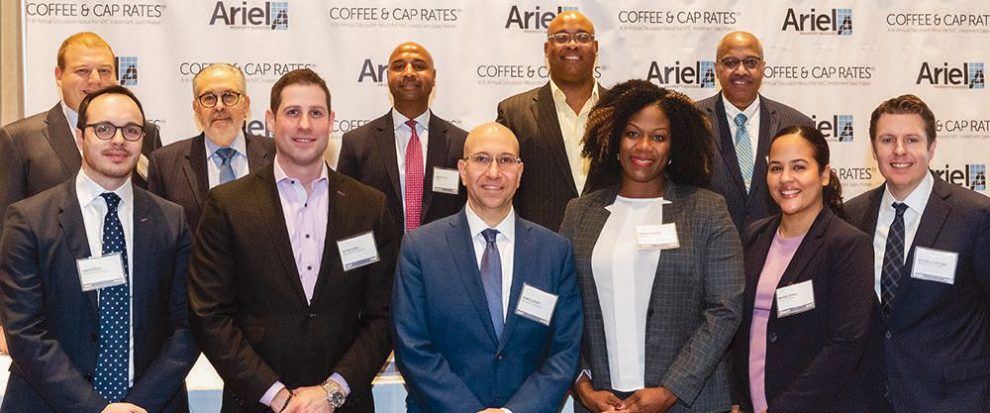

With tax law changes in 2019 and an election in the fall, real estate investors have faced uncertainty in the last year, at least according Ariel Property Advisors’ Multifamily report, discussed at the firm’s “Coffee and Cap Rates” conference in February. The event also featured a presentation by Legal Outreach, a nonprofit that prepares students from underserved communities to prepare for higher education and professional careers.
Throughout the city, with only a few exceptions, transaction volumes, building volumes, dollar volumes and total unit transactions declined both overall and in in Manhattan, the Bronx, Brooklyn and Queens, the company reported.
“Multifamily has been in turmoil since the beginning of 2019,” said Shimon Shkury, president of Ariel Property Advisors. “We’re seeing a structural change we haven’t seen in our lifetime in New York City.”
That means that each asset must be examined individually for underwriting, said Joseph Fingerman, managing group director at Signature Bank, in a panel discussion. While they’re seeing clients looking at Texas and Florida, “We are still lending [in New York]. But we do spend more time on the legal end.”
In 2019, the city experienced $6.91 billion in multifamily investment sales activity, totaling 290 transactions covering 451 buildings, with all metrics showing a decline. Dollar volume dropped by 40%, transaction volume declined 36% and building volume was down 47%.
Unsurprisingly, Manhattan posted the highest dollar volume in the city at $2.38 billion, but that was down by 52% versus 2018. However, price per square foot and price per unit increased. Brooklyn saw $1.5 billion trade (a decline of 48% over 2018), but that number was skewed slightly by the $904 million sale of Starrett City in 2018. Otherwise, dollar volume would have dropped by just 24%.
In terms of pricing, “We’re seeing a mixed bag,” Shkury observed. “Queens and Northern Manhattan stayed flat, while the Bronx increased. The South Bronx is doing extremely well” due to its proximity to public transportation.”
“There’s a tremendous amount of oversupply in condos,” Shkury continued, noting the impact of higher transfer taxes and mansion taxes and a decline in international investors.
That means that the days of buying a rent roll are over, said Tyrone Barnes, vice president of Taconic Investment partners. “The law took out the quick hitters and flippers,” he said.
Nuveen Real Estate isn’t buying multifamily right now, preferring workforce housing, said Nader Settles, a managing director. But the team is watching what’s happening at both Hudson Yards and Grand Central with interest.
“We love Hudson Yards. It’s great for the city,” he said, adding that it helps his own company’s location near Penn Plaza. “And Grand Central is an amazing story. When you look at all the capital going in, it will revitalize the area. There will be a push back east.”
Transactions volumes declined 40%, though the price per square foot rose 5% in Manhattan and 8% in Brooklyn. However, the clarifications issued in the last quarter of 2019 resulted in transactions picking up again, Shkury noted.
Ariel expects 2020 pricing to follow the same patterns as 2019 with cap rates trending higher. But the presidential election remains a wild card and should result in transactions slowing in the fourth quarter.

Long Island City is “densifying, changing,” Settles said. “Life sciences will have a great opportunity to grow.”
High street retail will survive, he added. Traditional restaurants can still appeal if they are the right experience.
“Retail has its challenges,” Settles said. “But as it is repriced, it can appeal to investors.”
Others are less certain. Signature Bank looks much more closely at projects that include retail, especially which tenants might be able to break leases.
“We like retail,” said Joseph Fingerman, managing group director. “But we’d rather have services. In the New York area, some landlords are happy to get rid of these tenants.”
Despite the woes of WeWork, the concept itself remains a strong one. the attendees agreed.
“The business model is here to stay, and the fact that they’ve hired Sandeep [Mathrani, former chief of Brookfield Retail] is good,” Settles said. “We have a building in Penn Plaza that is largely leased to WeWork, and it works well.”
Co-living, he added, appears to be growing and could be something Nuveen examines..
Opportunities also exist outside the city limits. Transit-oriented developments should thrive in New Jersey over the next 10 years, Barnes said, though they’re more problematic in Long Island because of local objections, Fingerman noted.
Demographics also will play a role. As baby boomers continue to age, 55-and-over communities will become increasingly important for the next two decades, Barnes said.