




How family brand Raga harmonizes the traditional with the contemporary
If we’ve learned anything from epic poets, it’s that great artists often need to invoke a muse for inspiration. But what if that muse wasn’t an abstract character of beauty and art and, instead, was a life coach? And also your mom?
As a figure of authenticity and spirituality for her husband and sons, Savita Chaudry has proven to be quite the anchor for her family’s business, Raga.
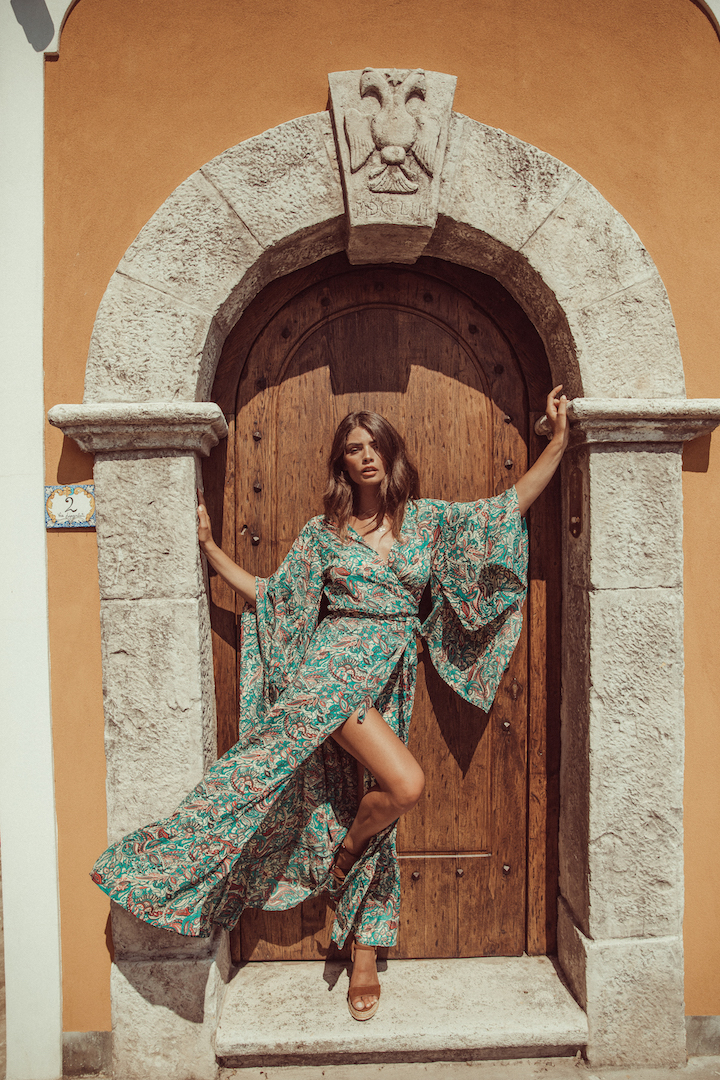
“The Raga woman really takes a lot of influence from my mother,” admitted Sahil Chaudry, brand director of the Los Angeles-based brand. “Our clothes are loose, free-flowing — but they’re elevated. I think that spirit comes from my mother, because she has that feel, and we do discuss what she would wear and what she would feel as part of the brand aesthetic and spirit.”
 As a co-founder with her husband, Savita’s words, “We are here to play our notes,” have nourished the center of Raga as a brand. This idea feeds into the dual meaning of the very word raga, which comes from Sanskrit. The raga scales are the basis for classical Indian music (as opposed to the heptatonic scale of most Western music). It also means “to dye” — a translation that the brand uses more literally.
“When you sing the raga, you are coloring the souls of the audience,” said Sahil. “And our main message through our colors is that we’re better when we’re together.”
Familial and cultural unity is a message that extends far beyond the translation of the brand’s name and origins. Sahil and his father, Krishan, who designs most of the line, are committed to bridging gaps: from music to color, India to California, traditional to contemporary.
In many ways, the evolution of Raga’s designs mirrors the journey of the Chaudry family. As a recent Indian immigrant in 1976, Sahil’s father was looking for a way to feel at home in Venice Beach, California. According to Sahil, Krishan started with a small retail shop where he sold Indian-inspired clothing and other kinds of goods. He discovered a passion for designing clothing when he looked at the customers walking into his store and thought, “What could I do for them?”
Though he had no previous experience in fashion or design, Krishan was emboldened by the opportunity to connect with his new California community.
“We’re coming at this from a cultural perspective,” Sahil said. “I would say that this is our way of connecting our heritage with our home.”
Once they found a way to connect their vision to products their customers wanted, the Chaudry family stuck together in business. Sahil, a lawyer, and his younger brother, Samir, a film-maker, joined their father’s business in 2012 with the vision to make it more contemporary. Since then, the frequent trips to Rajasthan have become a family affair.
“We go to India, and we work with a network of artists and suppliers that my dad has built up over the last 40 years,” Sahil explained. “We spend a few weeks in the factory, and we go in with an idea about what kind of collection we want to create. But really, I have to say that we let go and kind of let India help us figure it out. Because we walk the streets, we look at the fabrics, we look at the colors, we look at the artwork, and we let that inform us. So we really don’t chase trends, we let those trips that we take design the collection for us.”
Some of the partners that Raga works with have been doing traditional Indian printing for generations. Some of them, Sahil reported, even created prints for royal families. With so much practice and history behind them, the brand is positioned to work with a lot of gorgeous material — but Sahil emphasized that they do not fall back on tradition.
“We’re not just picking up traditional pieces and bringing them here,” he said. “We are cutting and stitching them into pieces that you could wear … to the beach.”
The contemporary story of India-meets-Los Angeles is one that Sahil and his brother have tried to emphasize since beginning work with their father. While they often use prints from saris or traditional patchwork in their designs, Raga repurposes these elements into fresh styles, like maxi skirts or jumpsuits.
“Every piece that you see from Raga is some traditional artwork that has been adapted to be contemporary,” he said. “As we get to know what our community wants, you see the collection evolve. We only grow as our community grows.”
The translation of Indian-inspired styles to the streets of LA reflects another core tenet of Raga’s philosophy.
“When you’re wearing our piece, we want you to feel at home in it,” Sahil said. This is true even for the muse and spiritual anchor of the brand itself.
“My mom basically only wears the clothes my dad designs, and I think it’s because she also feels at home in [them],” he continued. “I think that’s a real core tenet of our business and our brand. It’s that we want people to feel at home sharing themselves authentically.”
As the brand continues to grow, Sahil wants to make sure that he and his family remain grounded in that mission as well as their commitment to building bridges.
“We’ve learned to be more present and just take our business day by day. The most important thing is just to let our community guide us,” he said. “I hope that every time someone wears a Raga piece, it’s one more voice in the world for a more multi-cultural and inclusive world.”


