




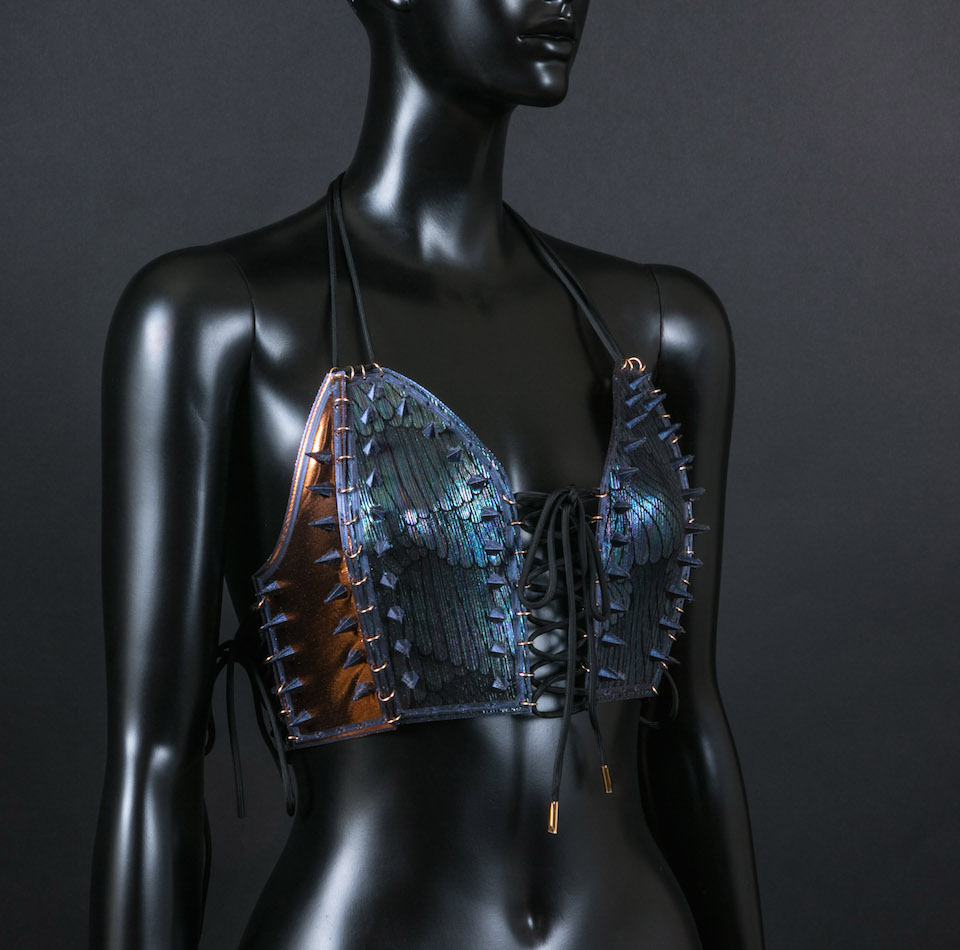
Freelance designer David Shorey is thinking one dimension ahead
When speaking with designer David Shorey, you might wonder: is this science fiction or science fashion?
It’s not often that you meet someone who is so comfortable moving between women’s wear and a wearable exoskeleton programmed to teach you a new skill via muscle memory — even if that women’s wear is 3D-printed. But then again, Shorey did not set out to make regular apparel. As he said, “Fashion is only part of it.”
Shorey first had the idea to 3D print for fashion about two years ago, after watching his mom do embroidery work. Curiosity got the better of him, and he decided to try printing on porous fabrics, like cotton, organza, silk and tulle.
“There is no formal training,” he said, referring to 3D printing. “It’s about being part of a community of 3D printers and using online resources.”
Up until recently, 3D printing has been tough for laypeople to access. The technology was first  invented in the 1980s, though according to Shorey, only a select few companies could use the technology due to patent protection. Cost was also a significant barrier; the first 3D printer available for under $10,000 didn’t appear until 2007 (according to 3D Printing Industry online), and the first commercially available 3D printer in kit form arrived in 2009. For many hobbyists, communal printers are still the best option.
“I went to maker spaces when I was first learning it,” Shorey explained. “It was really difficult.” He had to learn to adjust the printer, because what might have worked for one print could have shifted after weeks of use, leading to a mistake in another.
“There’s a high failure rate for 3D printing,” he continued. “And that rate increases dramatically when you add fabric.”
The steep learning curve hasn’t stopped Shorey from exploring a multitude of design opportunities, though. He has made industrial products, such as steel mesh and carbon fiber glass screens, as well as creative lighting fixtures that channel origami techniques. He has worked on visual effects for movies and TV productions, and he finds a receptive audience of cosplayers who covet his garments.
His creative process for fashion usually begins, like many traditional designers, with a dress form, which he marks with tape.
“Then, I try to find fabric and 3D-printed filament that compliment each other,” he explained.
Finally, he uses a computer program (the same one that you might use to design car parts, shelves or any other 3D printed item, he noted) to lay out the shapes that will ultimately compose the final garment.
Shorey describes his aesthetic as something that embodies both “‘80s-influenced sci-fi” and “avant-garde runway,” since he designs everything from shoes (aptly named “cyberella”) to bags (like the “StarShopper,” modeled on the starhopper space ship from Star Wars) to festival wear.
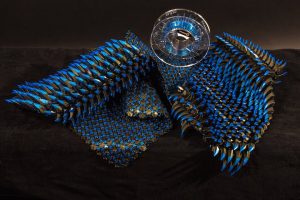 Sometimes, Shorey’s fashion designs disregard fabric and sewing all together, using only printed parts and metal loops to join the final product.
“I wanted to show how you can overcome a lack of sewing ability with technology,” he said. “I’m using tools that give me a level of precision that I couldn’t get if I were just doing it by hand.”
Moving forward, Shorey hopes to perfect many of the designs he has been working on, though this sometimes proves to be a challenge.
“I just want to get the vision out of my head at a quality that it’s at in my head,” he chuckled.
And if you’re still curious about the exoskeleton prototype that may teach you to play the piano, there’s a video on Shorey’s instagram (@shoreydesigns).


