




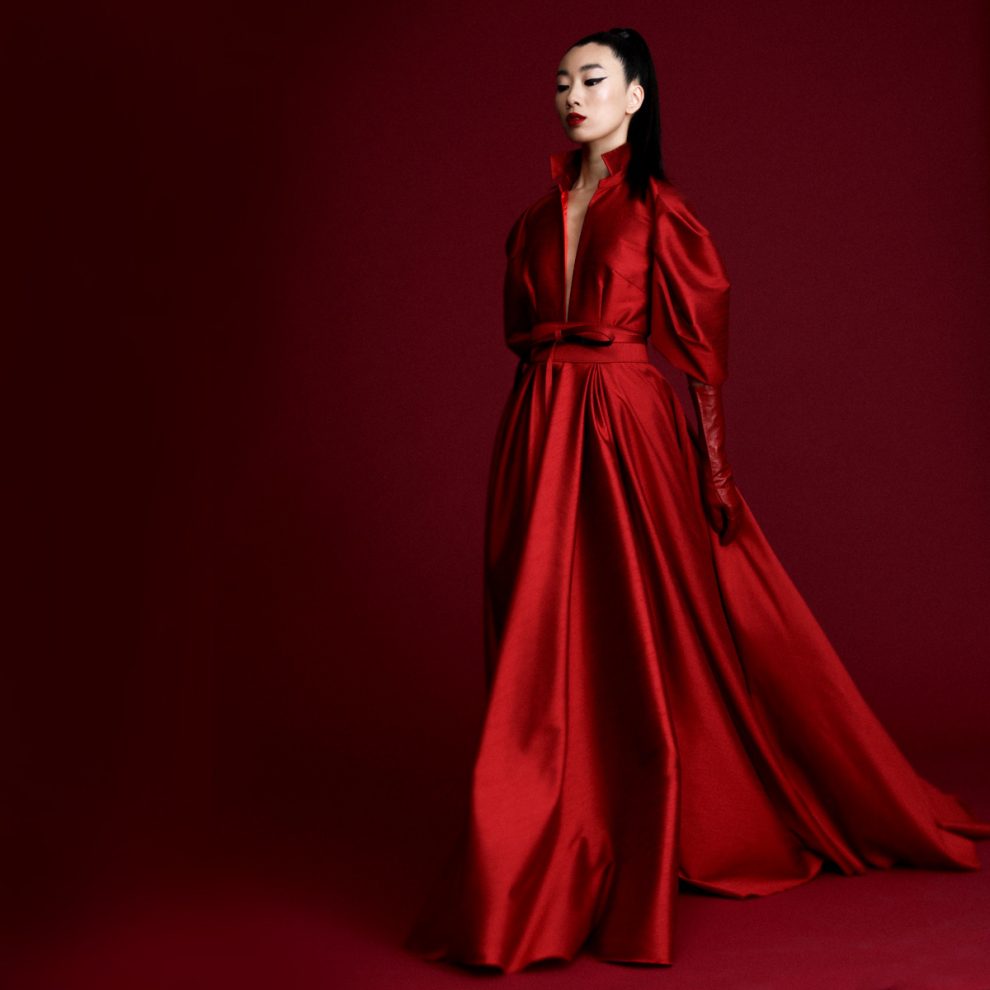
Cyril Verdavainne’s rise as one of New York’s most compelling eveningwear designers began not with a meticulously charted plan but with a series of unexpected shifts. Long before his Manhattan atelier became a destination for discerning women seeking custom luxury, he was a young Parsons Paris student sketching for Pierre Balmain and Thierry Mugler in the late 1990s. Couture was his world. New York, he admits, was not. But when Parsons required all Paris students to complete their senior year in New York, he had no choice but to cross the Atlantic. What he found upon arrival was a fashion landscape unlike anything he expected.
The adjustment was jarring. “I wanted to create masterpieces,” Verdavainne said. But the American market of the late ’90s was undergoing a profound shift. Oscar de la Renta was designing couture for Balmain in Paris, while Geoffrey Beene continued crafting brilliant outliers; yet, across the U.S., designers who had once pursued artisanal technique were now elevating commercial sportswear. Donna Karan was opening her major Madison Avenue flagship. Tommy Hilfiger was expanding well beyond the denim-driven casual wear that made him famous. Calvin Klein was preparing to bring on Francisco Costa. And soon after, Zac Posen would emerge with sharply tailored, Charles James-reminiscent silhouettes that reignited a conversation about American glamour. For a young designer steeped in Parisian couture codes, it was simultaneously disorienting and electrifying.
His first Parsons New York assignment underscored this cultural divide: “Design a collection for Donna Karan and Tommy Hilfiger.” Verdavainne recalled, “I called a friend at Vogue Paris to ask who they were. There was no internet. It was painful.” Yet, the challenge forced him to engage with a market driven by pragmatism and velocity. Slowly, the world he initially resisted began to take shape as an opportunity.
By graduation, Verdavainne no longer envisioned a return to Paris. New York’s intensity had captivated him. “The energy, the drive, the edge—things moved faster here,” he recounted. In France, he felt constrained by bureaucracy and entrenched hierarchy. In New York, he felt possibility. And importantly, a Parsons degree carried more weight in the U.S. than it did in Paris; professionally, staying just made sense.
His early career became a crash course in the rhythms of American fashion. As a French citizen on an H-1B visa, he had one year to secure sponsorship. Carmen Marc Valvo hired him, and although he left periodically to explore other opportunities, Verdavainne credits Valvo with shaping his understanding of the eveningwear business. “It took me 20 years to truly understand how fashion works here,” he said. That long education laid the groundwork for Verdavainne, his own custom luxury eveningwear brand, now known for its impeccable craftsmanship and deeply personal approach to service.
Today, Verdavainne’s Manhattan atelier attracts clients nationwide and, increasingly, across Asia. His philosophy remains grounded in couture discipline but responsive to contemporary realities. He believes that the future of eveningwear lies in service, intimacy and custom solutions. “There is a real thirst for service and the custom experience,” he said. “Direct-to-consumer is essential. No one is buying a $3,500 dress online with a no-return policy.”
That commitment has garnered industry recognition. Verdavainne’s New York Fashion Week presentations—staged in the private dining room at Cipriani Wall Street—were strikingly well received, catching the eye of fashion financier Gary Wassner. Wassner chose to feature Verdavainne as a “One to Watch” in Fashion Group International’s Communiqué newsletter, which soon led to a nomination for FGI’s 2024 Rising Star Award in Eveningwear. Verdavainne won.
His clarity extends to his perspective on the shifting retail ecosystem. Department stores, he says, once invested heavily in young talent. Buyers took risks; stores nurtured talent and rewarded discovery. “Today it’s all drop-ship,” he explained. “No one wants to own stock.” Saks, where he held trunk shows, recently suspended events for designers without in-store placement. Rather than lament the loss, Verdavainne doubled down on his showroom, where he can maintain control and create a client experience grounded in trust and precision. “We’re growing slowly and steadily,” he said. “Supporting smaller stores and being supported by them. Back to basics.”
Yet the future he thinks most about is not his own—it is the next generation of designers. Fashion schools, he notes, face the challenge of balancing educational aspiration with workplace truth. “In 2001, there were 75 of us graduating from Parsons and almost no jobs. Last year, there were 280 graduates.” Social media, he warns, layers a glossy sheen over the industry, making success appear instant and effortless. “Young people see these posts and think it’s the way the fashion industry works. But they don’t show what it takes to last.”
To counter that illusion, Verdavainne now lectures, sharing the realities, setbacks and endurance required to build a career that lasts beyond a few seasons. His ethos is anchored in giving back—not only to students but also to women battling cancer, a cause deeply personal to him and his husband. Through partnerships with the American Cancer Society and Ambulance Wish Singapore, Verdavainne participates in auctions and events that channel fashion toward meaningful impact. “Fashion must have a higher purpose,” he said.
For aspiring designers hoping to launch their own line, his message is straightforward: Work for someone else first. Learn their problems. Understand the customer—truly understand her. Build relationships before building product. “If it is real clothes you want to create, find out who you are making them for,” he advised. “Only then do you learn what it takes to begin.”
Cyril Verdavainne may have arrived in New York by necessity, but he built his house by design. Through craft, candor and purpose, he has become an essential voice in American eveningwear—one shaping not just what women wear but what the industry values.


