
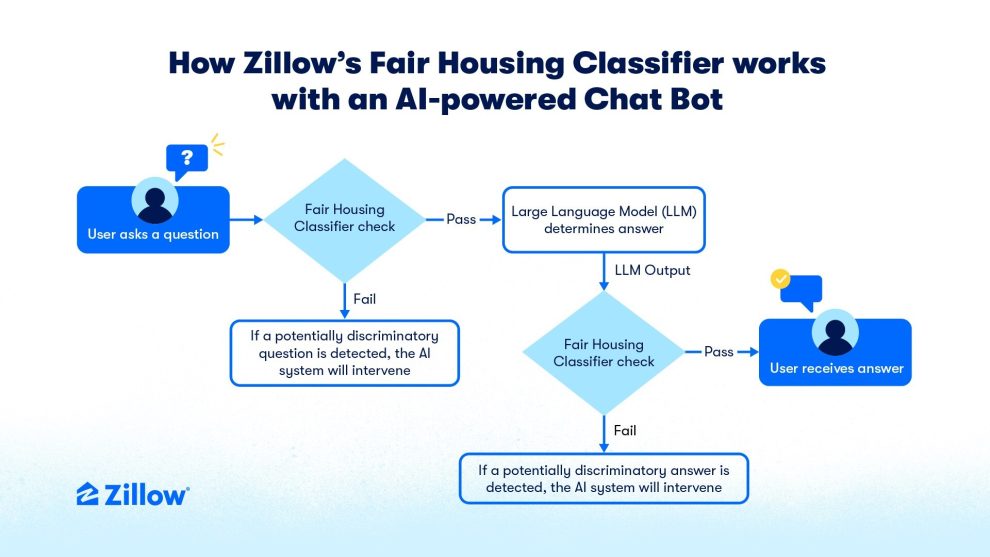
Zillow as released its open-source Fair Housing Classifier, which establishes guardrails to promote responsible and unbiased behavior in real estate conversations powered by large language model (LLM) technology.
The Fair Housing Classifier acts as a protective measure, to encourage more equitable conversations with AI technology. Zillow’s Fair Housing Classifier focuses on mitigating the risk of illegal steering — the practice of influencing a buyer’s choice of communities based upon the buyer’s legally protected characteristics under federal law.
Many AI tools disregard fair housing requirements and, when deployed, can perpetuate bias and undermine the progress achieved in advocating for fair housing. Zillow’s Fair Housing Classifier focuses on mitigating the risk of illegal steering — the practice of influencing a buyer’s choice of communities based upon the buyer’s legally protected characteristics under federal law.
“Since 2006, Zillow has used AI to bring transparency to home shoppers, powering tools like the Zestimate,” said Josh Weisberg, senior vice president of artificial intelligence. “We’ve made it our business to increase transparency in real estate — open sourcing this classifier demonstrates that advancements in technology do not need to come at the expense of equity and fairness for consumers. We’re offering free and easy access so that others in civil rights, tech and real estate sectors can use it, collaborate and help improve it.”
The Fair Housing Classifier acts as a protective measure, to encourage more equitable conversations with AI technology. It detects questions that could lead to discriminatory responses about legally protected groups in real estate experiences, such as search or chatbots. The classifier identifies instances of noncompliance in the input or the output, leaving the decision of how to intervene in the hands of system developers.
“In today’s rapidly evolving AI landscape, promoting safe, secure and trustworthy AI practices in housing and lending is becoming increasingly important to protect consumers against algorithmic harms,” said Michael Akinwumi, Ph.D., chief responsible AI officer at the National Fair Housing Alliance. “Zillow’s open-source approach sets an admirable precedent for responsible innovation. We encourage other organizations and coalition groups to actively participate, test, and enhance the model and share their findings with the public.”
The decision to offer the Fair Housing Classifier as open-source underscores Zillow’s commitment to transparency, equity and fair housing in real estate, the company said. Organizations looking to adopt the Fair Housing Classifier can access the code and comprehensive framework on GitHub. Trusted partners who would like to contribute to and enhance the classifier can reach out to the email alias on the GitHub page, through which they can request access to training data and a pretrained model, after presenting a genuine use case. This transparency is key to encouraging contributions to improve the model. Improvements to the Fair Housing Classifier can be submitted via the standard request process on GitHub.
Although fair housing laws — which ensure equal and nondiscriminatory access to housing — have been in place for nearly 60 years, discrimination remains a stubborn factor in housing, Zillow’s latest Housing Aspirations Report shows. The survey found a majority of respondents (57%) reported experiencing some kind of housing discrimination, with groups such as LGBTQ+ populations reporting discrimination at higher rates. However, overall, only 42% of respondents reported that fair housing impacts them or their families, highlighting how much work is needed to continue to educate people about their rights under fair housing laws.