
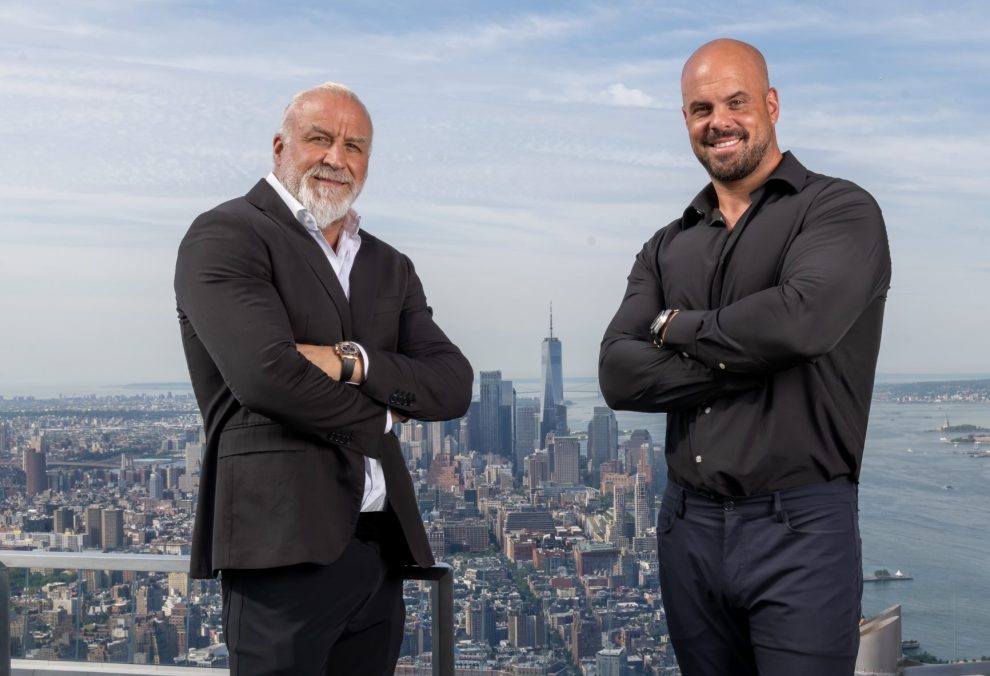
Many companies celebrate a centennial with a party. C & A Seneca Construction, a family-owned company celebrating its 100th anniversary this year, builds the floors where the parties happen.
Founded in 1926 by Anthony Seneca, the firm has remained family-owned and operated for four generations, evolving from a trade business into a dominant builder of hospitality spaces in the city. This transition became complete after Anthony Seneca’s great-grandson Carlo Seneca, CEO and president, redirected the company’s focus into the New York City hospitality sector and high-end residential amenity spaces nearly a quarter of a century ago.
Since then, C & A Seneca Construction has worked with developers and brands including Related Companies, Tao Group Hospitality, Lightstone Group, Marriott, Silverstein Properties and Dream Hotel Group. C & A Seneca Construction has completed over $1 billion in New York City construction.
“I kind of kicked in the door by opening my own nightclub to come into the hospitality end, and from there, we haven’t stopped a day,” said Carlo Seneca, the fourth generation of his family to run the company. “That was in 2003. So, now it’s 23 years of just strictly hospitality building.”
C & A Seneca Construction projects that have been completed or are in progress include: a full renovation of the 101st floor of 30 Hudson Yards, which includes Tao Group Hospitality’s Peak with Priceless and Avenue Sky Lounge; Brooklyn Tower’s amenity spaces with the largest outdoor pools in New York City; 222 Broadway’s Wrey residences amenity spaces with the largest indoor and outdoor pool overlooking the Freedom Tower; Above Rooftop, the largest rooftop in New York City and many hotel renovations. Over the years, the company has become known for craftsmanship, innovation, speed and an ability to accomplish designs that other builders would consider impossible.
Company founder Anthony Seneca was a millworker, with a gift for kitchen cabinets and other ornate woodworking. From there, his son Carlo Seneca, the second generation, progressed to building custom houses on Staten Island, developing such a strong reputation he had a two-year waitlist for his services. After, the third-generation Anthony Seneca expanded into commercial real estate, including strip retail centers, daycare centers and medical facilities throughout New York’s five boroughs. These are the sites Carlo worked in his youth.
Carlo Seneca never met his great-grandfather but was in training with his father and grandfather from the age of seven.
“I worked with them daily — every Christmas break, Thanksgiving break, Easter break and then during the summer every day,” he said.
That’s how he came to love the business — in time.
“When all the kids are at the malls and playing, and you’re not able to go, at first you don’t love it,” he recalled. “But I really started getting excited when at around 10 or 11, I could jump in the big equipment like the bulldozer and backhoe. I was able to drive the trucks on the site — not on the street — and that’s when it started becoming really fun for a kid.”
Carlo earned a civil engineering degree from Manhattan College. By the time he reached adulthood in the early aughts, he had another interest — nightclubs.
“I was going out every weekend to all the clubs — the Tunnel, Limelight — with a friend who was an attorney,” Carlo remembered he said. “One day, we saw one of the owners and thought, ‘If he could do it, we could, right?’”
The two found a location, raised the funds and opened a club in West Chelsea. True to family tradition, quality design mattered. Carlo hired globally renowned Stephane Dupoux of Dupoux Design as the designer and Joe Klineman as the architect to help him build a unique Miami vibe style club, Quo Nightclub — a high-energy Chelsea nightclub-lounge.
“That was one of the core points to where we are. Once he saw how I built my own nightclub, with quality and speed, he said no one would work on anything for him in New York City but me,” Carlo said. “That has always been at our core — exceptional attention to detail, understanding and sticking to budgets and most importantly timelines, surpassing the expected. This creates long-standing relationships and fabulous end results.”
As a result, Carlo Seneca built the long-awaited New York City branch of Buddha-Bar for famed owner of Buddha-Bar from Paris and Stephane Dupoux, which led to a restaurant for Sant Singh Chatwal and Greg Briar, and then hotels for Dream Downtown Hotel, Chatwal Hotel and many others. Today, the company focuses solely on hospitality and entertainment.
“Specializing weeds out competition,” Carlo said. “And it’s also fun. Every project is different. One day we could be building a spinning carousel on a roof, or a 32nd floor infinity pool over the Freedom Tower. It’s ever-changing.”
In time, he brought in Bruce Moshier, first as a project manager and now COO and partner, via an unusual route.
“It almost felt like fate — I answered a Craigslist ad, which wasn’t even common then, met Carlo and the connection was immediate,” Moshier recalled. “I had grown up working in construction, earned a degree in architecture, spent a few years in an architectural firm and I realized I missed the hands-on side of building. Joining Seneca gave me the opportunity to combine my construction background with my architectural education.”
Together, the two oversee a team of 170 dedicated to building quality and keeping to timelines other construction fi rms might consider impossible.
That speed and quality come from C & A Seneca Construction’s vertical integration — nearly all services except mechanical are in-house, courtesy of two architects and more than 100 master skilled tradespeople. This can save weeks up front, Carlo noted.
“It allows us to maintain control over every stage of a project — from fabrication to execution — rather than relying on outside subcontractors. The more we control internally, the better we can protect quality, maintain schedules and uphold Seneca’s reputation,” Moshier added. “It’s really part of our secret sauce: by managing the process ourselves, we deliver a more consistent product and keep projects moving effi ciently.”
The firm also continues to adapt to changing needs. The basics of hospitality remain the same, Carlo noted. “Owners and developers are still building expensive, large spaces. But what’s in them is changing. Entertainment is a sector that must adapt to the interests of each new generation.”
“The trend has shifted away from massive mega-clubs toward more intimate, curated experiences. High-end lounges, private social clubs and supper clubs are thriving, offering exclusive atmospheres and personalized hospitality,” Moshier observed. “Guests are looking for memorable experiences, and every venue now needs a standout feature — an ‘Instagram moment’ that makes it unlike anywhere else.”
Unlike a decade ago, when much of the company’s work centered on large hotel renovations, demand has risen for high-end residential conversions and amenity-driven spaces, Moshier said.
“Residential buildings have evolved far beyond a gym and bike storage — they now feature golf simulators, bowling alleys, dog parks, children’s play spaces, expansive indoor-outdoor pools and wellness-focused amenities that create a true lifestyle experience,” he said.
A current project is seven floors of amenities at The Wrey at 222 Broadway.
“I’ve never seen amenities like this in my life,” Carlo marveled. “The gym there is better than any luxury fitness gym yet built. The pool is 80 feet long in the lower level. Similarly, at the Brooklyn Tower, we’re doing three huge pools: one that is 80 feet long and two 40-foot-long pools.”
Rooftops remain a focus, one the company has been accommodating for years. The Moxy Hotel rooftop, Moshier’s fi rst project with the company, wanted a spinning carousel on a roof. The price was “astronomical,” Carlo said, but was too important to eliminate.
“I told them that they should just buy the material, and I’d give it to them for free,” Carlo said. “We couldn’t delete it.”
“The client came to us with nothing more than a sketch on a napkin and asked if we could design and build it so it would rotate,” Moshier added. “We engineered the entire concept from scratch, figuring out everything from the structural system to the rotating electrical connections.”
But the only person with the expertise to build it was working on another C & A Seneca Construction rooftop project. So, after informing that client what was going on, the carousel was constructed in pieces on the other building, disassembled, transported to the hotel and reassembled.
“And every year, the Moxy Hotel decorates it,” Carlo said. “What draws everyone in is that carousel — it is a major draw.”
That became the foundation of a long-term relationship with the client that resulted in multiple additional projects over the next decade.
“Earning that level of trust — and keeping it over multiple projects — is something I’m incredibly proud of,” Moshier said.
All the demand doesn’t mean that C & A Seneca Construction is growing too big. Carlo remains choosy about the company’s projects to ensure quality and keep relationships strong.
However, the company was recently licensed and opened a new office in Miami led by Romeo Soriano, COO and partner for C & A Seneca Construction Miami, for future opportunities there. Soriano is presently overseeing The Thomas, a 17,000-square-foot new, Art Deco-inspired restaurant and supper club, set to open in Tribeca this fall for the hospitality and entertainment entrepreneur Brandon Voss.
Guests will enjoy exceptional dining alongside live jazz, vocalists and specialty performances (imagine seeing aerialists soaring above the diners).
“I like the way we’re doing it now. We have the best reputation, we perform, we always hit schedules. I have no need to get any bigger,” Carlo said. “I just want to stay the best, be the best, and have the best quality.”
Carlo is preparing the company’s fifth generation, with his two sons and two daughters attending courses at the American Institute of Architects in their teens.
“They don’t do work old-school as I did for my father and grandfather, but I do show them the sites and teach them,” he said.
And it’s still fun.
“We’re doing a supper club right now. We have to figure out how to make a zip line so that I can have a dancer fly across the club,” Carlo said. “Every day has something different like that. That’s why hospitality is great, because there’s always something crazy.”