
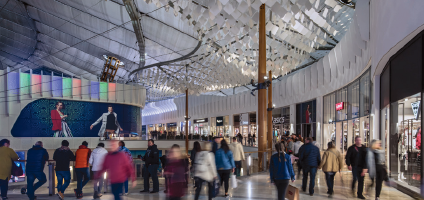
But what does this new form look like? While physical and spatial reinvention is a given, the primary way shopping centers are changing lies in the experience of going to one itself. Let’s start at the beginning. The first American malls started popping up in the 1950s and took over the retail landscape. These malls were suburban, required customers to drive to them and park and featured a variety of mass market chain stores. Malls used to be a center of public life, a social hub for youth and a place for the community to intermingle. As these shopping centers evolved, they became the symbol of American consumerism throughout the 1990s.
Flash forward to today and shifting consumer needs have led retailers to reestablish their retail spaces as community centers through new offerings. No longer is the national chain or big box store enough to draw in potential customers. The modern consumer is looking for personalization and customization, as well as a genuine experience.
We see examples of this in the recent reimagination of the anchor store. While anchors formerly consisted of, mainly, giant national department stores, we are observing a variety of spaces pop up to fill their now empty shells. From grocery stores, gyms, entertainment spaces, local art and healthcare, developers are reimagining the retail center of today. They are focused on integrating them seamlessly into the life of the consumer. By fulfilling community needs, while providing an experiential component, people are driven to regularly visit these physical spaces.
While the advent of technology has hurt the traditional shopping center in many ways, it also provides an opportunity to blur the lines between physical and virtual. Everything we do is tethered to our smartphones. As such, retailers are looking to maximize shoppers’ experiences within a physical location through our devices. Consumers in 2021 prefer the personalization they find online. Retailers are beginning to translate this personalized experience to their locations; for example, they are determining the likes and interests of consumers upon entrance to the store (through their devices) and specifically targeting them with sales, events and other offers that they know will be of interest.
This amalgamation of online personalization with in-person shopping denotes the future of the retail industry. This future is one where physical retailers embrace technology that is often displacing them as opposed to rejecting it, thereby maintaining their relevancy and staying “with the times.” Further, technology with tracking capabilities gives developers and designers insights into consumer traffic patterns in a space, allowing them to better plan layouts and adjust the presentation of products. This hybrid approach can take various forms, and consumers often respond differently to different forms of technological involvement. Some prefer genuine face-to-face interactions, while others like a quick email or text to complement their retail experiences. The future of retail spaces will evolve as we continue to think of new ways to maximize the consumer experience through technology.
Now that we’ve discussed the draw of the experience to the modern consumer and how retailers are shifting to use technology more effectively, we can discuss the physical composition of malls and how layouts are being adjusted to accommodate new consumer expectations. Something we see more of is the acceleration of malls turning “inside out.” Simply put, this involves allowing more exterior access and providing additional outdoor seating and dining areas. Retail spaces are leveraging outdoor spaces for nature walks, community events, or other areas with greenery, in line with trends regarding health, wellness and sustainability.
Something else we’ve observed that will undoubtedly continue is “de-malling.” When the retail experience is relegated to the confines of the box that is an indoor mall, shopping centers lose much of the charm and culture that can be experienced when shopping in an urban area. We’re now witnessing retailers and developers create areas that allow consumers to enter a sort of walking track, enabling shoppers to meander through a retail space. This interweaving of the experience of the shopping center into a more urban fabric, even if the location itself is in a more suburban area, is more enticing and enjoyable for the average consumer. It simultaneously capitalizes on the experiential aspect of shopping in a more diversified, culturally interesting space.
The truth of the matter is that we’ve all been “malled” to death. The question we’ve collectively begun to ask ourselves now is, “How much of that do we need?” The answer, it seems, is less and less. A retail center should be, first and foremost, a destination, a place where people go for an experience but can leave with a souvenir to remember their experience (and eventually return). As we see the redevelopment of these spaces, we should remain vocal about the needs and wants of our local community and city centers.
Retailers are evolving to meet the updated needs of consumers, with a stringent focus on wellness, sustainability and social economic impact. While the future of retail centers isn’t totally clear, is it unmistakable that the present provides an interesting opportunity to reinvent the retail center of yesterday into something exciting, experiential and community-focused today.